

The Paradigm Shift: From Network Perimeters to Identity Gates
In traditional on-premises architectures, security teams protected applications by enclosing them within trusted network zones, VPNs, and corporate firewalls. In a modern multi-tenant SaaS application, this model is obsolete. Every public API endpoint—whether powering a React Single Page Application (SPA), an iOS client, or a third-party developer webhook—is exposed directly to the open internet.
Consequently, identity, authorization, and rate limiting represent the actual perimeter of your software platform. When an attacker sends an HTTP request, your gateway cannot assume the client is benign simply because the request originated from an authenticated IP address or carries an active session cookie. Every single API request must pass through a multi-tiered security pipeline before touching business logic or persistent data.
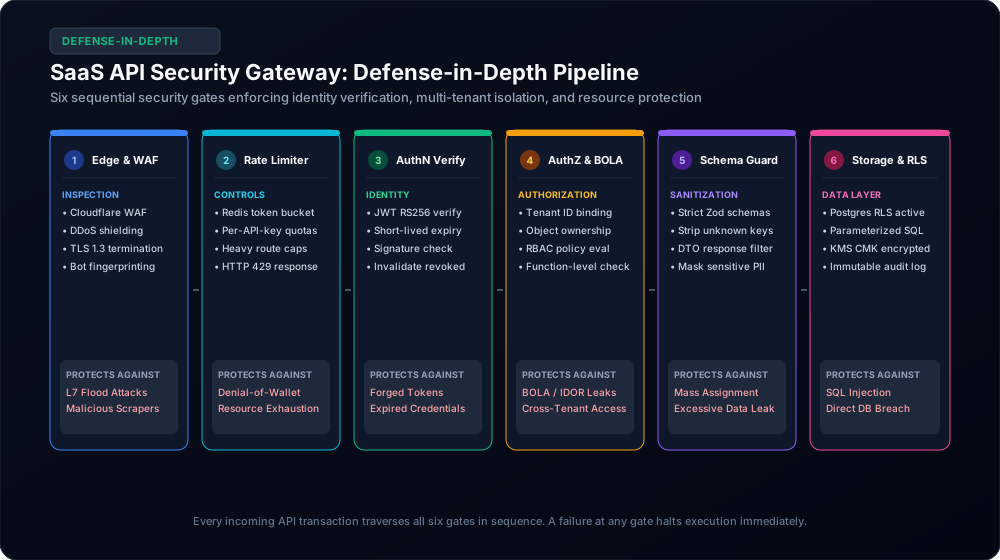
As illustrated in Figure 1, robust custom software engineering enforces six sequential security layers:
- Distributed Rate Limiting: Intercepts abuse at the API gateway using Redis-backed token bucket algorithms to throttle abusive IP ranges and rogue API keys.
- WAF & Schema Validation: Web Application Firewall (AWS WAF / Cloudflare) inspects for SQL injection, cross-site scripting (XSS), and oversized payloads, while strict JSON schemas validate incoming data structures.
- Cryptographic Authentication: Validates JSON Web Token (JWT) asymmetric signatures (RS256/EdDSA), verifies token expiration, and checks revocation blacklists.
- Role & Attribute Authorization: Evaluates coarse-grained permissions (RBAC) and fine-grained context (ABAC) to verify the user possesses the right to invoke the target action.
- Tenant Isolation & Row-Level Security: Enforces database-level isolation so that queries automatically filter by
tenant_id, neutralizing parameter tampering. - Audit Logging & Anomaly Detection: Emits structured audit logs with actor IDs, IP addresses, and timestamps to security information and event management (SIEM) systems.
BOLA / IDOR: The Number One SaaS API Vulnerability
In the OWASP API Security Top 10, Broken Object Level Authorization (API1:2023 - BOLA), formerly known as Insecure Direct Object References (IDOR), consistently ranks as the most prevalent and damaging vulnerability in modern applications.
BOLA occurs when an endpoint accepts an object identifier (such as a database primary key or UUID) from the client request and accesses the target object without verifying whether the authenticated user actually owns or has permission to view that object.
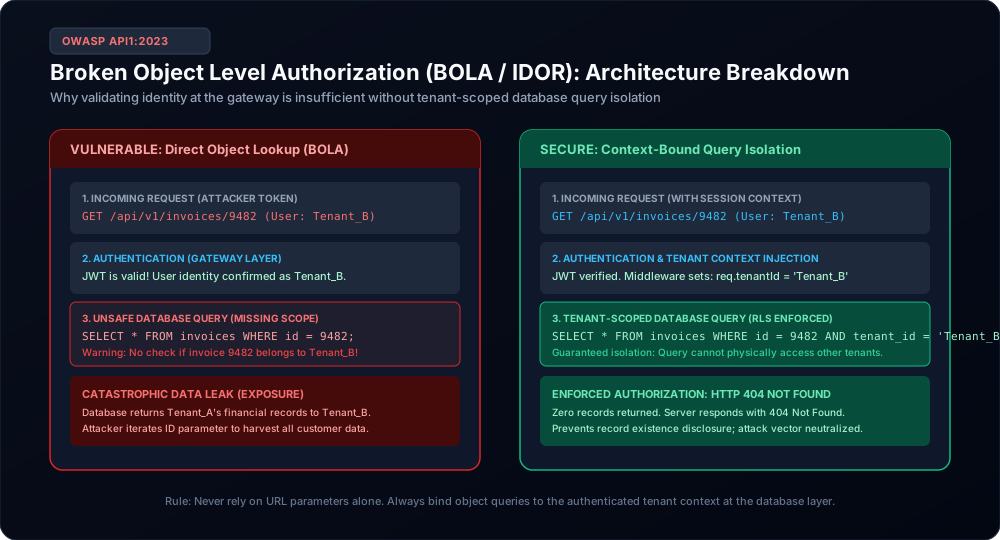
Why Traditional Authorization Fails to Stop BOLA
Consider the vulnerable code snippet below, frequently observed in rapidly built SaaS backends:
// VULNERABLE ENDPOINT: Authenticated, but lacking object-level authorization
app.get('/api/v1/invoices/:invoiceId', authenticateToken, async (req, res) => {
  // Attacker provides invoiceId: 9812 belonging to a completely different customer
  const invoice = await db.invoices.findById(req.params.invoiceId);
  if (!invoice) return res.status(404).json({ error: 'Invoice not found' });

  // Catastrophic Leak: User is authenticated, but does not own this invoice!
  return res.json(invoice);
});
The code properly checks that the user is logged in via authenticateToken. However, the database query blindly trusts req.params.invoiceId. An attacker simply logs in with their own basic account, iterates through integer IDs or brute-forces UUIDs, and downloads invoices belonging to rival enterprise tenants.
The Engineering Remedy: Tenant Context and Row-Level Security
To eliminate BOLA fundamentally, application queries must bind directly to the authenticated session context rather than relying on client-supplied parameters alone:
// SECURE PATTERN: Tenant-scoped lookup with strict ownership binding
app.get('/api/v1/invoices/:invoiceId', authenticateToken, async (req, res) => {
  const { tenantId, userId } = req.user; // Extracted cryptographically from verified JWT

  // Query enforces both the invoice ID AND the user's organization boundary
  const invoice = await db.query(
    'SELECT * FROM invoices WHERE id = $1 AND tenant_id = $2',
    [req.params.invoiceId, tenantId]
  );

  if (!invoice.rows.length) {
    // Return 404 to avoid leaking the existence of other tenants' records
    return res.status(404).json({ error: 'Invoice not found' });
  }

  return res.json(invoice.rows[0]);
});
In modern PostgreSQL architectures, teams implement PostgreSQL Row-Level Security (RLS). By setting SET LOCAL app.current_tenant_id = 'org_42' at the start of each database transaction, the PostgreSQL database engine automatically appends WHERE tenant_id = 'org_42' to every SELECT, UPDATE, and DELETE statement executed by the connection, making cross-tenant data leaks physically impossible even if a junior developer writes a faulty query.
Authentication Hardening: Avoiding Common JWT Traps
JSON Web Tokens (JWTs) are the standard mechanism for stateless authentication across distributed APIs. However, improper cryptographic configuration introduces severe security holes:
- Enforce Asymmetric Signing (RS256 / Ed25519): Never use symmetric signing (HS256) where both the authentication service and downstream microservices share the same secret key. If a single downstream worker is compromised, the attacker can forge administrator tokens for any tenant. Use public-key cryptography where only the identity provider holds the private signing key, and APIs verify tokens using the public JSON Web Key Set (JWKS).
- Explicitly Reject the
noneAlgorithm: Flawed JWT libraries historically accepted tokens with{"alg": "none"}, bypassing signature verification entirely. Verify that your parsing middleware enforces an explicit algorithm whitelist:algorithms: ['RS256']. - Short-Lived Access Tokens: Set access token lifespans to between 5 and 15 minutes. Long-lived tokens (e.g., 30 days) cannot be revoked if stolen. Combine short-lived access tokens with rotating, secure HTTP-only refresh tokens stored in a centralized database or Redis cache.
- Immediate Revocation via Redis JTI Blacklist: When a user logs out, changes their password, or is suspended by an enterprise workspace administrator, the application must immediately blacklist the token's unique identifier (
jticlaim) in a low-latency Redis cache matching the token's remaining TTL.
Abuse Prevention: Rate Limiting and Volumetric Defense
APIs must protect themselves against automated scraping, brute-force credential stuffing, and Denial of Service (DoS) attacks. A robust abuse prevention strategy enforces rate limits across three independent tiers:
1. IP-Based Edge Limiting
Configured at the Cloudflare or AWS WAF layer. Restricts total requests from an individual IP address (e.g., maximum 600 requests per minute) to absorb crude DDoS attacks and basic bot scanners before reaching your application servers.
2. User & Tenant Token Bucket
Managed at the API Gateway using Redis Lua scripts. Enforces fair resource allocation per tenant (e.g., maximum 100 requests/second with a burst capacity of 150) to prevent a single noisy enterprise customer from degrading performance for others.
3. Endpoint-Specific Throttle
Applied to sensitive, high-risk routes such as /api/v1/auth/login, /api/v1/password-reset, or export endpoints. Restricted to strict limits (e.g., maximum 5 failed attempts per 15 minutes per IP/username pair) with exponential backoff.
OWASP API Security Top 10 Remediation Matrix
To assist security and engineering leads in prioritizing remediation sprints, Figure 3 and the matrix below outline the 2023 OWASP API Security Top 10 vulnerabilities, their exploit vectors, and proven technical remedies:
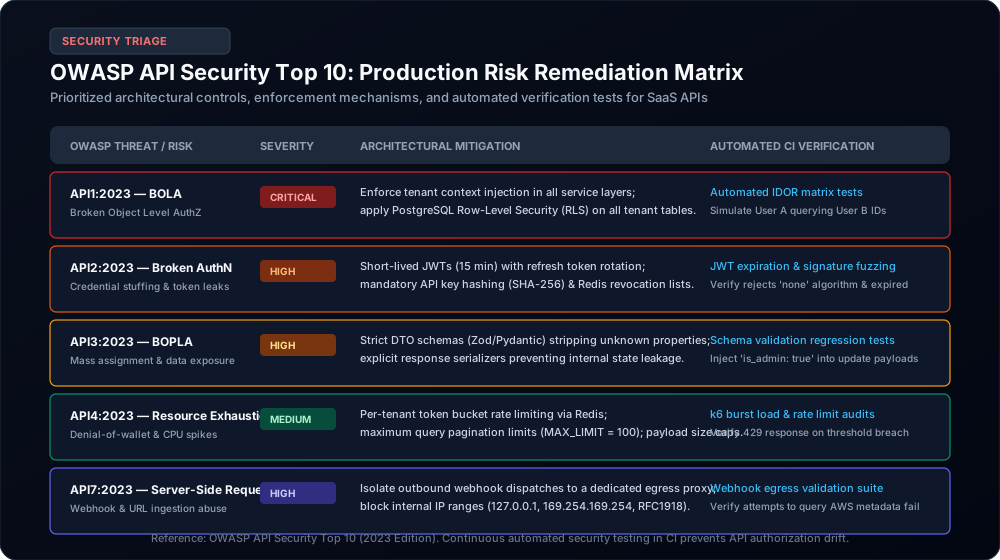
| Vulnerability (OWASP 2023) | Severity | Common Exploit Vector | Concrete Engineering Remedy |
|---|---|---|---|
| API1: Broken Object Level Authorization | CRITICAL | Manipulating object IDs in URL paths to access other tenants' data | Enforce PostgreSQL Row-Level Security (RLS) and tenant-scoped session filters |
| API2: Broken Authentication | CRITICAL | Weak JWT signing, missing token expiration, lack of brute-force lockout | RS256 asymmetric keys, short 15m token TTL, Redis JTI revocation list |
| API3: Broken Object Property Level Auth | HIGH | Mass assignment: client submits "is_admin": true in registration JSON |
Strict schema filtering with Zod / Pydantic; reject undocumented properties |
| API4: Unrestricted Resource Consumption | HIGH | Requesting ?limit=1000000 or unthrottled complex GraphQL queries |
Hard pagination caps (max 100), query depth limits, and Redis token bucket rate limiting |
| API5: Broken Function Level Authorization | HIGH | Regular user invoking administrative API endpoints (POST /api/v1/admin/users) |
Declarative RBAC middleware on route definitions; test negative permissions in CI |
| API6: Unrestricted Access to Sensitive Business Flows | MEDIUM | Automated bots purchasing scarce ticket inventory or scraping pricing tables | Device fingerprinting, Cloudflare Turnstile, and behavioral velocity checks |
| API7: Server-Side Request Forgery (SSRF) | HIGH | Webhook endpoint pinging cloud metadata service (http://169.254.169.254) |
Validate outbound webhook URLs against private IP / loopback address blacklists |
| API8: Security Misconfiguration | MEDIUM | Verbose stack traces in 500 errors, unhardened CORS headers (Access-Control-Allow-Origin: *) |
Sanitize error responses in production; restrict CORS strictly to trusted frontend origins |
| API9: Improper Inventory Management | MEDIUM | Exposed unauthenticated /v1/ or debug endpoints left running alongside /v2/ |
Deprecate and decommission legacy endpoints; maintain single source of truth OpenAPI specs |
| API10: Unsafe Consumption of Third-Party APIs | MEDIUM | Trusting untrusted payloads from third-party vendor integrations without validation | Treat external vendor webhooks as untrusted user input; validate schemas and verify HMAC signatures |
Automating Security in the CI/CD Pipeline
Manual code reviews alone cannot catch every authorization flaw across dozens of microservices. Engineering teams must automate API security testing directly in the continuous integration (CI) pipeline:
- OpenAPI Contract Drift Detection: Utilize tools like Spectral to lint OpenAPI 3.1 definitions on every commit. Fail pull requests that introduce undocumented endpoints or remove required security schemes.
- Static Application Security Testing (SAST): Run tools such as Semgrep with custom rules to detect missing authorization checks, hardcoded API secrets, or unverified JWT decodings before code merges to main.
- Automated DAST API Fuzzing: Integrate dynamic application security testing (DAST) tools like OWASP ZAP or StackHawk to automatically replay API endpoints with modified tokens and unexpected data payloads during staging deployments.
- Automated Secret Scanning: Enforce pre-commit hooks (TruffleHog / GitGuardian) to block developers from accidentally committing AWS credentials, database URIs, or Stripe secret keys into Git repositories.
Authoritative Engineering Sources & Further Reading
- OWASP Foundation: OWASP API Security Top 10 (2023 Edition)
- NIST Special Publication 800-204: Security Strategies for Microservices-based Application Systems
- Internet Engineering Task Force (IETF): RFC 7519 — JSON Web Token (JWT)
- PostgreSQL Global Development Group: Row Security Policies Documentation
Protect Your SaaS Platform from API Breaches
From multi-tenant row-level security to robust OAuth2 and JWT authorization gateways, Ramaaya Technologies architects and audits enterprise-grade software systems that defend against modern cyber threats.