

The Fundamentals: Untangling RTO and RPO
Every disaster recovery discussion begins with two foundational metrics: Recovery Time Objective (RTO) and Recovery Point Objective (RPO). While frequently paired together, they govern completely different architectural disciplines:
- Recovery Time Objective (RTO): The maximum acceptable duration of clock time that can elapse between an outage declaration and the complete restoration of service for end users. RTO dictates your compute and routing strategy: will you spin up new containers via automated Terraform scripts (hours), promote scaled-down standby nodes (minutes), or route traffic instantly to active multi-region clusters (seconds)?
- Recovery Point Objective (RPO): The maximum acceptable age of data that can be lost due to a disaster event, measured in units of time. RPO dictates your storage and database replication strategy: can your business afford to lose the last 24 hours of nightly snapshot data, or do regulatory requirements require sub-second synchronous or asynchronous storage replication across geographic regions?
The relationship between business cost and technical capability is steeply non-linear. As target RTO and RPO approach zero, infrastructure complexity and cost escalate exponentially. A system engineered for a 24-hour RTO/RPO might add only 5% to your base cloud bill, whereas a sub-minute Active-Active multi-region architecture typically adds 70% to 120% in redundant compute, cross-region egress fees, and distributed data replication licenses.
The Four Cloud Disaster Recovery Strategies
The cloud computing paradigm provides four distinct disaster recovery strategies, arranged across a spectrum of operational cost and recovery speed:
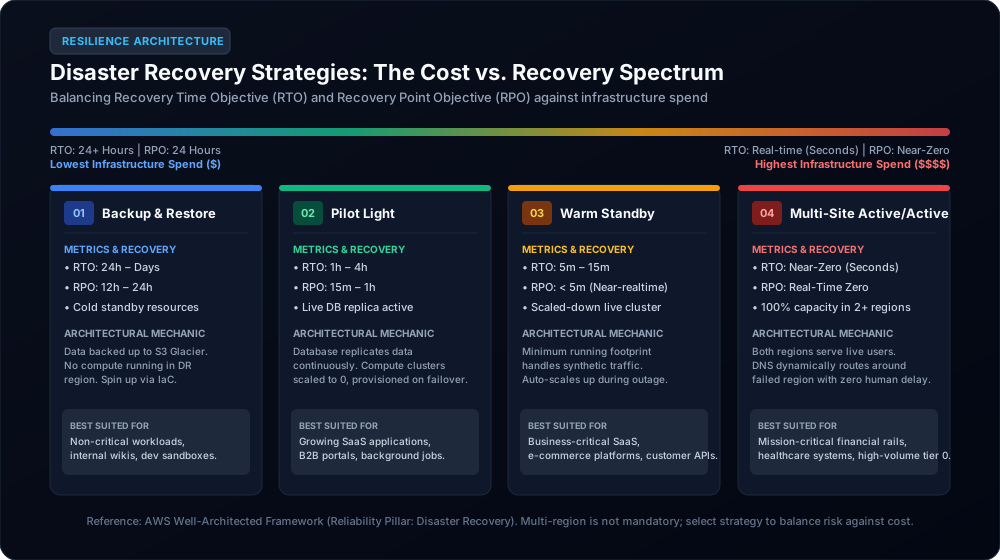
1. Backup and Restore (Cold Standby)
The simplest and lowest-cost disaster recovery pattern. Automated daily snapshots of databases (Amazon RDS, Google Cloud SQL) and object storage (Amazon S3, Google Cloud Storage) are copied asynchronously to a secondary cloud region. Compute resources (VMs, Kubernetes clusters) exist only as declarative code (Terraform, Pulumi, AWS CDK) in version control.
Trade-offs: RTO is typically 6 to 24 hours because when a disaster strikes, engineers must provision VPCs, create clusters, download terabytes of database snapshots, and rehydrate storage volumes before serving traffic. However, running cost overhead is negligible (typically 5% to 15% surcharge for cross-region storage and snapshot retention).
2. Pilot Light (Core Data Live, Compute Dormant)
In a Pilot Light topology, the secondary region maintains live, continuously synchronized database replicas (such as an Aurora Global Database cross-region replica or PostgreSQL streaming replication), but the application compute tier is kept completely dormant or scaled to absolute zero (e.g., an empty EKS node group or minimal base configuration). Core network routes, security groups, and IAM roles are pre-provisioned.
Trade-offs: Because data is already present in the target region, RPO drops to under 5 minutes (often sub-second). RTO is governed by how quickly compute autoscaling or container orchestration can scale from zero to production capacity—typically 15 to 60 minutes. Running cost overhead is moderate (20% to 40% surcharge).
3. Warm Standby (Scaled-Down Active Replica)
Warm Standby builds directly upon Pilot Light by running a fully functional, end-to-end version of the software stack in the recovery region 24/7, scaled down to handle a fraction of production traffic (e.g., 10% to 20% capacity). The secondary region runs live health-check synthetic tests, continuously verifying that database connections, background workers, and API gateways function correctly.
Trade-offs: When a regional failover occurs, DNS traffic is shifted immediately. The standby environment handles initial priority traffic within minutes while Kubernetes Horizontal Pod Autoscalers (HPA) and cloud autoscaling groups scale up the compute fleet to 100% capacity. RTO is typically under 10 minutes, with sub-second RPO. Cost overhead ranges between 40% and 75%.
4. Multi-Region Active-Active (Zero Downtime)
In an Active-Active deployment, production workloads run simultaneously in two or more cloud regions. Global DNS or Anycast IP routing (such as AWS Route 53 Geolocation / Latency Routing or Cloudflare Anycast) distributes live user requests to the closest geographic region. Databases utilize multi-region active replication (such as Google Cloud Spanner, AWS DynamoDB Global Tables, or CockroachDB).
Trade-offs: Near-zero RTO and RPO. If an entire cloud region goes offline, health checks instantly divert traffic away from the degraded region with zero human intervention required. However, Active-Active introduces intense architectural complexity: distributed transaction latency, conflict-free replicated data types (CRDTs), cross-region data egress costs, and potential data divergence if network partitions occur. Running cost overhead is typically 80% to 130%+.
Anatomy of a Resilient Multi-Region Failover Topology
To understand how modern cloud engineering teams build disaster recovery in practice, consider the multi-region active-passive architecture shown in Figure 2:
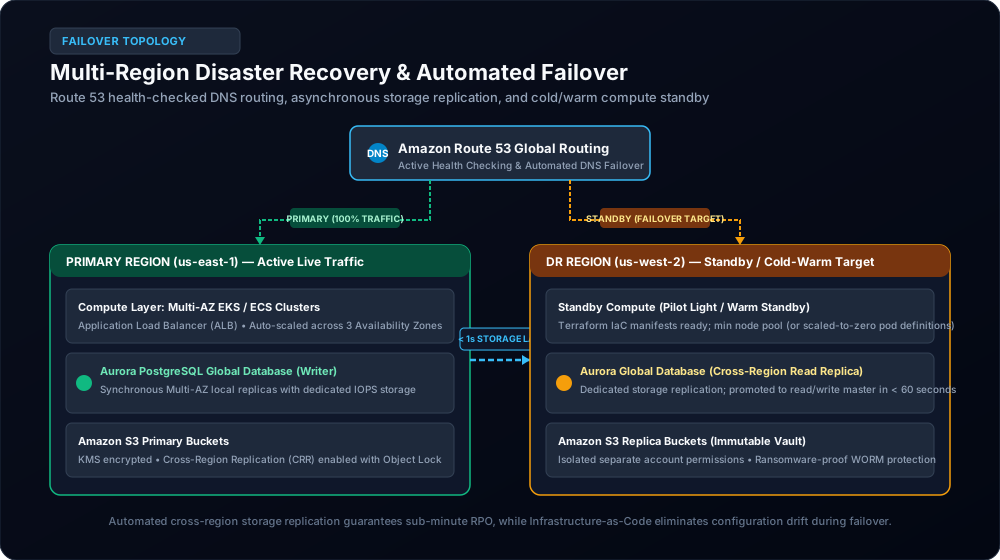
This reference architecture relies on four coordinated infrastructure layers:
1. Intelligent Global DNS & Traffic Steering
At the edge, a global DNS management layer (such as Amazon Route 53 or Cloudflare) evaluates health check probes against public Application Load Balancers (ALBs) in the primary region (us-east-1). These health checks do not merely query a static HTTP 200 endpoint; they interrogate a deep diagnostic health-check handler that tests downstream database connectivity and internal worker queues. If three consecutive probes fail, DNS records automatically fail over to the secondary region (us-west-2).
2. Asynchronous Cross-Region Storage Synchronization
The database tier leverages storage-level replication rather than application-level dual-writing. In AWS, Amazon Aurora Global Database utilizes dedicated physical storage replication that bypasses the database compute engine, delivering cross-region replication latencies typically under one second with zero impact on primary database write performance. Concurrently, Amazon S3 Cross-Region Replication (CRR) replicates immutable customer files, encrypted under multi-region AWS KMS customer-managed keys.
3. Infrastructure as Code (IaC) Parity
A fatal disaster recovery mistake is allowing the secondary region's configuration to drift from the primary. In a resilient organization, all infrastructure—VPCs, subnets, IAM policies, security groups, and Helm charts—is authored in Terraform or Pulumi. Every Git pull request that deploys changes to the primary region triggers an automated deployment pipeline to mirror identical definitions in the recovery region.
The Split-Brain Trap: Why Automated Failover Must Be Guarded
While automating failover sounds appealing to executive stakeholders seeking minimum RTO, uncontrolled automatic failover creates the most destructive failure mode in distributed computing: Split-Brain.
Split-brain occurs when the secondary region mistakenly concludes the primary region has failed—due to an intermittent external network glitch or transient DNS flap—and automatically promotes its local database replica to primary writable status while the original primary database is still actively processing customer transactions. When network connectivity is restored, the engineering team faces two divergent databases containing conflicting customer orders, account updates, and financial ledger balances.
How to Choose: Workload Tiering & Decision Matrix
High-performing software organizations avoid applying a single disaster recovery standard across all internal services. Instead, they categorize services into distinct architectural tiers:
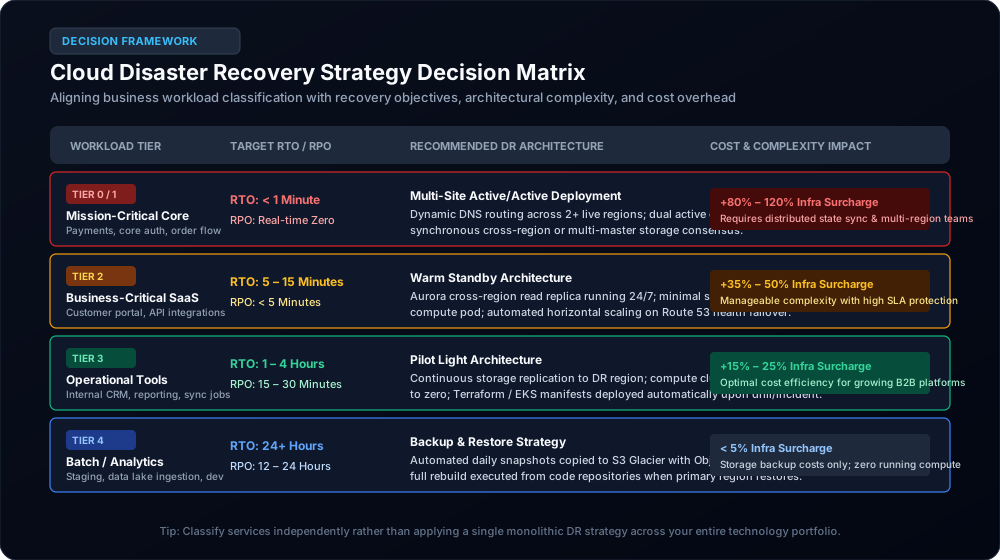
| Workload Tier | Representative Workload Examples | Target RTO | Target RPO | Recommended DR Strategy |
|---|---|---|---|---|
| Tier 1 — Mission Critical | Payment processing, authentication gateways, real-time telemetry streaming | < 5 minutes | < 1 second | Multi-Region Warm Standby or Active-Active |
| Tier 2 — Core Business | Order management, user dashboards, customer support portals, ERP integrations | < 30 minutes | < 5 minutes | Pilot Light with automated compute scaling |
| Tier 3 — Internal Operations | Reporting dashboards, non-critical background jobs, internal billing analysis | < 4 hours | < 1 hour | Pilot Light or Scheduled Warm Snapshots |
| Tier 4 — Archival & Dev | Development sandboxes, staging environments, historical log analytics | < 24 hours | < 24 hours | Automated Backup & Restore from S3/GCS snapshots |
SRE Best Practice: Validating DR with Chaos GameDays
A disaster recovery plan that has never been tested in production is nothing more than wishful thinking. Cloud infrastructure changes constantly: new services are deployed, security group rules are updated, and IAM permissions evolve. Without active validation, disaster recovery runbooks decay within months.
Leading Site Reliability Engineering (SRE) teams enforce continuous resilience through quarterly GameDays:
- Simulate Total Regional Failure: SREs inject artificial network partitions using chaos engineering tools (such as AWS Fault Injection Simulator or Chaos Mesh), completely blocking ingress traffic to the primary region during controlled testing windows.
- Measure Actual RTO and RPO: The incident response team executes the recovery playbook without advance notice, recording the exact timestamps for database replica promotion, DNS cache propagation, and API traffic stabilization.
- Verify Data Integrity: Synthetic automated test suites compare database transaction IDs before and after failover to mathematically prove that zero customer records were lost during the migration.
- Conduct Failback Drills: Returning traffic to the primary region (Failback) is frequently more hazardous than initial failover because data written to the secondary region during the outage must be reverse-replicated back to the primary database before demoting the secondary.
Disaster Recovery Readiness Checklist
Before declaring your cloud infrastructure disaster-ready, verify these eight critical engineering gates:
- Cross-Region KMS Keys: Are your storage snapshots and database replicas encrypted with multi-region AWS KMS keys that are accessible from the recovery region?
- Automated DNS TTLs: Are production DNS record TTLs configured to 60 seconds or lower to facilitate rapid traffic cutover without stale ISP caching?
- Secret and Config Synchronization: Are API tokens, environment secrets, and third-party webhook URLs automatically replicated across regions via HashiCorp Vault or AWS Secrets Manager?
- Database Connection String Decoupling: Do application services reference regional CNAMEs or service discovery endpoints rather than hardcoded database hostnames?
- Third-Party IP Whitelisting: If your backend connects to payment gateways (Stripe, Adyen) or financial APIs that enforce IP whitelisting, have the secondary region's NAT Gateway Elastic IPs been pre-whitelisted?
- Cloud Provider Quota Audits: Does your secondary region have sufficient vCPU, EBS storage, and Elastic IP service quotas pre-approved to support 100% production capacity?
- Immutable Backup Vaults: Are database backups locked with AWS Backup Vault Lock or GCP Retention Policies to prevent malicious deletion during ransomware events?
- Documented & Drilled Runbooks: Is there a step-by-step, markdown-formatted failover runbook stored outside the primary cloud provider (e.g., in an offline Git repository or secondary workspace)?
Authoritative Engineering Sources & Further Reading
- AWS Well-Architected Framework: Reliability Pillar — Disaster Recovery (DR) in the Cloud
- Google Cloud Architecture Center: Disaster Recovery Planning Guide
- NIST Special Publication 800-34 Rev. 1: Contingency Planning Guide for Federal Information Systems
- Google SRE Book: Addressing Cascading Failures and Managing Risk
Is Your Cloud Infrastructure Truly Resilient?
A single regional outage shouldn't threaten your business. Ramaaya Technologies' cloud architects design, audit, and automate enterprise multi-region disaster recovery systems that guarantee strict RTO/RPO compliance.