

The Testing Dilemma in Growing Engineering Teams
In early-stage startups, manual verification and basic unit tests often suffice. However, as the platform expands into multiple microservices, asynchronous queues, third-party payment gateways, and complex database schemas, a dangerous paradox emerges:
"Our test suite has 1,500 passing unit tests and reports 92% code coverage, but when we deploy to production, customer checkout fails immediately due to an unhandled database column type mismatch."
Why does this happen? Because traditional unit tests achieve coverage by mocking external dependencies: mocking database queries, mocking Redis caches, and mocking third-party HTTP endpoints. When you test a mock against a mock, you test what you think the external system does, not what the real production system actually does. When database schemas evolve or third-party APIs update their JSON payload structure, mocked unit tests continue to pass green while production burns.
Testing Pyramid vs. The Pragmatic Testing Trophy
For over a decade, engineering organizations followed Mike Cohn's classic Testing Pyramid (2009): 70% Unit Tests, 20% Integration Tests, and 10% End-to-End Tests. While groundbreaking in its day, the pyramid was conceived in an era of monolithic enterprise applications running slow in-memory JVM test harnesses.
In modern cloud-native architectures, high-performing teams follow the Testing Trophy (championed by Kent C. Dodds and modern distributed systems practitioners):
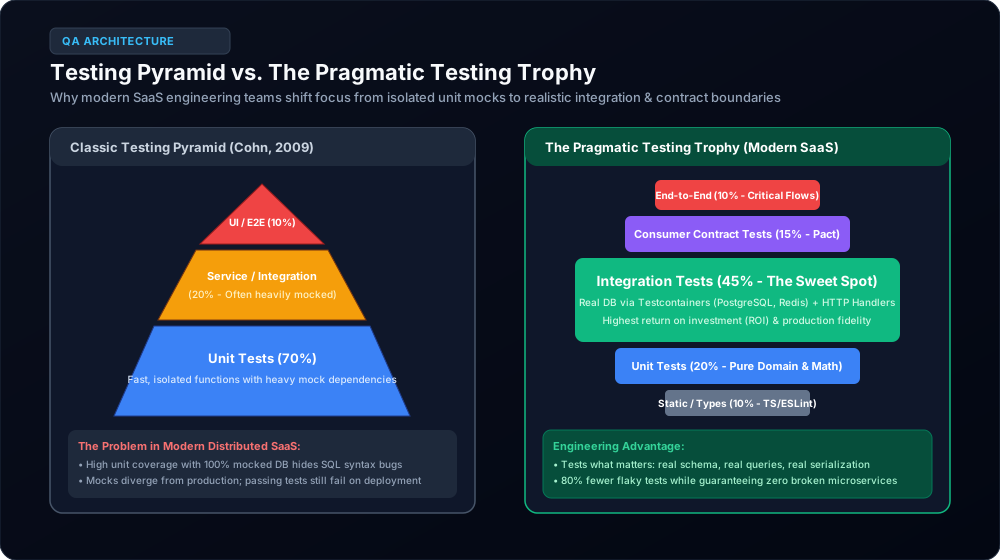
As visualized in Figure 1, the modern testing hierarchy reorganizes test allocation based on Return on Investment (ROI) and production fidelity:
1. Static Analysis & Strict Types (The Pedestal)
Catches syntax errors, misspelled property names, null dereferences, and API contract type mismatches within milliseconds in your IDE. In TypeScript, Go, or Rust, strict compilation paired with ESLint / Ruff eliminates an entire class of trivial bugs before tests even run.
2. Unit Tests (Pure Domain Functions)
Keep unit tests fast and focused strictly on pure business logic, math calculations, and complex algorithms (e.g., pricing discount calculators, state machine transitions, date utility calculations). Never write unit tests that spend 50 lines mocking database connection pools or ORM repositories.
3. Integration Tests (The Trophy Body — Highest ROI)
The dominant layer of your automated test suite (typically 40% to 50% of tests). Integration tests execute real HTTP request handlers, real SQL queries against an actual PostgreSQL instance, and real Redis cache operations. Because no critical I/O is mocked, passing integration tests provide genuine confidence that production code works.
4. Consumer-Driven Contract Tests (Microservice Decoupling)
Validates that microservice consumers (e.g., Billing Service) and providers (e.g., User Service) agree on HTTP/gRPC schemas and payload contracts, without needing both services running simultaneously in a complex, fragile staging environment.
5. End-to-End Tests (Critical Revenue Journeys Only)
Runs headless Chromium/Firefox via Playwright to simulate real user behavior across the full frontend and backend stack. Restricted strictly to top revenue-generating customer journeys: Sign Up, Authentication, Checkout, and Core CRUD workflows.
Integration Testing with Real Databases: The Testcontainers Revolution
Historically, developers avoided running real databases during integration tests because spinning up local databases was slow, created dirty state between test runs, and required complex CI configuration. Developers turned to in-memory mocks (like SQLite or H2), only to discover that SQLite behaves completely differently than PostgreSQL when executing JSONB operators, CTE queries, and row-level locks.
Today, Testcontainers has revolutionized integration testing. Testcontainers is an open-source library (available for Node.js, Go, Java, Python, and .NET) that uses Docker to spin up lightweight, ephemeral instances of real production databases during test execution:
// PRODUCTION INTEGRATION TEST WITH TESTCONTAINERS & POSTGRESQL
import { PostgreSqlContainer } from '@testcontainers/postgresql';
import { Pool } from 'pg';
import { runMigrations } from '../src/db/migrate';
import { createInvoice } from '../src/services/billing';

describe('Billing Service Integration Tests', () => {
  let container;
  let pool;

  beforeAll(async () => {
    // 1. Spin up an ephemeral PostgreSQL 16 container in Docker (< 2 seconds)
    container = await new PostgreSqlContainer('postgres:16-alpine')
      .withDatabase('test_db')
      .withUsername('test_user')
      .withPassword('test_pass')
      .start();

    pool = new Pool({ connectionString: container.getConnectionUri() });

    // 2. Run real production database migrations
    await runMigrations(pool);
  }, 30000);

  afterAll(async () => {
    await pool.end();
    await container.stop(); // Automatically destroys container, zero residue
  });

  it('calculates tax and records invoice transaction with row locks', async () => {
    const result = await createInvoice(pool, {
      tenantId: 'tenant_42',
      amountCents: 10000,
      currency: 'USD'
    });

    expect(result.status).toBe('created');
    expect(result.totalWithTax).toBe(10825); // Real tax query calculation verified
  });
});
This test exercises your real SQL queries, your real database migration scripts, your real foreign key constraints, and your real database connection pool. If a developer renames a database column in a migration without updating the query, this test fails immediately in CI.
Contract Testing: Breaking Free from the Staging Trap
In microservice architectures, teams frequently fall into the Staging Trap: attempting to build an exact replica of production in a staging environment to run end-to-end tests across 15 microservices. Staging environments are notoriously unreliable: test data gets corrupted, third-party sandbox APIs go down, microservice versions drift, and releases stall because "Staging is broken again."
High-velocity engineering teams eliminate cross-service staging tests using Consumer-Driven Contract Testing with the Pact framework:
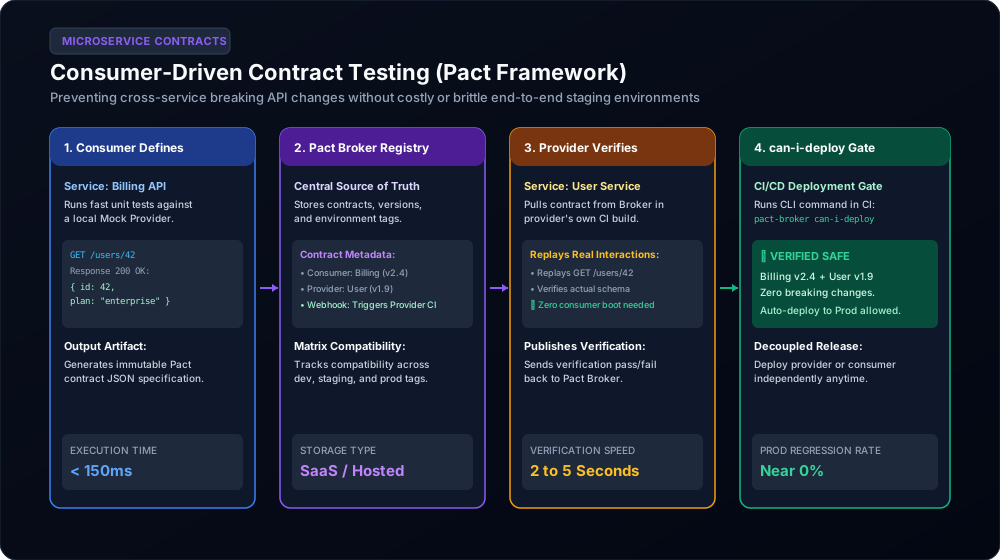
As demonstrated in Figure 2, the contract testing lifecycle operates in four decoupled stages:
- Consumer Generates Contract: The consumer service (e.g., Billing) defines its exact API expectations in a fast local unit test against a Pact mock server. The test generates a versioned
billing-userservice.jsonpact file containing request paths and expected response JSON structures. - Contract Stored in Pact Broker: The consumer's CI pipeline publishes the pact file to a centralized Pact Broker, tagging it with the Git commit hash and branch.
- Provider Verifies Independently: When the provider service (e.g., User Service) runs its own CI pipeline, it pulls the latest active contracts from the Pact Broker, spins up its local service, and replays the consumer's recorded interactions against real HTTP handlers.
- The
can-i-deployGate: Before deploying to production, both teams query the broker usingpact-broker can-i-deploy. If the matrix confirms 100% verification compatibility between deployed versions, the service deploys immediately—completely independent of the other team's release schedule.
Lean End-to-End Testing with Playwright
End-to-End (E2E) browser tests are the most expensive tests to write, maintain, and execute. If your E2E suite takes 45 minutes to run, developers stop running tests locally and treat CI failures with skepticism.
Modern software engineering practices enforce three strict rules for End-to-End browser testing:
1. Restrict to Critical Revenue Paths
Only write E2E tests for core user journeys that directly cause revenue loss if broken: User Registration & Email Verification, Authentication Login, Checkout / Payment Processing, and Core Data Creation. Edge cases belong in integration tests.
2. Zero Hardcoded Sleep Timers
Never write await page.waitForTimeout(5000). Hardcoded sleeps slow down suites and cause flakiness when CI servers run under load. Use Playwright's web-first auto-waiting assertions: await expect(page.getByRole('button')).toBeVisible().
3. Dynamic Test Data Fixtures
Never rely on pre-seeded database accounts (e.g., logging in as testuser@company.com). If two CI builds run concurrently, they collide and corrupt each other's state. Generate unique, isolated tenant fixtures dynamically per test run.
Testing Risk & Coverage Allocation Matrix
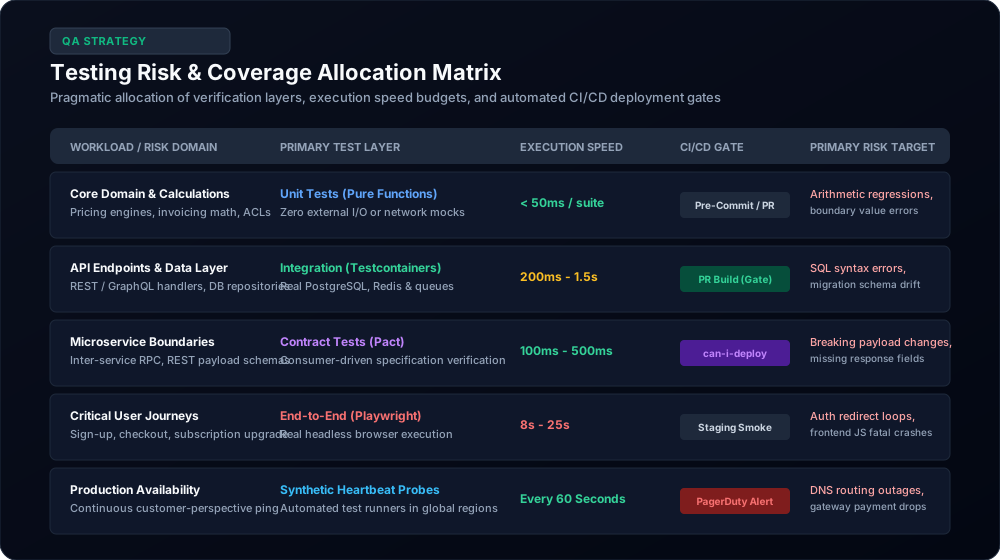
To help engineering leads allocate QA automation budgets effectively, Figure 3 and the matrix below outline where each test layer belongs, its execution speed budget, and the specific failure modes it neutralizes:
| Workload / Risk Domain | Primary Test Layer | Execution Speed | CI/CD Gate | Target Risk Mitigated |
|---|---|---|---|---|
| Core Domain & Calculations | Unit Tests (Pure functions) | < 50ms / suite | Pre-commit / PR hook | Math errors, pricing drift, edge-case regressions |
| API Endpoints & Data Repositories | Integration Tests (Testcontainers) | 200ms - 1.5s | PR Build (Blocking Gate) | SQL syntax errors, migration schema mismatches, ORM bugs |
| Microservice Boundary Schemas | Contract Tests (Pact framework) | 100ms - 500ms | can-i-deploy CLI gate |
Breaking JSON payload changes, missing API response fields |
| Critical User Revenue Flows | End-to-End (Playwright) | 8s - 25s / journey | Staging Release Smoke | Broken auth redirects, frontend JS runtime crashes, payment errors |
| Live Production Availability | Synthetic Heartbeat Canaries | Every 60 seconds | PagerDuty On-Call Alert | DNS routing faults, CDN edge caching drops, third-party API outages |
8-Step Engineering Blueprint for High-Performing Teams
Transforming your team's testing culture does not require halting feature development. Follow this pragmatic phased rollout:
- Enforce Strict Type Checking in Pre-Commit: Ensure TypeScript / strict compiler flags fail builds before code is committed. Eliminate trivial type errors early.
- Refactor Pure Business Logic into Standalone Modules: Extract pricing calculators, tax math, and permission checkers into pure functions with zero database dependencies. Cover them with fast, comprehensive unit tests.
- Introduce Testcontainers in One Core Service: Replace SQLite/in-memory test databases with a real Dockerized PostgreSQL instance in your primary backend service. Measure the immediate drop in migration-related deployment bugs.
- Audit Existing E2E Suites for Flakiness: Identify tests that fail intermittently. Quarantine flaky tests into a separate non-blocking suite until they are rewritten with auto-waiting assertions and isolated dynamic fixtures.
- Adopt Contract Testing for New Microservice APIs: Before introducing your next microservice, implement Pact contract verification between the consumer and provider in CI.
- Establish a 10-Minute CI Build Budget: If your pull request CI pipeline takes longer than 10 minutes to run, developers lose focus. Parallelize integration tests across multiple container shards.
- Test Negative Security Permissions: Ensure integration tests explicitly verify that unauthorized users receive HTTP 403 / 404 when attempting to access other tenants' data.
- Deploy Synthetic Production Canaries: Run periodic automated headless browser checks against production every 60 seconds to detect silent infrastructure issues before customers file support tickets.
Authoritative Engineering Sources & Further Reading
- Martin Fowler: The Practical Test Pyramid
- Kent C. Dodds: The Testing Trophy and Testing Classifications
- Testcontainers Project: Testcontainers: Cloud-Native Integration Testing with Real Dependencies
- Pact Foundation: Contract Testing with Pact in CI/CD Pipelines
Build Faster with Rock-Solid Automated Testing
Tired of flaky test suites holding up deployments and production regressions eroding customer trust? Ramaaya Technologies helps scaling engineering teams architect modern integration suites, Testcontainers pipelines, and contract verification systems.