
Who This Architecture Guide Is For
This guide is designed for Chief Information Officers (CIOs), Vice Presidents of Engineering, and lead software architects responsible for connecting multiple disparate business systems—whether internal portals, third-party SaaS platforms, mobile applications, or B2B partner ecosystems. If your organization is struggling with brittle webhook chains, conflicting customer definitions, or slow frontend delivery cycles waiting on backend developers, this blueprint establishes the principles of production-grade API-First design.
What "API-First" Actually Means (And What It Does Not)
In traditional "Code-First" development, an engineering team builds a database model, writes backend application logic, and then auto-generates API endpoints as an afterthought to serve an immediate UI view.
This approach produces severe operational liabilities:
- UI-Coupled Endpoints: APIs reflect specific web page layouts rather than canonical business domain entities, forcing mobile apps and third-party partners to stitch together 8 different endpoints to perform a single business action.
- Blocked Engineering Squads: Frontend engineers, mobile developers, and integration partners must sit idle for weeks while backend developers finish writing database logic before API testing can begin.
- Unannounced Breaking Changes: Backend developers rename a database column or alter a type, inadvertently breaking third-party partner integrations without warning.
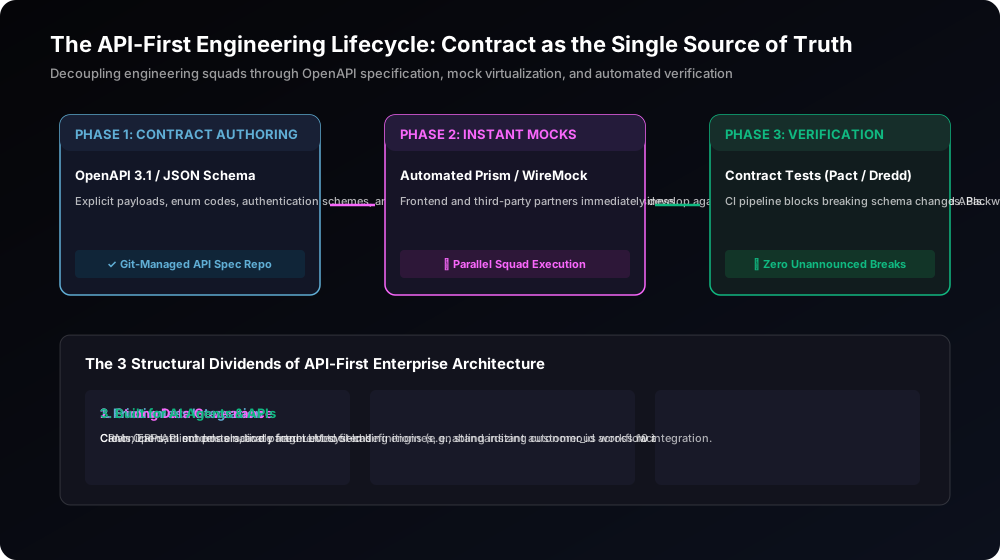
API-First inverts this process completely: The API contract is treated as a first-class digital asset and the single source of truth. The interface is formally defined, peer-reviewed by business and engineering stakeholders, and mock-virtualized before a single line of backend database code is written.
The Three Phases of the API-First Engineering Lifecycle
1. Contract Authoring as Collaborative Design
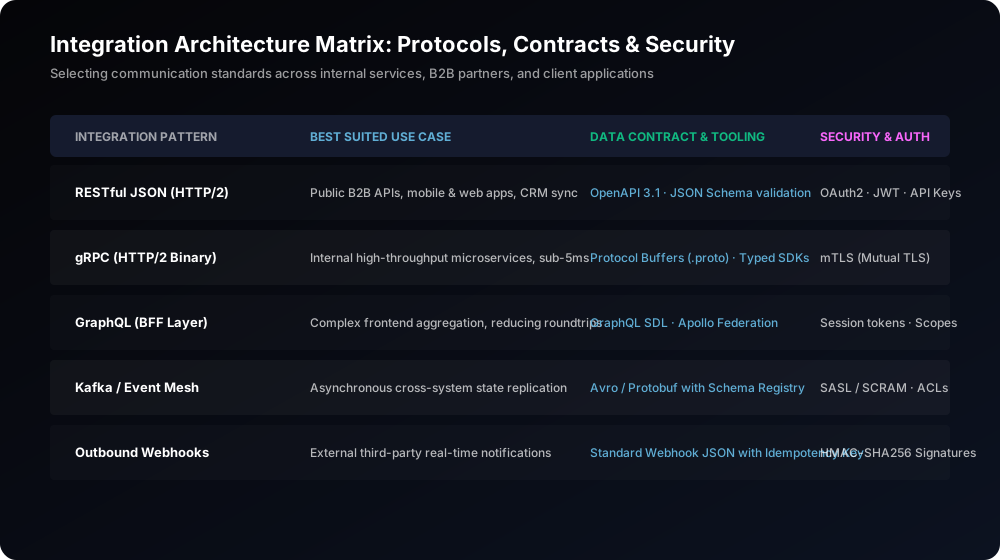
The contract is authored using machine-readable specifications—primarily OpenAPI 3.1 for synchronous HTTP/REST APIs, Protocol Buffers for high-throughput gRPC services, or AsyncAPI for message queues.
A production-grade OpenAPI specification does not merely list URLs; it defines strict typed schemas:
# OpenAPI 3.1 Excerpt: Canonical Order Submission
paths:
  /v1/orders:
    post:
      summary: Submit a validated enterprise purchase order
      headers:
        Idempotency-Key:
          schema: { type: string, format: uuid }
          required: true
      requestBody:
        required: true
        content:
          application/json:
            schema:
              $ref: '#/components/schemas/OrderSubmissionRequest'
      responses:
        '201':
          description: Order accepted and queued for execution
        '409':
          description: Idempotency conflict / duplicate request detected
Because this contract is committed to a central git repository, business analysts, security engineers, and frontend architects can review and comment on request parameters and business logic prior to implementation.
2. Instant Mock Virtualization & Parallel Velocity
Once the OpenAPI contract is approved, an automated mock server (such as Prism or WireMock) is deployed instantly. The mock server responds with realistic, schema-valid JSON fixtures matching the contract.
The result is immediate developer parallelism: Frontend squads build web UI components, mobile teams build iOS/Android screens, and external B2B clients code their integration webhooks simultaneously against the mock server. By the time backend engineering completes the PostgreSQL persistence layer, the UI and integration harnesses are already built and tested.
3. Automated Contract Testing in CI/CD
To ensure production code never drifts from the published specification, automated contract testing tools (such as Pact or Dredd) execute during continuous integration pipelines. If a backend engineer modifies a response payload or removes an enum value that breaks consumer expectations, the CI/CD pipeline immediately fails, physically blocking the build from deployment.
Harmonizing Inconsistent Enterprise Data Models
The most common challenge in business system integration is semantic data fragmentation:
- In Salesforce, an entity is called an
Accountwith a 18-character alphanumeric ID. - In the internal billing database, the same entity is called a
Customerwith a UUID. - In the logistics ERP, it is called a
Shipping_Consigneewith a legacy integer key.
If engineering connects these systems through point-to-point webhooks, every developer must write custom conversion scripts, leading to edge-case bugs and data divergence.
At Ramaaya Technologies, our IT Consulting practice implements a Canonical Data Model (CDM) layer. The enterprise API exposes an unambiguous business object (e.g., EnterpriseOrganization). An integration gateway or event transformation adapter translates external SaaS schemas into the internal canonical representation at the perimeter. Downstream services never see vendor-specific field names; they operate strictly on clean, unified enterprise data entities.
Synchronous Request-Response vs. Asynchronous Event-Driven
A frequent architectural mistake is forcing all system integrations into synchronous HTTP request-response patterns.
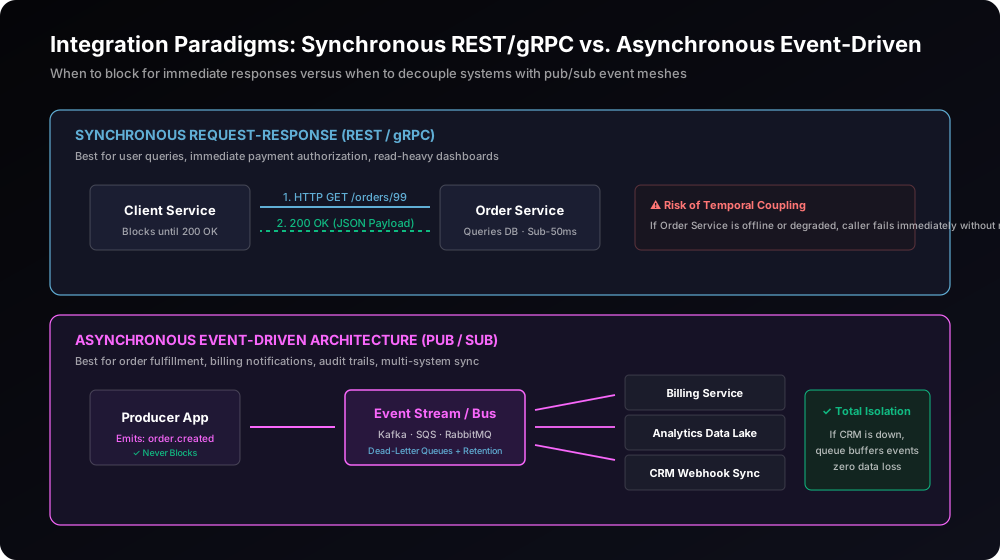
Consider what occurs when a customer confirms an order on an e-commerce platform. If the checkout service makes synchronous HTTP calls to the credit card gateway, the inventory ERP, the CRM, and the email notification provider:
- Temporal Coupling: If any single one of those four downstream systems experiences downtime, the entire checkout transaction fails, costing the company revenue.
- Compounding Latency: The user's browser hangs for 4.5 seconds waiting for all four external network calls to return
200 OK.
In an API-First architecture engineered by Ramaaya's Software Engineering team, we split workflows by intent:
- Synchronous (REST/gRPC): Used exclusively for immediate, transactional validation (e.g., authenticating credentials or authorizing payment hold). The service returns
202 Acceptedin sub-100ms. - Asynchronous (Event Mesh): The service emits an immutable domain event (
order.created) to an event bus (Apache Kafka, AWS SQS, or RabbitMQ). Downstream consumers (billing, inventory, analytics, CRM webhook dispatch) process the event independently. If the CRM is down for maintenance, the event sits safely buffered in the message queue without impacting the customer.
Authentication, Security & Idempotency Governance
Connecting business systems introduces significant security exposure. An enterprise API-first architecture enforces three non-negotiable security controls:
- Mutual TLS (mTLS) & OAuth2 Machine-to-Machine (M2M): Internal service-to-service communication requires cryptographic certificate verification (mTLS) paired with short-lived JWT bearer tokens containing fine-grained scopes (e.g.,
orders:readrather than global admin privileges). - Mandatory Idempotency Keys on Mutations: Network timeouts are inevitable in distributed systems. When a network connection drops mid-request, client systems automatically retry. To prevent duplicate billing or double-inventory reservations, all
POSTandPATCHendpoints enforce anIdempotency-Keyheader checked against a fast Redis distributed cache. - Centralized Ingress API Gateway: Business systems never expose direct database ports or application servers to the internet. All traffic passes through a unified API gateway (Kong, Traefik, AWS API Gateway) enforcing rate limiting, DDoS shielding, and WAF inspection.
When NOT to Build an API-First Architecture
While API-First design is transformative for multi-system enterprises, it introduces overhead that is inappropriate for certain scenarios:
- Early Proof-of-Concept Prototypes: If you are validating an unproven product idea in a 4-week hackathon, authoring formal OpenAPI specs and contract tests before writing code slows down discovery. Code-first rapid prototyping is acceptable until product-market validation is achieved.
- Closed, Single-Developer Internal Scripts: One-off ETL migration scripts that run once and will never be consumed by other services do not warrant OpenAPI governance.
The Ramaaya Perspective: Contracts Build Scalable Ecosystems
Business systems do not achieve integration through luck; they achieve integration through disciplined architecture. By treating APIs as strategic products—defining contracts first, enforcing automated compliance, and decoupling workflows through asynchronous events—enterprises build composable software ecosystems that scale effortlessly.
To understand how multi-tenant architectures support enterprise API workloads, read our technical breakdown on B2B SaaS Multi-Tenant Architecture: A Practical Engineering Guide, or explore our consulting advisory under IT Consulting & Technology Strategy.