Who This Architectural Guide Is For
This guide is written for SaaS founders, CTOs, and principal backend engineers designing greenfield products or re-architecting monoliths experiencing tenancy scaling pains. Whether you are moving from early single-tenant prototypes to a multi-tenant platform or hardening security for mid-market compliance audits, this paper provides concrete engineering blueprints.
The Core Tenancy Challenge: Isolation vs. Cost & Velocity
Every multi-tenant software system exists to solve a fundamental economic challenge: how to maximize resource sharing to reduce hosting costs while providing ironclad logical or physical isolation so that Tenant A can never view, mutate, or slow down the data of Tenant B.
In software engineering, there are three primary database topologies to achieve this:
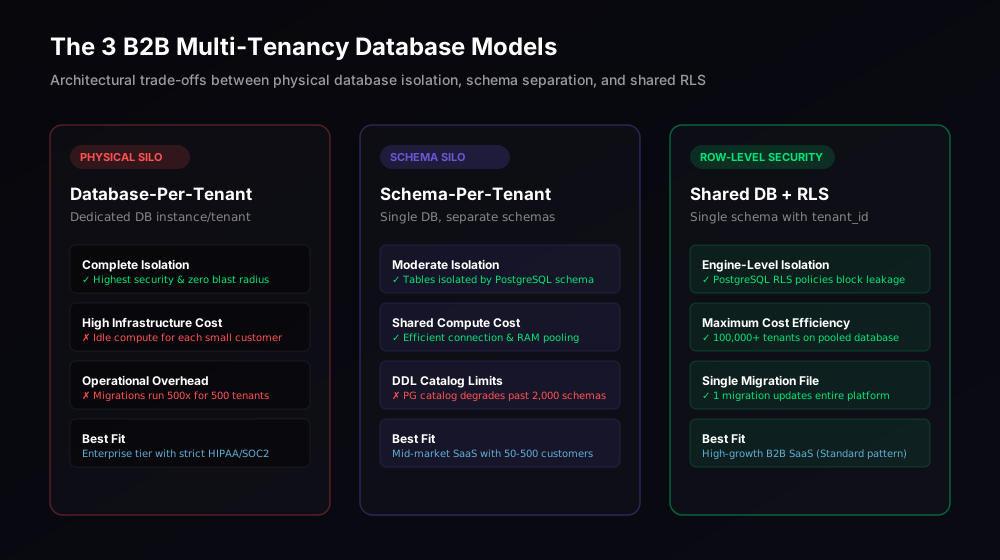
1. Database-Per-Tenant (Physical Silo)
In this model, each tenant provisions a completely separate relational database instance or serverless database branch.
- Advantages: Maximum physical security. Blast radius is strictly isolated: if Tenant A's database crashes from a runaway analytical query, Tenant B is completely unaffected. Backing up and restoring an individual customer's database is trivial.
- Drawbacks: High infrastructure overhead. Underutilized instances consume CPU and RAM while idling. Running database schema migrations requires fan-out worker orchestrators executing scripts across hundreds of distinct connection strings, significantly slowing down CI/CD release cadence.
2. Schema-Per-Tenant (Namespace Silo)
A single shared database engine hosts multiple PostgreSQL schemas (e.g., tenant_acme.invoices, tenant_globex.invoices).
- Advantages: Moderate resource sharing. Tables are logically namespaced, and developers switch tenant context via
SET search_path TO tenant_acme. - Drawbacks: PostgreSQL system catalog degradation. As an organization scales past 2,000 schemas with 50 tables each, PostgreSQL's internal catalog tables swell to over 100,000 relations. This inflates connection memory, degrades migration speed, and can trigger severe query planning latency.
3. Shared Database with Row-Level Security (PostgreSQL RLS)
All tenants share the exact same database tables. Every table containing tenant data includes an indexed tenant_id UUID column. PostgreSQL engine-level Row-Level Security policies intercept every SELECT, INSERT, UPDATE, and DELETE statement automatically.
- Advantages: Maximum capital efficiency and engineering agility. A single schema migration updates the entire SaaS platform instantaneously. Global analytics and cross-tenant machine learning pipelines can be executed cleanly. Up to 100,000+ organizations can run seamlessly on a pooled database cluster.
- Drawbacks: Requires meticulous connection pooling governance and disciplined session variable configuration to prevent context bleeding.
The Production Implementation: PostgreSQL RLS & Request Lifecycle
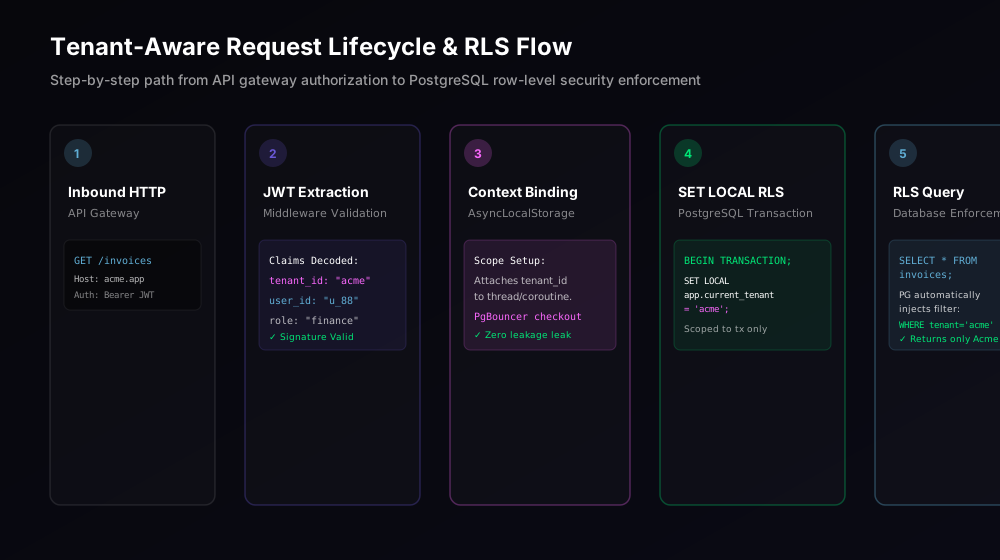
At Ramaaya Technologies, our Software Engineering team leverages PostgreSQL Row-Level Security as the gold standard for high-growth B2B SaaS applications. Here is how the end-to-end request lifecycle operates:
Step 1: Inbound Authentication & Context Binding
When an authenticated user invokes an endpoint, the API gateway verifies the JSON Web Token (JWT) or session cookie. The token payload contains the cryptographically signed tenant_id and user role. Middleware binds this value to the current execution thread or async context (e.g., AsyncLocalStorage in Node.js or request context in Go).
Step 2: Transaction-Mode Connection Pooling & Variable Injection
Because opening hundreds of database connections exhausts RAM, production SaaS applications place PgBouncer in front of PostgreSQL in transaction pooling mode. When a transaction begins, the application executes a session configuration statement:
BEGIN;
-- Set the tenant ID strictly for the duration of this transaction
SET LOCAL app.current_tenant_id = 'c90e3812-4f10-482a-bc91-382a8b981244';

-- Application query: Developers do not need to append manual WHERE clauses
SELECT id, invoice_number, total_amount, status FROM invoices;

COMMIT;
Using SET LOCAL guarantees that once the transaction completes or rolls back, the variable resets automatically, preventing the connection returned to PgBouncer's pool from leaking tenant context to subsequent requests.
Step 3: Database Engine RLS Policy Enforcement
Row-Level Security is enabled on the database table directly:
-- Enable RLS on the table
ALTER TABLE invoices ENABLE ROW LEVEL SECURITY;
ALTER TABLE invoices FORCE ROW LEVEL SECURITY;

-- Create policy ensuring only rows matching the session tenant are visible
CREATE POLICY tenant_isolation_policy ON invoices
  AS RESTRICTIVE
  USING (tenant_id = current_setting('app.current_tenant_id', true)::uuid)
  WITH CHECK (tenant_id = current_setting('app.current_tenant_id', true)::uuid);
Even if an inexperienced software developer writes SELECT * FROM invoices without a WHERE clause, the PostgreSQL engine rewrites the execution plan internally. Data belonging to other organizations is completely invisible. Application bugs cannot bypass the database kernel.
Decision Matrix: Choosing the Right Tenancy Model
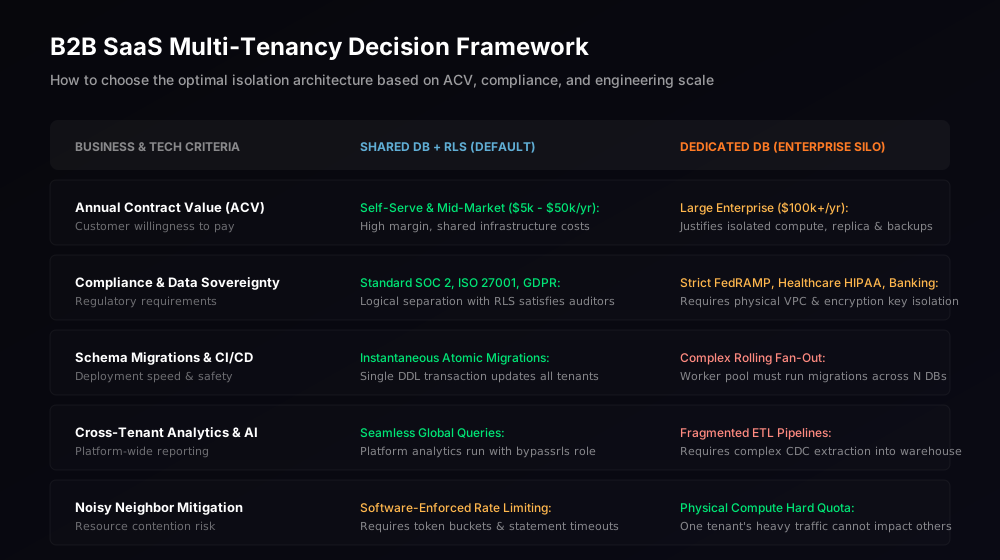
Architectural models should match business economics. Selecting an overly complex physical separation model too early drains capital, while selecting naive shared models without RLS invites severe data security breaches.
ACV < $50,000 / Year
Shared Database + PostgreSQL RLS is the undisputed gold standard. It provides exceptional profit margins, minimal cloud compute spend, and instant platform-wide deployment velocity.
ACV > $100,000 / Year
Enterprise accounts paying high six-figure contracts justify dedicated infrastructure. Deploy a hybrid model: run 98% of customers on shared RLS, and carve out isolated database clusters for select enterprise tier contracts.
Strict Compliance (FedRAMP / Banking)
When legal contracts require customer-managed KMS encryption keys (BYOK) or physical hardware isolation, Database-per-tenant with dedicated VPC network boundaries is structurally mandatory.
Solving the Noisy Neighbor Problem
In a shared-database environment, a single customer running a massive bulk CSV export can monopolize database CPU, degrading query performance for all other organizations. Production architectures mitigate this through three mechanisms:
- Statement Timeouts: Configure PostgreSQL
statement_timeout = '8000ms'for user-facing OLTP queries. Analytical batch reports must be offloaded to read replicas or background workers. - Redis Token Bucket Rate Limiting: Enforce rate limiting at the API gateway layer per
tenant_id(e.g., 600 requests per minute per tenant) to prevent rogue API scripts from degrading the shared platform. - Logical Read Replicas: Route heavy read queries (dashboard aggregations, reporting tables) to PostgreSQL read replicas, keeping the primary database write connection pool clear for real-time transactions.
Common Mistakes in Multi-Tenant Engineering
- Context Leaks in Background Workers: Web requests possess HTTP context, but background message queues (e.g., BullMQ, Celery) do not. Always serialize the
tenant_idinto the background job payload and explicitly invokeSET LOCAL app.current_tenant_idinside the worker thread before executing database queries. - Unindexed Tenant ID Columns: Omitting a B-Tree index on
tenant_idturns every single RLS query into a full table scan. Create composite indexes matching your primary query patterns (e.g.,CREATE INDEX idx_invoices_tenant_created ON invoices (tenant_id, created_at DESC);). - Relying on Application-Level ORM Filters: Framework-level filters (like Prisma extensions or Hibernate filters) can be bypassed by raw SQL queries or administrative scripts. Security must be enforced at the database engine level.
The Ramaaya Perspective: Build for Tenancy from Day One
Retrofitting multi-tenancy into a single-tenant database after gaining commercial traction is one of the most painful, expensive engineering migrations in modern software. By structuring your application schemas around PostgreSQL Row-Level Security, transaction-mode connection pooling, and strict tenant context propagation from Day One, your platform gains the ability to scale seamlessly from 10 to 100,000 organizations.
For organizations migrating operational systems out of manual spreadsheets into custom SaaS platforms, read our companion analysis: Replace Spreadsheets With Custom Business Software: When Excel Stops Scaling.