

The Information Asymmetry in Software Procurement
When an enterprise hires a civil engineering firm to construct a bridge, licensing boards, municipal building codes, and physical material inspections guarantee minimum structural standards. In software engineering, no such regulatory barrier exists. Anyone with a polished marketing website, a Dribbble portfolio, and an off-the-shelf proposal template can present themselves as an "enterprise software development powerhouse."
During the sales cycle, prospective clients interact with charismatic managing partners, seasoned solution architects, and sophisticated presentation decks. But once the contract is signed, work is frequently handed off to a completely different tier of developers: junior trainees, unaccountable subcontractors, or rotating offshore pools juggling five accounts simultaneously. This phenomenon—the agency bait-and-switch—is the single largest driver of software project failure.
Bridging this information asymmetry requires replacing subjective impressions with systematic, objective evaluation. Through our strategic IT consulting practice, Ramaaya has guided dozens of due diligence reviews. We organize the vetting process into a rigorous 4-stage evaluation pipeline.
The 4-Stage Due-Diligence Evaluation Pipeline
Evaluating 15 competing agencies in depth is operationally impossible. The evaluation pipeline acts as a progressive filter, narrowing candidates at each gate based on concrete technical criteria.
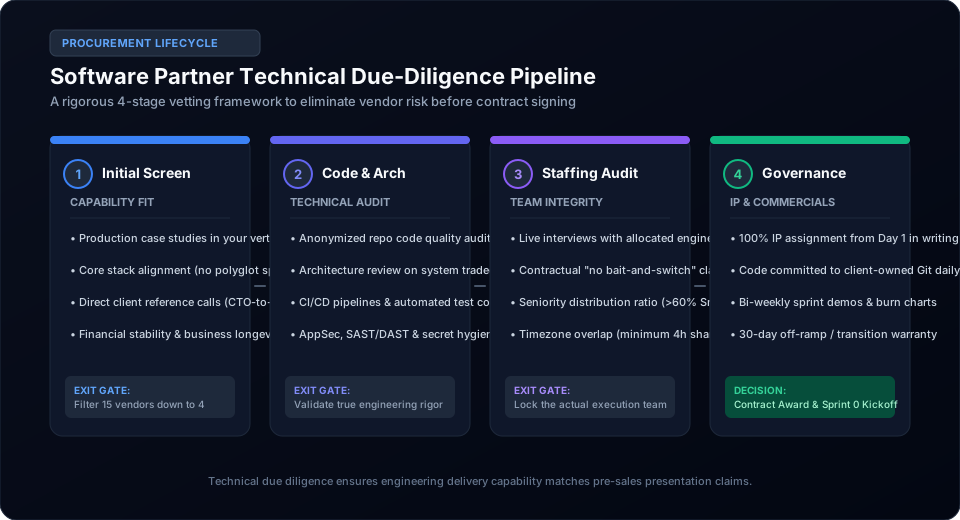
As illustrated in Figure 1, the vetting lifecycle moves through four progressive gates:
- Stage 1: Initial Screen (Capability Fit): Filter based on verifiable production case studies in your specific vertical, core technology stack alignment (avoiding polyglot generalists who claim mastery over 30 languages), direct CTO-to-CTO client reference calls, and multi-year financial stability.
- Stage 2: Technical Audit (Code & Architecture): Reviewing real, anonymized production code repositories, inspecting architecture decision records (ADRs), assessing test automation coverage (>75%), and evaluating static analysis (SAST) and secret management hygiene.
- Stage 3: Staffing Audit (Team Integrity): Conducting live technical interviews with the exact named engineers assigned to your pod, verifying seniority ratios, and inserting contractual "named resource replacement" clauses.
- Stage 4: Governance (Commercials & IP): Securing 100% intellectual property assignment in writing from Day 1, mandating daily commits to client-owned Git and cloud accounts, and establishing a 30-day off-ramp warranty.
The Staffing Seniority Illusion: Why Cheap Rates Compound Costs
The most deceptive metric in software procurement is the hourly billable rate. A vendor quoting \$40/hour often appears twice as cost-effective as a partner quoting \$85/hour. However, software engineering productivity and defect rates do not scale linearly—they follow an exponential curve.
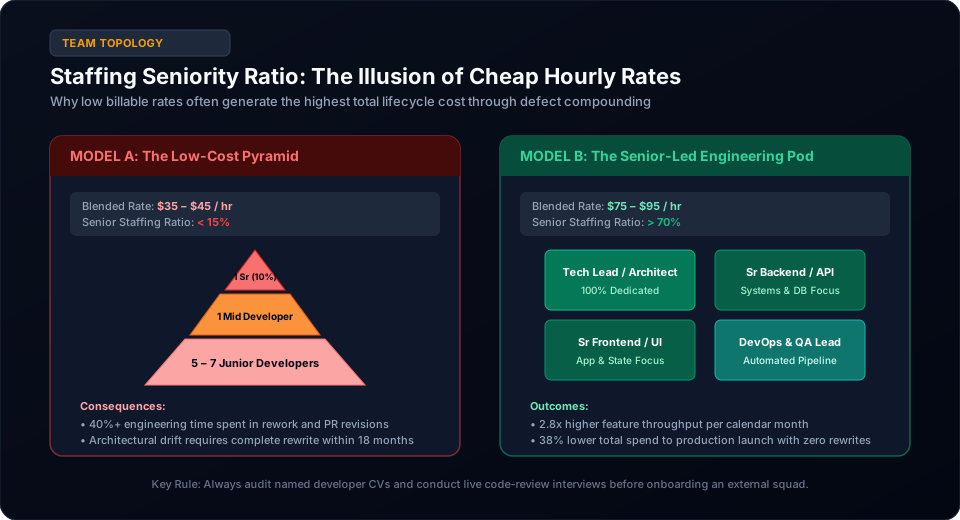
Compare the two operational models shown in Figure 2 (Note: The hourly rates, staffing ratios, and throughput metrics represent illustrative comparative models based on DORA rework distributions and typical agency structures, rather than fixed universal quotes.):
Model A: The Low-Cost Junior Pyramid
Structure: 1 Senior Architect (shared across 6 clients, ~10% time allocation) + 1 Mid-level engineer + 6 Junior developers.
Rate: Blended \$35 – \$45/hr.
Operational Reality: Juniors produce un-modular, copy-pasted code without automated tests. Senior lead is overwhelmed by pull request reviews. Over 40% of sprint capacity is consumed by bug fixes and rework. The project runs 3x longer than scheduled, ballooning total spend and creating unmaintainable technical debt.
Model B: The Senior-Led Engineering Pod
Structure: 1 Dedicated Tech Lead/Architect (100% focused) + 2 Senior Full-Stack Engineers + 1 DevOps/QA Automation Specialist.
Rate: Blended \$75 – \$95/hr.
Operational Reality: Modular, domain-driven architecture with clean separation of concerns. Strict type safety and automated CI/CD test gates catch defects in minutes. Throughput is 2.8x higher per sprint. Total cost to production launch is 35% to 40% lower with zero post-launch rewrites.
The Technical Due-Diligence Questionnaire: What to Ask
When conducting technical interviews with prospective agency leads, avoid generic questions like "Are you agile?" (every agency answers yes). Ask concrete, operational questions that expose real practices:
1. Code Quality & Automated Testing
- "Can you share an anonymized GitHub repository from a recent client engagement so our lead architect can inspect your commit history, PR review discussions, and branch hygiene?"
What you want to hear: Immediate agreement via an NDA or screen-share walkthrough. You want to see small, atomic commits, descriptive pull request templates, automated linter checks, and high test coverage. If they claim all code is strictly confidential and refuse even an architectural screen-share, treat this as a major red flag. - "What is your target unit and integration test coverage, and how is it enforced?"
What you want to hear: Coverage thresholds (>75%) are enforced automatically as blocking gates in GitHub Actions or GitLab CI. Code cannot be merged tomainif tests fail or coverage decreases.
2. Architecture & System Decision Making
- "How do you record and communicate major technical tradeoffs, such as database selections or third-party service dependencies?"
What you want to hear: Use of standardized Architecture Decision Records (ADRs) stored in the codebase alongside the software, detailing context, evaluated alternatives, consequences, and compliance requirements. - "What is your approach to multi-tenant isolation, data encryption at rest, and secret management?"
What you want to hear: Strict environment variable injection via AWS Secrets Manager or HashiCorp Vault. Zero hardcoded secrets in Git. KMS encryption with customer-managed keys (CMKs) and row-level security (RLS) or database-per-tenant isolation models.
3. Staffing & Resource Integrity
- "Can we interview the specific senior engineers who will write our code before we sign the Statement of Work?"
What you want to hear: "Yes. Here are their verified LinkedIn profiles and technical bios. Let's schedule a 45-minute technical session." If the vendor responds that resources are assigned dynamically from an internal pool upon contract execution, they are operating a broker model. - "What happens if a core team member departs or underperforms?"
What you want to hear: A contractual 2-week notice period, client approval rights over replacements, and a mandatory 2-week overlap funded entirely at the vendor's expense to ensure seamless knowledge transfer.
4. Delivery Cadence, Tooling & IP Ownership
- "Where does the code live during development, and how frequently is it committed?"
What you want to hear: Daily commits pushed directly to a client-owned GitHub/GitLab organization and deployed automatically to a client-hosted cloud staging environment. Never permit a vendor to build your software in their private repository where access can be leveraged during billing disputes. - "What is the intellectual property (IP) assignment language in your Master Services Agreement (MSA)?"
What you want to hear: Complete, unencumbered assignment of all intellectual property, source code, and design assets to the client as a work-for-hire from inception, free of proprietary vendor runtime lock-ins.
The 5-Pillar Weighted Scorecard Matrix
To eliminate subjective bias and boardroom debates, score candidate partners using a weighted mathematical scorecard.
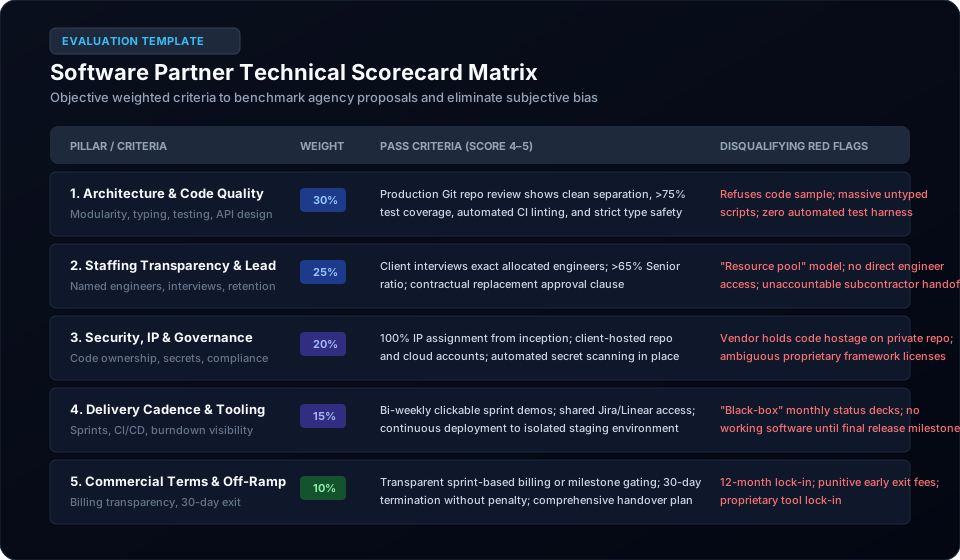
| Evaluation Pillar | Weight | Passing Threshold (4–5 / 5) | Automatic Disqualification (Red Flag) |
|---|---|---|---|
| 1. Architecture & Code Quality | 30% | Modular architecture, strict typing (TypeScript/Go/Rust), >75% automated test coverage, clear API schemas. | Refuses code review; untyped spaghetti code; zero automated test harness; missing CI/CD. |
| 2. Staffing Transparency & Lead | 25% | Named engineers interviewed by client; >65% senior-to-junior ratio; contractual replacement approval. | "Resource pool" model; no direct engineer access; offshore subcontractor churn. |
| 3. Security, IP & Governance | 20% | 100% IP assignment from inception; client-owned Git and AWS/GCP accounts; automated SAST vulnerability scans. | Vendor holds code on private server; unclear proprietary library licenses; secrets committed in plain text. |
| 4. Delivery Cadence & Tooling | 15% | Bi-weekly clickable sprint demos; shared Jira/Linear access; continuous staging deployments; burndown visibility. | "Black-box" monthly status decks; no clickable builds until final delivery milestone. |
| 5. Commercial Terms & Off-Ramp | 10% | Sprint-based milestone billing; 30-day termination without penalty; documented transition handover protocol. | 12-month lock-in; punitive exit fees; proprietary framework runtime licensing. |
Contract Safeguards: 5 Clauses Every MSA Must Contain
Even the most collaborative relationship must be protected by robust legal guardrails. Ensure your legal counsel incorporates these five non-negotiable clauses into the Master Services Agreement (MSA) and Statement of Work (SOW):
Work-for-Hire & Unconditional IP Assignment
All deliverables, documentation, source code, data schemas, and algorithmic configurations must be explicitly defined as "work-made-for-hire" with full worldwide ownership transferring immediately upon creation, irrespective of invoice payment status.
Client-Hosted Environments & Daily Commits
Mandate that all development occurs in client-owned repositories (GitHub/GitLab) and cloud tenancies (AWS/GCP/Azure). Development tools, CI/CD runners, and staging domains must reside under client administrative control.
Named Key Personnel & Replacement Veto
Specify the named Tech Lead, Senior Developers, and DevOps engineers in the SOW. Require 14 business days prior written notice for any staffing changes, and provide the client with unilateral veto power over proposed replacements.
Objective Code Quality Acceptance Gates
Define sprint acceptance criteria objectively: zero critical security defects on SonarQube/Snyk, automated test pass rate of 100%, and deployment to staging verified by automated smoke tests before an invoice milestone is approved.
30-Day No-Fault Termination & Knowledge Transfer
Reserve the right to terminate the agreement for convenience with 30 days written notice. Include a mandatory 30-day handover period where the vendor assists your internal engineers or a replacement partner with architecture onboarding.
Primary References & Industry Standards
- Fowler, Martin. Patterns of Enterprise Application Architecture (Architectural governance and modular boundary integrity).
- Forsgren, Nicole; Humble, Jez; Kim, Gene. Accelerate: The Science of Lean Software and DevOps (DORA metrics on team stability, deployment frequency, and change failure rates).
- IEEE Standard 1062-2015. IEEE Recommended Practice for Software Acquisition (Vendor evaluation models, quality metrics, and acceptance procedures).
- National Institute of Standards and Technology (NIST). Special Publication 800-161: Cybersecurity Supply Chain Risk Management Practices.
Seeking a High-Seniority Software Engineering Partner?
Ramaaya Technologies provides dedicated, senior-led engineering pods, rigorous architecture reviews, and transparent sprint execution engineered for zero technical debt.