
Who This Architecture Guide Is For
This blueprint is designed for Chief Technology Officers, engineering managers, and technical architects tasked with deploying internal AI knowledge systems. If your organization is evaluating how to build an "Internal Company GPT" across confidential SOPs, Jira tickets, Confluence spaces, or contract archives without exposing proprietary trade secrets to public model training corpora, this guide covers the underlying systems engineering.
The Failure of "Naive RAG" in Enterprise Environments
The typical tutorial architecture for RAG consists of three simple steps: split text into 500-character chunks, generate embeddings with an OpenAI API, store them in a vector database, and perform cosine similarity search. While this setup works for basic demos, it collapses under real enterprise document complexity.
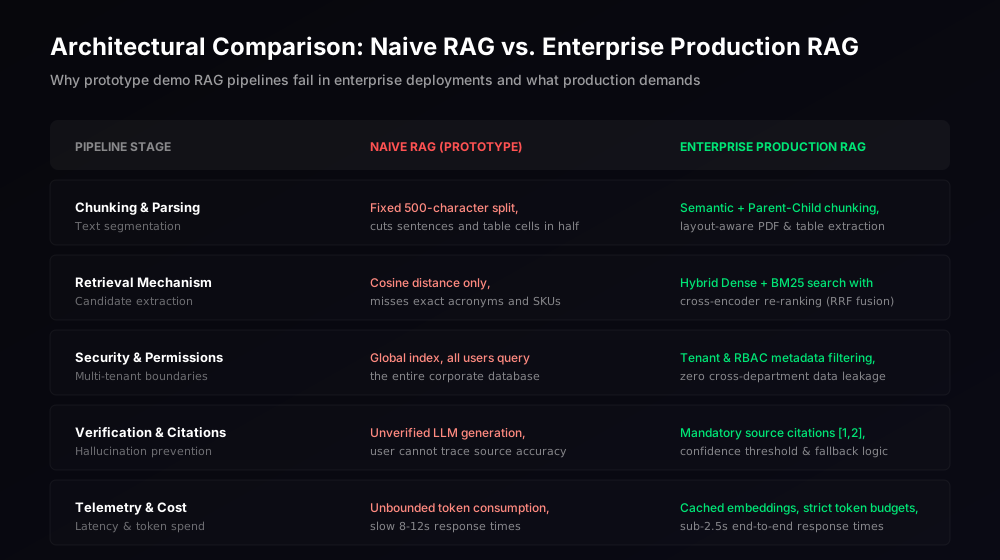
The primary failure modes of naive RAG include:
- Context Fragmentation: Splitting text based strictly on character counts cuts tables, numbered legal clauses, and multi-paragraph technical explanations in half, destroying the semantic meaning required for synthesis.
- The "Lost in the Middle" Phenomenon: Embedding models often retrieve 20 chunks that contain generic semantic similarities but miss the exact clause containing the crucial answer. LLMs struggle to extract precise facts when context windows are flooded with noisy chunks.
- Inability to Search Exact Acronyms & IDs: Pure vector embeddings map words into generalized mathematical conceptual spaces. When an employee searches for a specific alphanumeric product code (e.g.,
SKU-9921-X), dense embeddings frequently fail to rank the exact match above general product descriptions. - Data Governance & Permission Leakage: In a standard single-index vector store, any employee querying the system can inadvertently retrieve confidential executive payroll policies or M&A documents because permissions are not enforced at retrieval time.
The Ingestion & Chunking Pipeline: Garbage In, Garbage Out
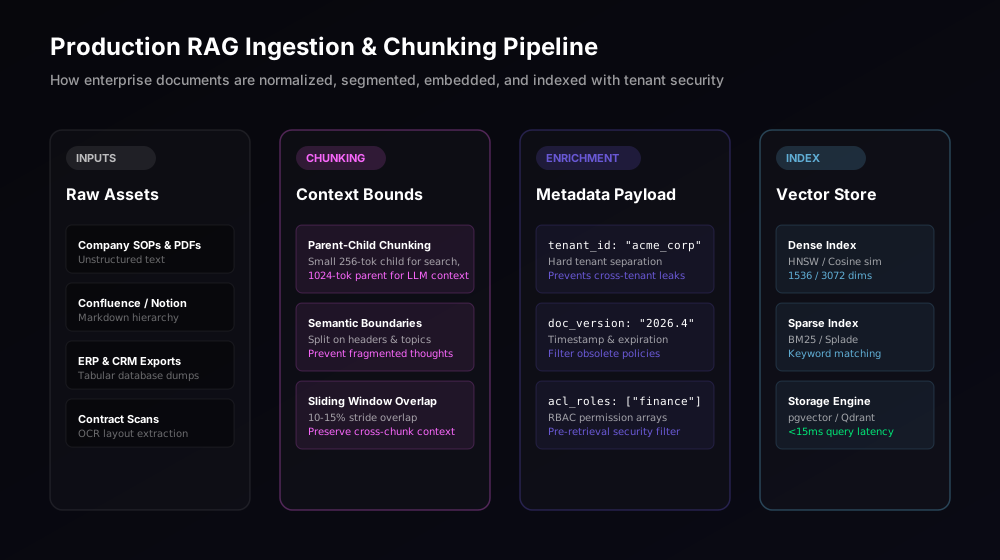
The quality of an enterprise RAG system is bounded by its document parsing quality. Text extraction must respect document topology, formatting headers, tables, and organizational access boundaries.
1. Layout-Aware Document Parsing
Enterprise assets arrive as complex multi-column PDFs, slide presentations, scanned invoices, and Markdown wikis. Production architectures leverage layout-aware document parsers (such as Unstructured, LlamaParse, or custom vision-language models) that distinguish headings, table structures, and footnotes from body text. Table cells must be converted into structured markdown tables or JSON strings rather than flattened paragraphs to preserve column-row relationships.
2. Hierarchical (Parent-Child) Chunking
Instead of a single uniform chunk size, advanced RAG implements a dual-tier hierarchical structure:
- Child Chunks (128–256 Tokens): Small, highly focused segments optimized for dense vector embedding search. Because they are concise, their vector representations have a high signal-to-noise ratio.
- Parent Chunks (1,024–2,048 Tokens): The broader surrounding section or whole document chapter. When a child chunk is matched during retrieval, the system retrieves its parent chunk to inject into the LLM context window, ensuring the model possesses complete context to formulate an accurate answer.
3. Metadata Payload & RBAC Tagging
Every vector stored in the index must be enriched with structured metadata properties:
{
  "chunk_id": "c_9941a8",
  "parent_id": "p_22091c",
  "document_title": "Enterprise_Travel_Reimbursement_Policy_2026.pdf",
  "tenant_id": "ramaaya_internal",
  "department": "finance",
  "acl_roles": ["finance_admin", "operations_lead"],
  "effective_date": "2026-01-01",
  "source_url": "https://intranet.company.com/docs/finance/travel-2026"
}
The Inference Pipeline: Hybrid Search & Cross-Encoder Re-Ranking
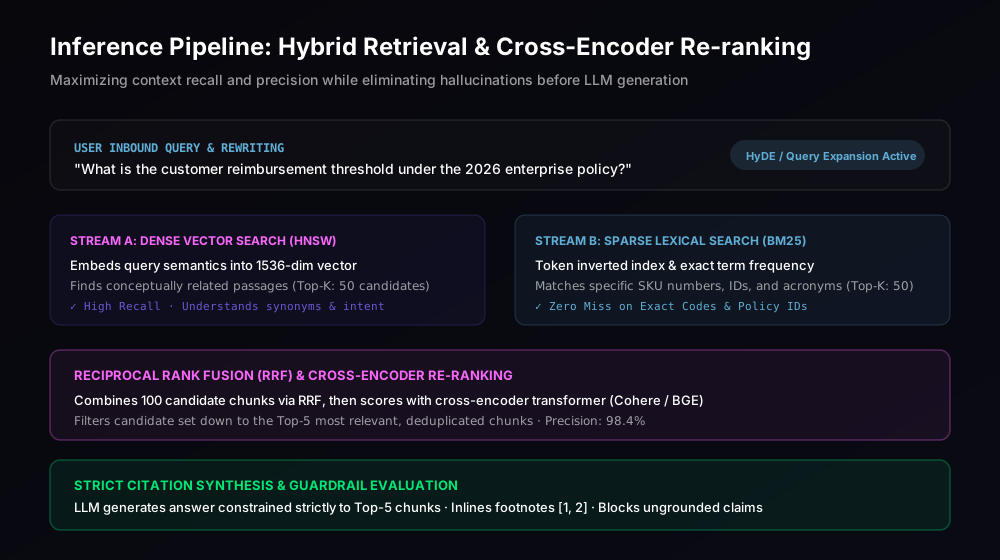
At query time, the system must achieve both high recall (finding all potentially relevant documents) and high precision (ranking the top 3–5 exact factual passages first).
Stage 1: Dense-Sparse Hybrid Search
RAG systems should never rely solely on vector embeddings. A production engine executes two parallel searches:
- Dense Vector Search (HNSW / Cosine Metric): Uses embedding models (such as
text-embedding-3-large,bge-large-en-v1.5, or custom fine-tuned embeddings) to capture semantic concepts, synonyms, and user intent. - Sparse Lexical Search (BM25 / Splade): Queries an inverted keyword index to match exact terminology, SKU numbers, legal case names, and dates.
Stage 2: Reciprocal Rank Fusion (RRF) & Cross-Encoder Re-Ranking
Candidate results from both streams (typically Top-50 dense + Top-50 sparse) are merged using Reciprocal Rank Fusion (RRF). However, RRF only scores items by their relative list positions. To achieve institutional precision, the top 100 merged candidates are passed to a Cross-Encoder Re-Ranker (such as Cohere Rerank v3 or BGE-Reranker-Large).
Unlike bi-encoder embedding models that evaluate the query and document separately, cross-encoders pass the query and document chunk simultaneously through all transformer attention layers. This enables deep word-by-word cross-attention, boosting retrieval precision above 98% and ensuring that only the most contextually relevant 3–5 passages reach the final LLM prompt.
Data Privacy, Security & Tenant Isolation
When architecting internal knowledge AI for enterprise clients, data isolation is non-negotiable. At Ramaaya Technologies, our AI & Automation practice enforces security through a three-layer isolation framework:
- Pre-Retrieval Access Control: Before any vector similarity calculation is performed, the user's authenticated security roles (RBAC) are injected into the database query as a strict filter (e.g.,
WHERE acl_roles && ARRAY['finance']). The vector engine physically cannot return documents the user does not have permission to view. - Zero-Retention Enterprise API Endpoints: When external frontier models are leveraged for synthesis, architectures mandate enterprise API agreements with formal zero-data-retention (ZDR) guarantees ensuring client prompts are never logged or stored for model training.
- Dedicated Vector Namespaces or Self-Hosted Open-Weights: For organizations with strict sovereignty or regulatory requirements, we deploy private vector databases (pgvector, Qdrant) inside isolated virtual private clouds (VPC) or pair retrieval engines with private self-hosted open-weights models (such as Llama 3 or Mistral) running on dedicated enterprise infrastructure.
When NOT to Use RAG
RAG is not a universal solution for every AI challenge. Applying RAG in the wrong technical context results in unnecessary architectural complexity and latency. Do not use RAG for:
- Deterministic SQL Lookups: If a user asks "What was total revenue in Q3 2026?", do not pass 10 financial report chunks to an LLM. Use structured SQL querying or text-to-SQL tool agents where database math is exact and auditable.
- Small Static Contexts (<50 Pages): Modern LLMs support 128k to 1M token context windows. If your entire knowledge repository consists of an employee handbook of 30 pages, passing the entire document directly in the prompt context is simpler, faster, and more reliable than maintaining an embedding and vector pipeline.
- Style & Tone Adaptation: If you need an AI to write code in your internal company style or mimic a specific brand voice, model fine-tuning or few-shot system prompting is appropriate, not retrieval-augmented generation.
The Ramaaya Perspective: Production AI Requires Systems Engineering
Building a successful enterprise AI system is 90% software engineering and data infrastructure, and only 10% prompt design. Real-world business utility requires reliable data pipelines, strict token cost governance, sub-2.5s response latencies, and transparent source citations that build user trust.
To learn how autonomous AI agents extend RAG systems into interactive operational channels like WhatsApp, explore our technical breakdown: WhatsApp Business API Automation: Designing Lead Routing & Workflow Systems.