
Who This Architecture Guide Is For
This guide is written for Chief Revenue Officers, growth architects, and backend engineering teams building automated communication systems. If your commercial sales team is manually copying WhatsApp lead inquiries into HubSpot or your existing chatbot repeatedly sends duplicate messages when campaigns launch, this blueprint provides production-grade architectural solutions.
The Webhook Pipeline: Avoiding Meta Retry Storms & Dropped Events
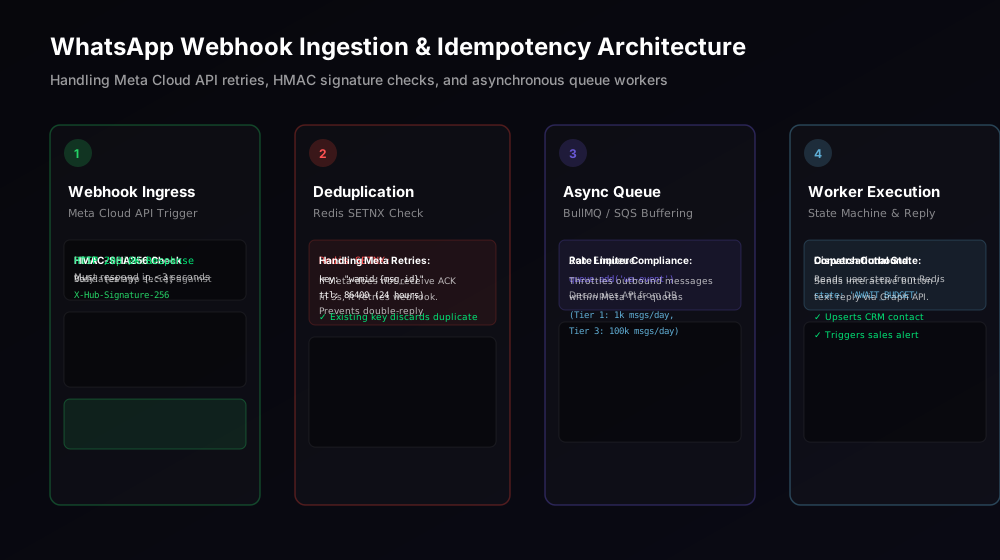
The foundation of any WhatsApp automation system is its inbound webhook listener. The Meta Cloud API dispatches a webhook POST request for every message sent, delivered, read, or failed. A naive implementation that executes synchronous database writes or slow LLM calls directly inside the webhook HTTP route will immediately trigger production failures.
Stage 1: Cryptographic HMAC Signature Verification
Every incoming payload must be verified against your Meta Application Secret using HMAC-SHA256:
const crypto = require('crypto');

function verifyMetaSignature(req) {
  const signature = req.headers['x-hub-signature-256'];
  if (!signature) return false;

  const hmac = crypto.createHmac('sha256', process.env.META_APP_SECRET);
  const digest = 'sha256=' + hmac.update(req.rawBody).digest('hex');
  return crypto.timingSafeEqual(Buffer.from(signature), Buffer.from(digest));
}
Stage 2: The Mandatory 3-Second ACK Rule
Meta's Cloud API requires your endpoint to return an HTTP 200 OK response within 3.0 seconds. If your server is delayed (e.g., executing a slow database query or waiting for a third-party CRM webhook), Meta flags the delivery as failed and automatically retries the webhook with exponential backoff. In high-volume campaigns, this creates a catastrophic "retry storm", flooding your servers with duplicate events.
Production Rule: Never execute business logic inside the webhook handler. Validate the signature, push the raw event payload into an asynchronous message queue (such as Redis BullMQ or AWS SQS), and immediately return HTTP 200 OK in under 50 milliseconds.
Stage 3: Redis Idempotency Deduplication
Even in healthy network environments, Meta occasionally delivers duplicate webhooks. To prevent sending duplicate greetings or charging a customer twice, workers check the unique WhatsApp Message ID (wamid) in Redis before executing workflow steps:
// Atomically set key if it does not exist with 24-hour expiration (86400s)
const isNewMessage = await redis.set(`wamid:${messageId}`, '1', 'EX', 86400, 'NX');
if (!isNewMessage) {
  // Duplicate webhook delivery detected; cleanly ack and discard
  return;
}
The Qualification Engine: Conversational Finite State Machines (FSM)
Many consumer chatbots fail because they give large language models complete, unconstrained freedom to chat indefinitely without guiding the user toward a commercial outcome. High-converting B2B WhatsApp systems utilize a Finite State Machine (FSM) that guides prospects through a structured qualification journey.
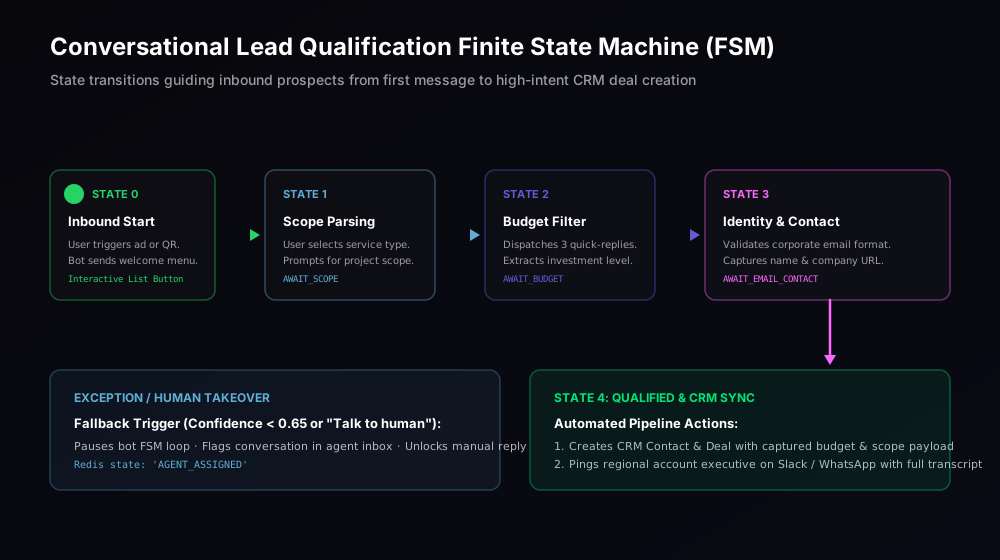
State 0 → Service Selection
Dispatches an interactive List Button menu displaying primary operational capabilities, preventing typos and providing immediate structure.
State 1 → Scope Extraction
Captures the prospect's project goals. Uses lightweight natural language entity extraction to parse timeline and scale.
State 2 → Budget Filtering
Presents interactive quick-reply buttons (e.g., "$10k-$25k", "$25k-$50k", "$50k+"). Categorizes buyer intent without intrusive open-ended interrogation.
State 3 → Contact & CRM Sync
Validates corporate email format with regex. Instantly creates a Contact & Deal record in the CRM and pings account executives.
Human-in-the-Loop (HITL) Fallback Architecture
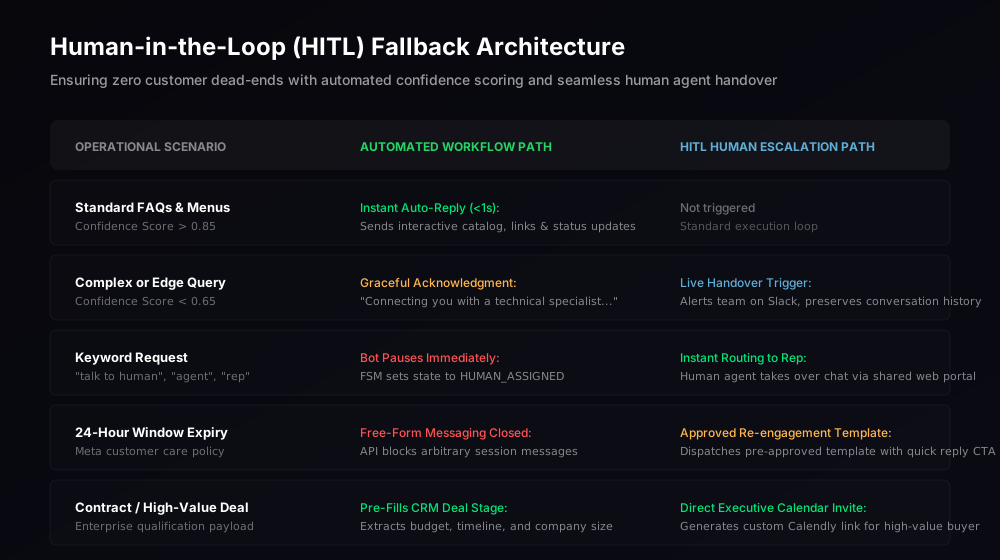
No automation system should ever trap a high-value prospect in a dead-end loop. Production WhatsApp automation must provide a graceful, instantaneous handover to human account managers.
How Graceful Handover Works:
- Confidence Scoring & Keyword Triggers: If an incoming query falls below confidence thresholds (<0.65) or explicitly matches escape keywords (e.g., "speak to human", "sales rep", "agent"), the bot stops automated responses immediately.
- State Locking in Redis: The session state is updated to
HUMAN_AGENT_ASSIGNED. All subsequent inbound webhooks are routed directly to the sales team's web inbox rather than the automated bot worker. - Full Transcript Context Preservation: The human agent interface displays the complete qualification transcript (budget, scope, company name), enabling the human representative to jump into the conversation seamlessly without asking the customer to repeat themselves.
Meta Compliance & The 24-Hour Customer Care Window
Architects must design workflows in strict adherence with Meta's messaging policies:
- The 24-Hour Service Window: When a user messages your business, a 24-hour customer service window opens. Within this window, your business can send automated free-form text and interactive buttons without per-template Meta approval.
- Re-engagement Templates Outside 24h: Once 24 hours elapse since the user's last message, free-form messaging is blocked by the API. Initiating a new conversation requires sending a pre-approved Meta Template (Utility or Marketing category) containing variables and quick-reply buttons.
- Strict Opt-In Compliance: Businesses must obtain explicit consent before initiating proactive outbound WhatsApp messages to prevent user reports, spam flags, and phone number tier demotions.
Common WhatsApp Automation Mistakes
- Attempting Synchronous Heavy Workloads in Webhooks: Executing database migrations, generating PDFs, or waiting for slow AI models inside the incoming webhook handler triggers Meta retry storms and server crashes. Decouple via message queues.
- Forgetting Idempotency Keys: Failing to deduplicate message IDs in Redis guarantees your bot will send duplicate responses during minor network hiccups, frustrating users.
- Trapping Users in Infinite "I Don't Understand" Loops: If a bot fails to understand a user twice in a row, it must immediately offer a button to connect with a human agent.
The Ramaaya Perspective: Conversation as an API
WhatsApp is not just a chat application; in high-velocity markets, it is the primary transactional operating system. By architecting WhatsApp automation with institutional software engineering principles—queue-backed workers, atomic idempotency keys, and bidirectional CRM synchronization—organizations create an automated sales engine that converts interest into revenue around the clock.
To understand how enterprise AI models integrate with private company knowledge stores to power support agents, explore our deep dive: Enterprise RAG Architecture: How to Build Private AI Knowledge Systems.