
The Core Architectural Divide: Conversation vs Execution
The fundamental difference between a chatbot and an AI agent is not the underlying Large Language Model (LLM). Both may invoke frontier models such as Claude 3.5 Sonnet, GPT-4o, or self-hosted open-weights models like Llama 3. The difference lies in agency: the ability to observe state, reason through multi-step objectives, select and invoke external tools, inspect environment feedback, self-correct errors, and execute permanent state mutations inside business databases.
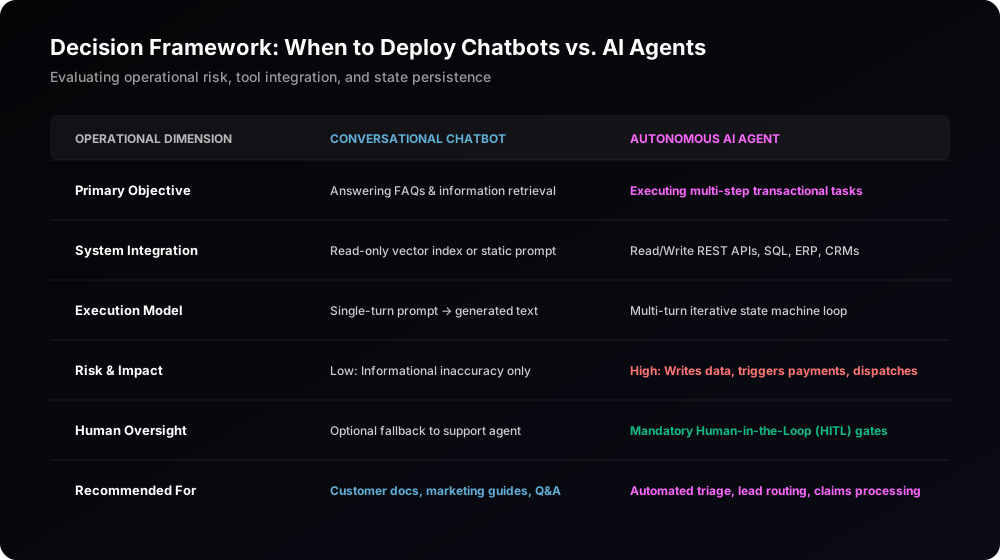
A standard chatbot operates as an ephemeral request-response text generator. The user submits a prompt; the system performs a stateless forward pass (optionally injecting static document chunks via naive RAG); and the model outputs a paragraph of prose. The conversation terminates until the user manually prompts it again.
An autonomous AI agent, by contrast, operates inside a closed-loop control system. Given a high-level business objective—such as "Reconcile overdue freight invoices against logistics bills of lading and post valid credit adjustments into SAP"—the agent decomposes the goal into discrete sub-tasks, queries external services via standardized schema interfaces (JSON function calling), evaluates responses, and iterates until the objective is fulfilled or an escalation threshold is reached.

How Autonomous Agent Tool Loops Actually Work
To engineer an autonomous agent, developers do not merely ask an LLM to "be helpful." Instead, the language model is cast as a reasoning engine inside a deterministic software wrapper. The architecture enforces the ReAct (Reasoning + Acting) cycle or plan-and-solve execution frameworks.
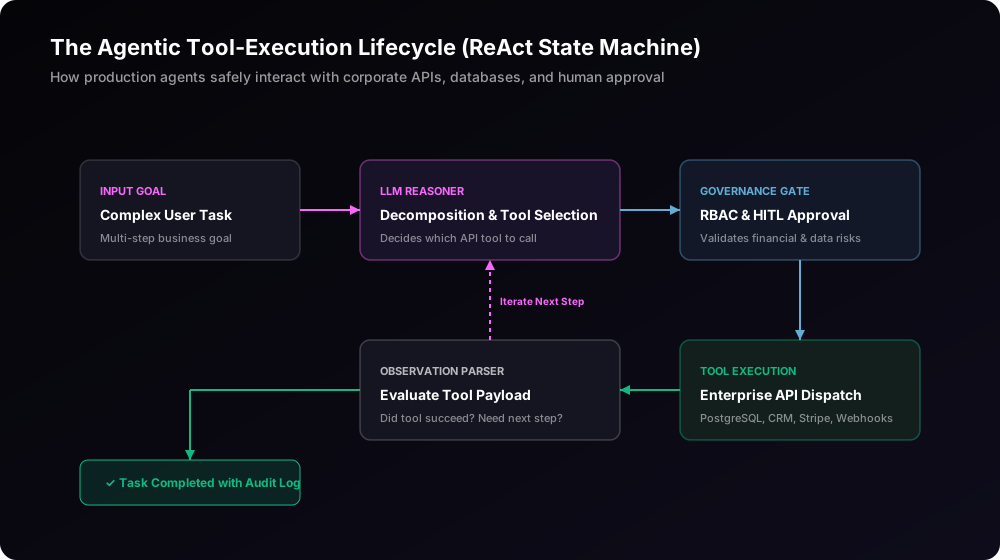
The lifecycle of an enterprise tool invocation follows a strict four-stage loop:
- Observation & Prompt Framing: The runtime collects current environmental state (user input, active session variables, historical database snapshot) and exposes a declarative manifest of typed tools (OpenAPI schemas or JSON Schema definitions).
- Reasoning & Tool Selection: The model evaluates whether the user intent can be fulfilled with immediate knowledge or requires tool execution. If external actions are required, it returns a structured tool call payload containing typed function arguments rather than natural language text.
- Deterministic Sandbox Execution: The application harness intercepts the tool call, validates arguments against schema definitions and role-based access control (RBAC) rules, and invokes the real external service (e.g., Stripe API, PostgreSQL database, ERP webhook). The model never directly touches the database; the host software executes the verified action.
- Environment Evaluation & Iteration: The output payload of the tool (success JSON or error code) is appended back into the model's message history as an observation. The agent inspects the result. If an error occurred (e.g.,
404 Not Foundor schema mismatch), the agent reformulates its query or attempts alternative fallback paths.
A Code-Level Examination: Tool Schema vs Natural Language Prompting
In a naive chatbot, a developer might prompt: "You are a billing assistant. If the user wants to cancel a subscription, explain our refund policy." In an autonomous agent engineered by Ramaaya's AI & Automation team, the system defines strongly typed tool schemas that the LLM invokes directly:
// TypeScript / JSON Schema tool definition provided to the LLM
{
  "name": "execute_subscription_credit",
  "description": "Issues an auditable prorated account credit to an active enterprise tenant",
  "parameters": {
    "type": "object",
    "properties": {
      "tenant_id": { "type": "string", "pattern": "^org_[a-zA-Z0-9]{12}$" },
      "credit_amount_cents": { "type": "integer", "maximum": 50000 },
      "justification_code": {
        "type": "string",
        "enum": ["SLA_BREACH", "BILLING_DISPUTE", "EXECUTIVE_OVERRIDE"]
      },
      "ticket_reference": { "type": "string", "pattern": "^JIRA-[0-9]{4,6}$" }
    },
    "required": ["tenant_id", "credit_amount_cents", "justification_code", "ticket_reference"]
  }
}
When the model issues this function call, the backend verifies that the requesting user possesses administrative delegation authority, logs the intent into an immutable audit trail, verifies that credit_amount_cents does not exceed the autonomous authorization threshold (\$500.00), and executes the transaction against Stripe. If the transaction exceeds the threshold, the agent transitions state to PENDING_HUMAN_APPROVAL and triggers an interactive Slack approval workflow.
When to Build a Chatbot vs When to Build an AI Agent
Not every business problem requires an autonomous agent. Introducing multi-step execution loops into simple informational retrieval creates unnecessary latency, API cost, and operational complexity.
When a Chatbot Is Sufficient
Informational Knowledge Retrieval: Browsing employee benefit documents, querying technical API documentation, or fielding general public inquiries on marketing sites. Here, semantic search and RAG provide instant answers without needing backend side effects.
When an Agent Is Mandatory
Operational Multi-System Workflows: Triaging customer support tickets where resolutions require issuing refunds, querying logistics trackers, updating CRM records, and emailing stakeholders without manual copy-pasting across tabs.
To evaluate whether your enterprise needs a conversational assistant or an autonomous agent, answer these three diagnostic questions:
- Does the user expect an action or merely an explanation? If the human must open another browser tab to click a button after getting an answer, the chatbot has merely moved the friction point. An agent executes the action directly.
- Does the resolution require sequential conditional steps? If step 2 depends on the live output of step 1 (e.g., check warehouse inventory, then query alternative suppliers if stock < 10), linear chatbots fail. Agents excel at recursive branching.
- Can the system recover from unexpected data errors? Chatbots hallucinate plausible excuses when confronted with API timeouts or missing fields. Robust agents catch exceptions, reformat queries, or cleanly escalate to human operators.
Production Pitfalls: How Agent Deployments Break
Moving an agent from a demo notebook into high-volume enterprise production introduces significant failure modes that standard software engineering teams often underestimate:
- Infinite Tool Loops: If a tool returns a non-fatal error (e.g., invalid query format) and the model is not constrained by strict recursion budgets, it may continuously call the same failing tool, consuming thousands of API tokens in seconds. Production runtimes must enforce hard recursion limits (typically 3–5 iterations per step).
- Prompt Injection & Indirect Tool Abuse: When agents process untrusted external data (such as emails or scraped web pages), malicious inputs can instruct the agent to ignore prior commands and invoke sensitive tools (e.g., "Transfer all funds to account X"). Agents must implement strict separation between instructions and untrusted data payloads.
- State Drift in Multi-Turn Dialogs: Without relational state tracking, agents lose context over complex multi-day workflows. Resilient architectures persist conversation state inside transactional databases (PostgreSQL, Redis) with explicit schema state machines (e.g., LangGraph or custom state graphs).
The Ramaaya Perspective: The Future Belongs to Workflow Agents
The era of passive, text-only corporate chatbots is ending. High-performing organizations do not want another conversational widget that creates work for human staff; they require software systems that autonomously handle operational friction. By combining structured API tooling, deterministic validation gates, and human-in-the-loop escalation, enterprise AI transforms from an expensive novelty into a measurable operational profit driver.
To explore how our engineering team builds autonomous workflow agents across omnichannel platforms, read our guide on WhatsApp Business API Automation: Designing Lead Routing & Workflow Systems, or dive into our foundation on Enterprise RAG Architecture: How to Build Private AI Knowledge Systems.