The Mechanics of Cloud Infrastructure Debt
In the early days of a software product, speed is paramount. Developers manually configure EC2 instances, spin up unencrypted RDS instances in default VPCs, attach overly permissive IAM policies like AdministratorAccess to satisfy tight deadlines, and postpone Infrastructure-as-Code (IaC) tooling. For an early prototype, these compromises are understandable.
However, when the product achieves scale—supporting hundreds of thousands of users and enterprise customer SLAs—these early decisions metastasize into existential risks. The team realizes that:
- A single AWS Availability Zone outage in
us-east-1atakes down the primary transactional database, with no automated failover configured. - A compromised API key from a junior developer's testing laptop has full administrative privileges across production S3 buckets.
- Cloud spend has quietly surged to \$35,000/month, with 30% consumed by unattached EBS volumes, forgotten staging clusters, and unindexed database queries pegged at 95% CPU.
- Nobody can replicate production from scratch because years of manual console tweaks have caused severe configuration drift from legacy Terraform scripts.
Resolving these vulnerabilities without disrupting live production traffic requires a structured cloud architecture assessment modeled on enterprise reliability principles.
The 5-Pillar Cloud Architecture Assessment Model
Rather than reviewing infrastructure haphazardly, leading Site Reliability Engineers (SREs) and cloud architects evaluate systems across five interdependent pillars.
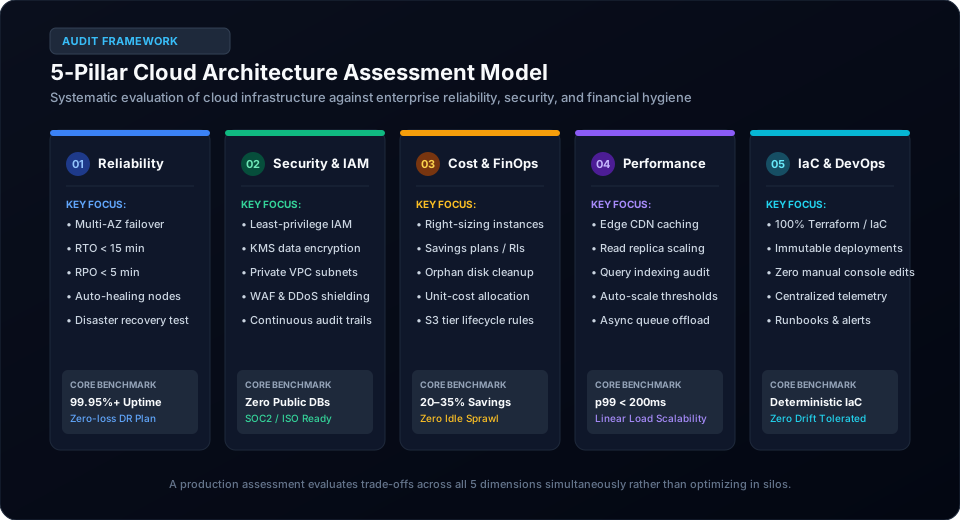
As shown in Figure 1, an effective assessment inspects five core dimensions against representative industry reliability benchmarks (Note: Target SLAs such as 99.95% uptime and sub-15-minute RTO represent reference Well-Architected targets; specific production metrics should align with your business SLAs.):
- Reliability & Disaster Recovery: Multi-AZ deployment, automated health checks, self-healing container pods, automated database failover, Recovery Time Objective (RTO < 15 min), and Recovery Point Objective (RPO < 5 min).
- Security & IAM Governance: Principle of least privilege, zero public databases, private subnet isolation, KMS encryption at rest, automated secret rotation, and immutable audit trails (CloudTrail/GuardDuty).
- Cost & FinOps Efficiency: Compute rightsizing, Graviton processor migration, orphaned disk cleanup, multi-year Savings Plans coverage (>75%), and S3 intelligent tiering. Read our dedicated FinOps Guide for Growing Businesses for granular cost reduction strategies.
- Performance & Scalability: Edge CDN caching, database connection pooling (PgBouncer), read replica distribution, asynchronous event queues, and horizontal auto-scaling policies.
- IaC & DevOps Operations: 100% Terraform/OpenTofu coverage, zero manual console interventions, ephemeral staging environments, and centralized OpenTelemetry/Datadog metrics.
Network Topology: Blast Radius Containment & Multi-Tier Isolation
The foundation of cloud resilience is blast radius containment: ensuring that an operational failure, traffic surge, or security breach in one component cannot propagate into catastrophic system-wide failure.
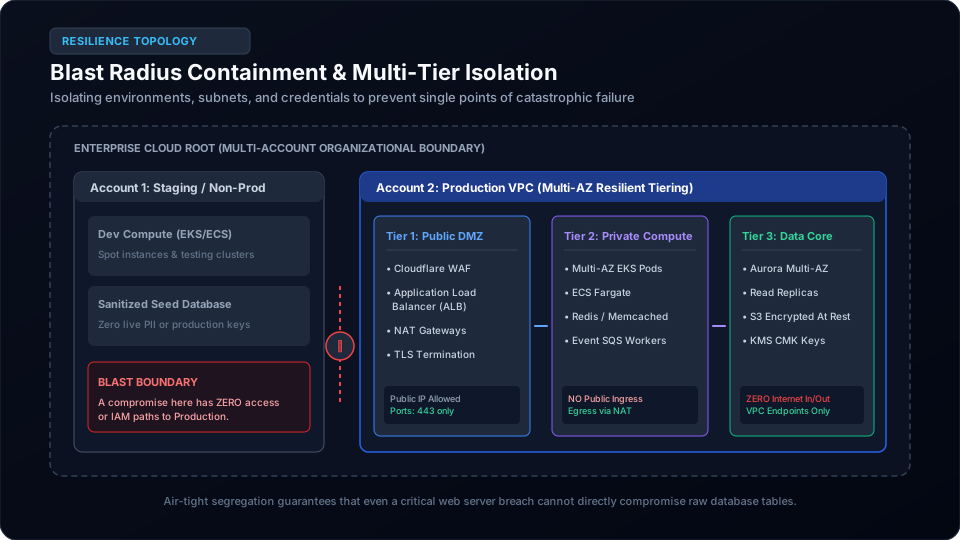
Figure 2 illustrates the three non-negotiable architectural boundaries required in modern cloud deployments:
1. Multi-Account Organizational Isolation
Staging and Production must never share a single cloud account or single VPC. A misconfigured test script or security breach in Staging must have zero IAM or routing pathways to reach production databases. Separate accounts under AWS Organizations or GCP Resource Manager guarantee hard boundaries.
2. Three-Tier Subnet Segmentation
Within the production VPC, workloads must be partitioned into three isolated tiers:
- Tier 1: Public DMZ: Houses only Application Load Balancers (ALB) and Cloudflare WAF endpoints. The only allowed inbound port is 443. Compute and databases are strictly barred from this tier.
- Tier 2: Private Compute: Houses container pods (EKS/ECS) and Redis caches in private subnets with private RFC1918 IP addresses. Ingress is permitted strictly from the ALB security group. Outbound internet access occurs exclusively through managed NAT Gateways for external API calls.
- Tier 3: Isolated Data Core: Houses relational databases (Aurora/RDS). This subnet has zero route to the Internet Gateway or NAT Gateway. Databases can only be accessed by compute pods within Tier 2 via strict security group rules on port 5432 (Postgres) or 3306 (MySQL). Data exfiltration to the public web is physically impossible at the network layer.
The Production Assessment Checklist
Execute this audit checklist across your production infrastructure. Any item marked "Fail" represents immediate operational or security vulnerability.
Security & Identity Hygiene Audit
• Verify root cloud account access keys are permanently deleted and hardware MFA is enforced.
• Audit all IAM roles: identify and eliminate wildcard permissions ("Action": "*", "Resource": "*").
• Confirm no database instance, Elasticsearch cluster, or Redis node is assigned a public IP or bound to 0.0.0.0/0.
• Verify all S3 buckets block public access and enforce SSE-KMS encryption with customer-managed keys.
Reliability & Availability Audit
• Confirm production databases operate in Multi-AZ mode with automated synchronous replica failover.
• Verify Point-In-Time-Recovery (PITR) is enabled with a minimum 14-day retention window.
• Review container cluster auto-scaling: ensure pods are scheduled across a minimum of 3 distinct Availability Zones with pod anti-affinity rules.
• Execute a simulated disaster recovery drill: restore a snapshot to an isolated sandbox and verify database integrity within your stated RTO.
FinOps & Resource Efficiency Audit
• Scan for unattached EBS volumes, idle Elastic IPs, and obsolete database snapshots older than 90 days.
• Review EC2/ECS CPU utilization: downsize instances where average 30-day utilization is below 20%.
• Evaluate compute architecture: transition eligible Linux container workloads to ARM-based AWS Graviton3 or GCP Tau instances for immediate 20% cost and performance improvement.
• Verify baseline predictable compute load is covered by 1-year or 3-year Compute Savings Plans.
Performance & Latency Profiling
• Implement connection pooling (PgBouncer/AWS RDS Proxy) to prevent database connection exhaustion during traffic spikes.
• Inspect slow query logs: identify queries executing full table scans and add missing B-tree or GIN indexes.
• Route static assets, media, and cacheable API GET responses through Cloudflare CDN or CloudFront with explicit Cache-Control headers.
• Offload non-blocking background tasks (email sending, image processing, webhooks) to asynchronous queues (SQS/RabbitMQ/Kafka).
DevOps & Infrastructure as Code (IaC)
• Run terraform plan against production: verify zero unmanaged drift between code and cloud console state.
• Enforce automated linting (tflint), security scanning (tfsec/Checkov), and container image vulnerability audits in GitHub Actions CI.
• Configure centralized logging and alerting with automated PagerDuty or Slack escalations on error rates (p99 latency > 500ms, HTTP 5xx > 1%).
Triage: The Cloud Risk Remediation Matrix
A comprehensive assessment typically surfaces dozens of potential improvements. Attempting to fix everything simultaneously paralyzes engineering sprints. Prioritize findings using an SLA-driven severity matrix.
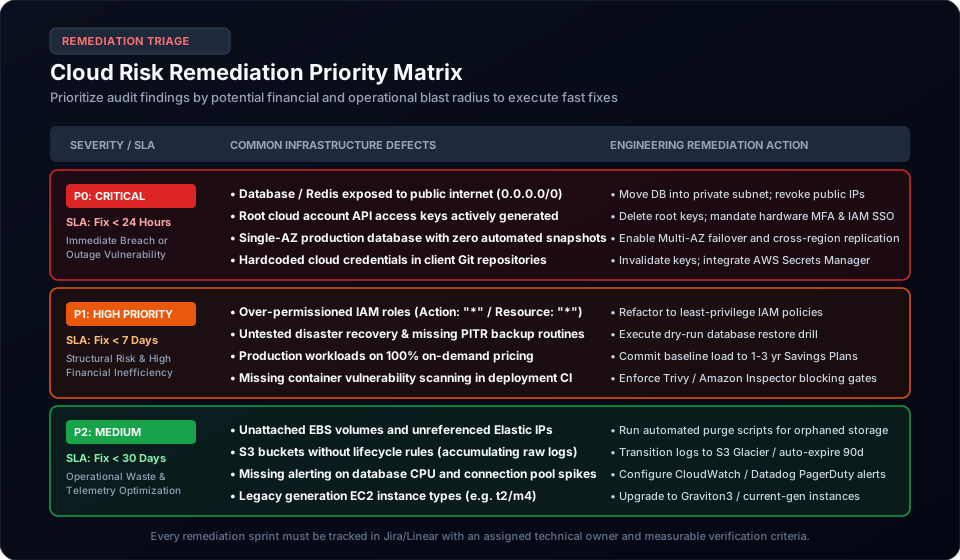
| Severity | SLA Target | Defect Examples | Remediation Action |
|---|---|---|---|
| P0: Critical | < 24 Hours | Database publicly accessible on port 5432; root API keys generated; production DB in single AZ without automated backups; hardcoded secrets in Git. | Move DB into private subnet immediately; revoke and rotate root keys; enable Multi-AZ failover; migrate secrets to AWS Secrets Manager. |
| P1: High Priority | < 7 Days | Wildcard IAM policies; untested disaster recovery; production compute on 100% on-demand pricing; missing container security scanning in CI. | Refactor to least-privilege IAM roles; execute snapshot restoration drill; commit baseline load to Savings Plans; add Trivy scanner to pipeline. |
| P2: Medium | < 30 Days | Unattached EBS volumes; S3 buckets lacking lifecycle rules; legacy instance types (e.g., t2.medium); missing CloudWatch alerts on memory spikes. | Run automated disk cleanup scripts; configure S3 Glacier lifecycle transitions; upgrade instances to Graviton; set up Datadog alerts. |
Primary Architecture & Security Standards
- Amazon Web Services. AWS Well-Architected Framework: Reliability, Security, Cost Optimization Pillars (2025/2026 Edition).
- Google Cloud Platform. Google Cloud Architecture Framework: System Design, Operational Excellence, and Security.
- Center for Internet Security (CIS). CIS Amazon Web Services / Google Cloud Benchmarks v3.0 (Rigid baseline hardening specifications).
- Beyer, Betsy; Jones, Chris; Petoff, Jennifer; Murphy, Niall Richard. Site Reliability Engineering: How Google Runs Production Systems. O'Reilly Media.
Uncover Hidden Risks in Your Cloud Architecture
Ramaaya Technologies delivers comprehensive cloud assessments, DevOps modernization, and cloud FinOps optimization for scaling businesses and enterprise systems.