
The Hidden Economics: The SaaS Per-Seat Licensing Tax
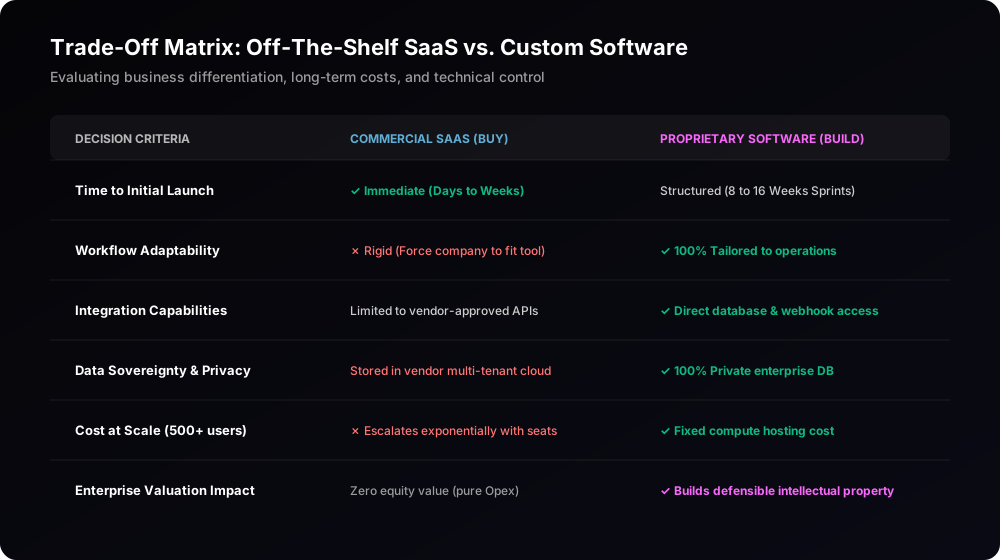
SaaS platforms pitch zero upfront capital expenditure and instant onboarding. For a 10-person startup, paying \$60 per user per month for a specialized CRM or ERP tool is economically rational: \$600/month is far cheaper than funding an internal engineering squad.
However, the SaaS pricing model is inherently exponential. As an organization scales from 25 to 250 employees:
- Monthly per-seat fees multiply across every department (Sales CRM, Ticketing, ERP, Inventory, Billing).
- Vendors aggressively push clients into "Enterprise" tiers to unlock basic requirements like Single Sign-On (SAML/SSO), audit logs, and API rate limits—frequently tripling per-seat costs.
- A company with 150 operational staff often spends \$350,000 to \$700,000 annually across 8 disconnected SaaS tools. Over a 5-year period, this represents \$2.5M+ in purely operational expense (OpEx) with zero equity or balance sheet asset value.
The TCO Inflection Curve: When Custom Software Becomes Cheaper
Total Cost of Ownership (TCO) reveals the mathematical reality that SaaS sales executives never mention: while custom software requires higher upfront development capital, its ongoing operational cost is flat (cloud infrastructure + maintenance). SaaS, by contrast, escalates linearly or exponentially as headcounts expand.
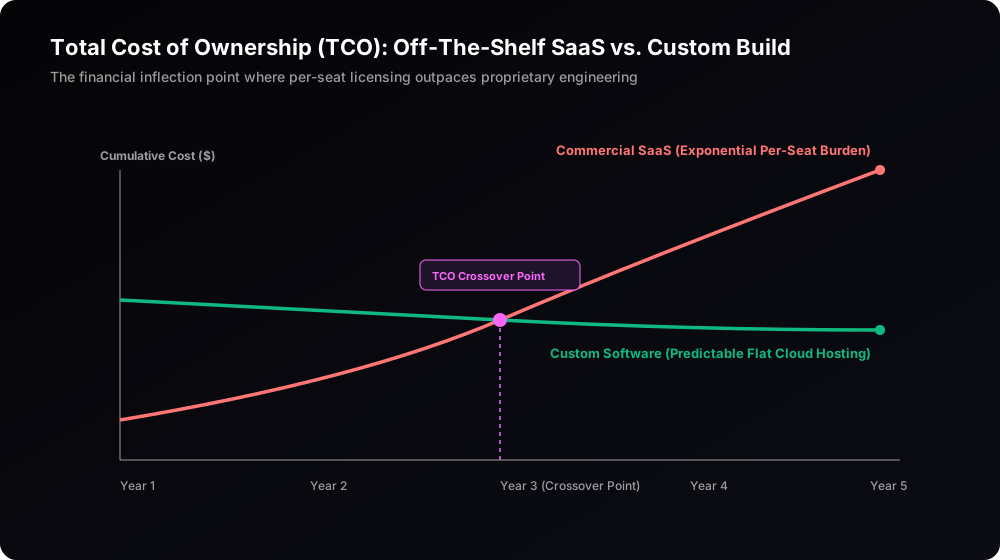
In mid-market operations engineered by Ramaaya's Software Engineering team, the TCO crossover point consistently lands between Month 20 and Month 26:
- Months 1–6: Custom software involves design, architecture, and engineering investment (\$150k–\$300k). SaaS appears cheaper upfront.
- Months 12–24: SaaS subscription fees accumulate, alongside hidden integration costs (Zapier/Make plans, third-party consultants, API maintenance). The custom platform reaches stable operations.
- Months 24–60: The custom platform's marginal user cost drops to near-zero (standard cloud database compute). SaaS costs continue their relentless compounding, resulting in massive long-term financial savings for the custom software owner.
The Competitive Advantage Dilemma: Core vs Non-Core Systems
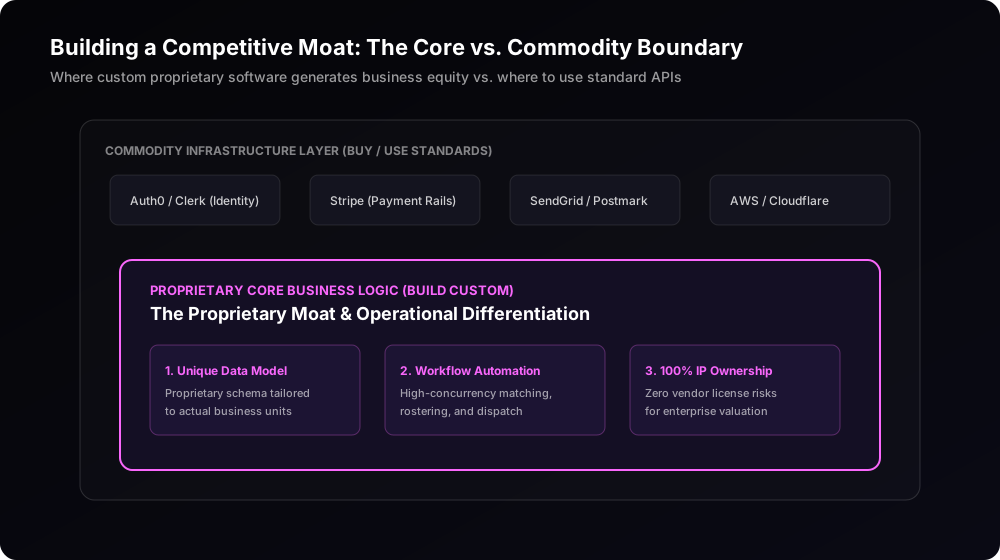
Financial efficiency is compelling, but the strategic imperative is even more decisive: Commodity software produces commodity business operations.
When you adopt an off-the-shelf platform for your primary operational workflow, you inherit the exact workflow assumptions, constraints, and data models designed for your average competitor. If your unique value proposition lies in a specialized logistics dispatch algorithm, a custom pricing structure, or a proprietary multi-tier quality inspection cycle, forcing your staff into rigid SaaS dropdowns actively destroys your operational advantage.
When You Should BUY (Commodity Workflows)
Standard Corporate Back-Office Functions: General ledger accounting, payroll processing, office email, and standard developer code hosting (e.g., Quickbooks, Gusto, Google Workspace, GitHub). These processes have zero differentiation; building custom software here wastes capital.
When You Should BUILD (Competitive Engines)
Core Revenue & Operational Differentiation: Proprietary quoting engines, specialized manufacturing dispatch, dynamic logistics routing, and customer-facing member portals. Building custom software here secures trade secrets and erects an uncopyable operational barrier to entry.
The SaaS Sprawl Tax: Why "Integration" Isn't Free
Many leadership teams attempt to avoid building custom software by purchasing 12 separate best-of-breed SaaS tools and stitching them together with webhook automation tools. This strategy leads to Integration Fatigue:
- Brittle Webhook Chains: A customer record created in Tool A syncs to Tool B via Zapier, which triggers an update in Tool C. When Tool B quietly changes an API parameter in an update, the sync silently breaks, resulting in corrupted customer data.
- Split Brain & Data Synchronization Lag: Different departments look at different versions of the truth. Sales sees customer status in Salesforce, support sees another status in Zendesk, and finance sees something else in Stripe.
- Security & Compliance Surface: Every third-party SaaS tool holding customer data is a potential SOC2/GDPR compliance risk and attack vector. Maintaining auditing logs across 15 vendors requires massive administrative overhead.
To understand how organizations break free from fragile spreadsheet and SaaS patchwork, see our technical breakdown: Replace Spreadsheets With Custom Business Software: When Excel Stops Scaling.
Data Sovereignty & Vendor Lock-In
When you rely entirely on commercial SaaS, your most valuable organizational asset—your historical operational data—is stored in a vendor's proprietary schema. If the vendor doubles their price, suffers catastrophic downtime, or deprecates a critical feature, your leverage is nonexistent. Exporting complex relational schemas out of proprietary SaaS systems is notoriously difficult and often deliberately obstructed.
With custom software engineered on modern, open architectures (PostgreSQL, Docker, Node.js, Go, Python), you own 100% of the code, data schemas, and infrastructure. Your database runs in your own AWS, Azure, or GCP virtual private cloud. You can extend, refactor, or integrate with new AI models whenever your business strategy demands.
The Ramaaya Perspective: Custom Software as an Equity Asset
Software is not merely an operational cost center; when built correctly, it is an enterprise valuation multiplier. During M&A due diligence, acquirers assign significantly higher multiples to businesses that run on proprietary software platforms with defensible IP, compared to companies that merely rent off-the-shelf subscriptions and maintain disconnected spreadsheets.
To review our complete scoring matrix for technology procurement, read our companion framework: Build vs Buy: A Technology Decision Framework for Growing Businesses, or explore our engineering capabilities under Custom Software Engineering Services.