
The Flaw in Dogmatic Approaches
Most technology procurement failures occur because leadership teams adopt extreme ideologies:
- The "Buy-Everything" Trap: Driven by CFOs attempting to minimize upfront CapEx, the organization purchases best-of-breed SaaS for every department. Within two years, operations are bogged down by 30 disparate tools, data silos, \$400k in annual license overhead, and massive productivity loss as employees toggle between tabs.
- The "Build-Everything" Syndrome: Driven by engineering purists who suffer from "Not Invented Here" syndrome. The engineering team spends 18 months building bespoke auth servers, notification delivery systems, and PDF report renderers—wasting runway on non-differentiating plumbing while competitors out-execute them in market.
A mature technology roadmap navigates between these extremes using objective metrics rather than gut instinct.
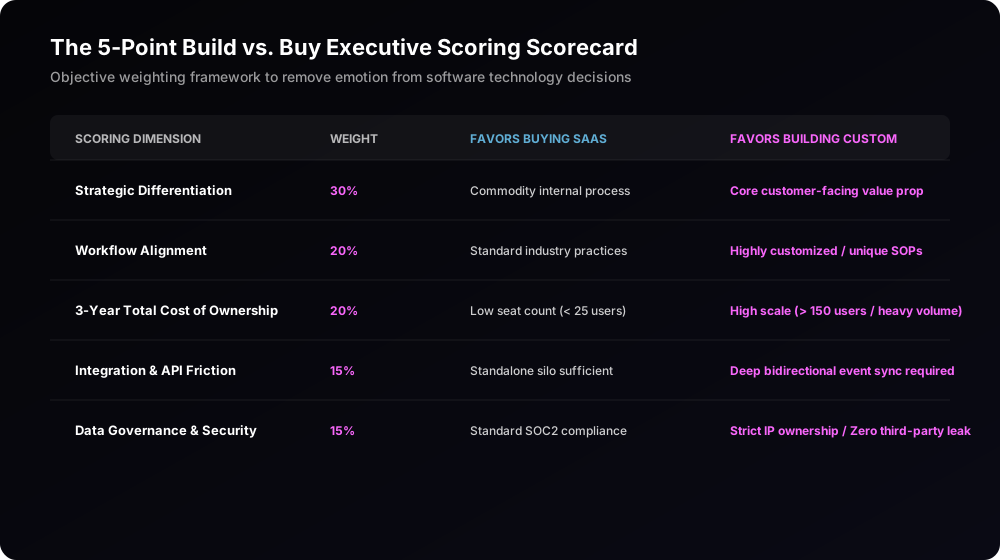
The 6-Dimensional Build vs Buy Scoring Model
When Ramaaya's IT Consulting practice advises growing mid-market enterprises, we evaluate potential software initiatives across six weighted dimensions (scored 1 to 5):
1. Strategic Alignment & Core Differentiation (Weight: 25%)
Does this software directly generate customer revenue or create a defensible competitive moat?
- Score 1–2 (Commodity Back-Office): Standard accounting, payroll, corporate email, office documentation. Action: BUY.
- Score 4–5 (Core Differentiation): Proprietary risk underwriting engine, custom field logistics scheduling, dynamic pricing algorithm. Action: BUILD.
2. Process Mismatch & Workflow Friction (Weight: 20%)
How closely does off-the-shelf software match your actual operational workflow?
We apply the 80/20 Rule of SaaS Customization: If commercial software satisfies 85%+ of your workflow without requiring extensive custom development or workarounds, buy it. However, if standard software requires your operations team to bend their workflows into unnatural shapes, or requires 20 custom Zapier webhooks to function, the "process mismatch" tax will destroy productivity. Build custom software instead.
3. 5-Year Total Cost of Ownership (Weight: 20%)
Compare all-inclusive financial models over a 60-month horizon:
- Bespoke Software TCO: Initial scoping and development + cloud hosting (PostgreSQL, compute) + annual maintenance (typically 15–18% of initial build cost).
- Commercial SaaS TCO: Baseline subscription fees + projected per-seat expansion + tier upgrade costs + premium API access fees + third-party integration maintenance.
As detailed in our economic study on Custom Software vs SaaS: When Should a Business Build Its Own System?, growing workforces encounter a clear financial crossover between Months 20 and 26.
4. Integration Overhead & Data Lock-In (Weight: 15%)
Evaluate how easily the proposed platform communicates with your existing system of record. Off-the-shelf tools frequently restrict API rate limits, charge extra for webhooks, or store relational data in proprietary structures that make real-time reporting impossible. If you need unified, sub-second reporting across ERP, CRM, and inventory, unified custom software is vastly superior.
5. Speed-to-Value & Opportunity Cost (Weight: 10%)
Can you afford to wait 4–6 months for a custom platform to be engineered, or is your business suffering immediate revenue loss that requires a solution live in 7 days? In urgent tactical scenarios, buying an imperfect SaaS tool to validate a market hypothesis is rational—provided leadership defines a clear migration roadmap before technical debt calcifies.
6. Intellectual Property & Valuation Moat (Weight: 10%)
In private equity or strategic acquisition transactions, businesses operating on bespoke software platforms with proprietary intellectual property receive higher enterprise EBITDA multiples than businesses running entirely on rented software licenses.
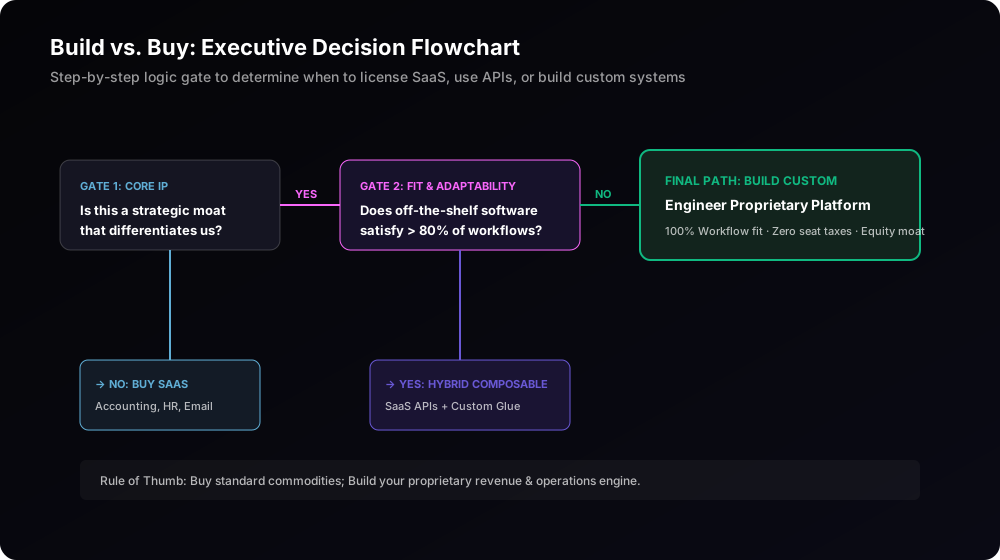
The Modern Architecture Paradigm: Composable & Hybrid
In modern enterprise engineering, the smartest technology leaders do not build monoliths from scratch, nor do they surrender control to all-in-one SaaS megaliths. They engineer Hybrid, Composable Architectures.
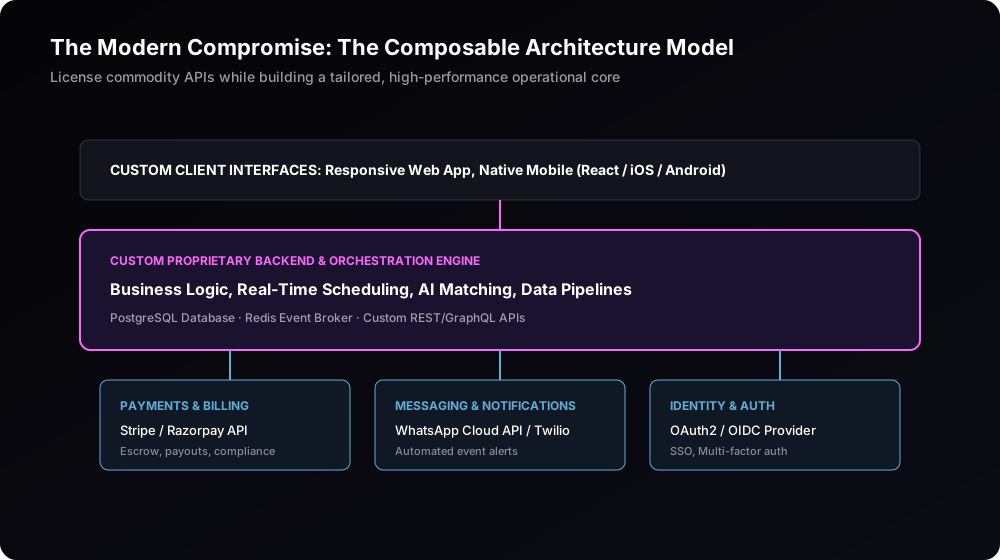
Under a composable approach engineered by Ramaaya's Software Engineering team:
- You BUY Commodity Primitives: You do not build a payment processing gateway; you use Stripe. You do not build transactional SMS infrastructure; you invoke Twilio. You do not maintain physical servers; you leverage AWS or Google Cloud.
- You BUILD the Proprietary Operational Engine: You build the bespoke business logic, database relationships, workflow routing, and specialized AI automation that coordinates those primitives into your company's proprietary service offering.
Executive Governance: Conducting a Technology Audit
If your leadership team is currently evaluating an ERP replacement, a CRM migration, or a custom internal portal, we recommend executing a 3-week Discovery & Scoring Audit:
- Document Shadow IT & Workarounds: Catalog where employees are currently using Google Sheets, Excel macros, or personal messaging tools to bypass rigid commercial SaaS platforms. These friction points reveal your true operational requirements. (See our guide: Replace Spreadsheets With Custom Business Software: When Excel Stops Scaling).
- Calculate 5-Year True License Expense: Aggregate every per-seat license, third-party connector subscription, and consultant billing rate across all business units.
- Score Against the 6-Dimensional Matrix: Apply Ramaaya's scoring rubric with cross-departmental stakeholders (Operations, Finance, and Engineering). If total weighted score > 3.6, building a custom platform is your highest-ROI decision.
The Ramaaya Perspective: Architecture Dictates Destiny
Every software decision is a long-term organizational commitment. By replacing emotional preferences with rigorous, data-driven scoring frameworks, executives ensure their capital builds defensible competitive moats rather than subsidizing vendor margins.
To learn how custom software platforms integrate with autonomous intelligence workflows, explore our deep dive on AI Agents vs Chatbots: What Businesses Actually Need, or connect with our advisors under IT Consulting & Advisory Services.