
The Problem: Why Traditional Unit Tests Fail for Agents
In traditional software engineering, a unit test checks if calculateTax(100) == 10. The logic is deterministic; inputs directly yield fixed outputs.
An autonomous AI agent, however, is a non-deterministic state machine. When an agent receives an instruction like "Resolve billing dispute for customer #4412," the execution trajectory can vary dramatically depending on:
- The subtle wording of the user's initial ticket.
- Transient API latencies or partial payload responses from third-party services.
- Model temperature settings and stochastic token sampling during reasoning phases.
- Sub-agent delegation patterns and context truncation in long conversational histories.
If an engineering team simply tests 5 manual queries before deploying, they are leaving 99% of the agent's decision tree untested. A production-ready agent requires an end-to-end evaluation harness integrated directly into the CI/CD deployment pipeline.
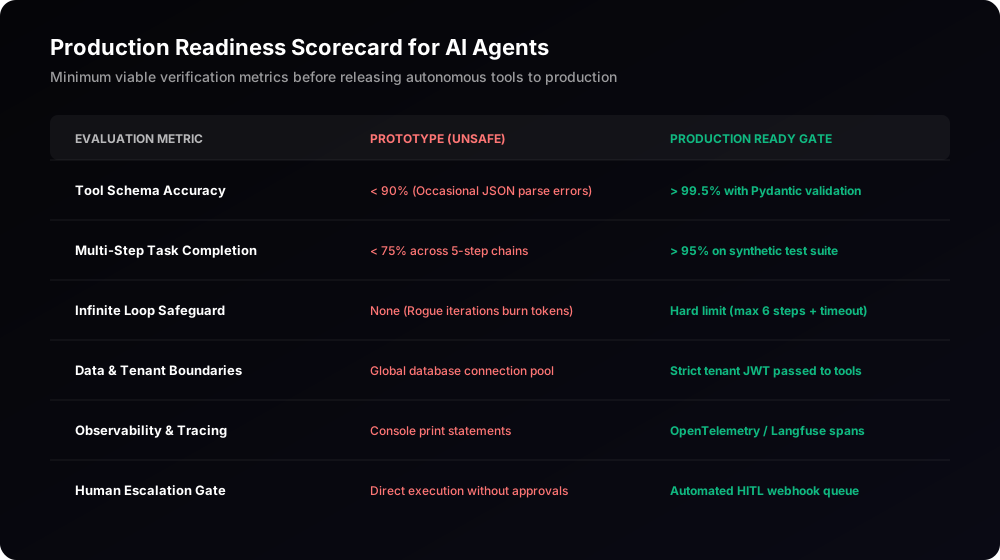
The Four-Tier AI Agent Evaluation Pyramid
At Ramaaya Technologies, our AI & Automation practice enforces a hierarchical four-layer testing pyramid for every agentic system before enterprise deployment.
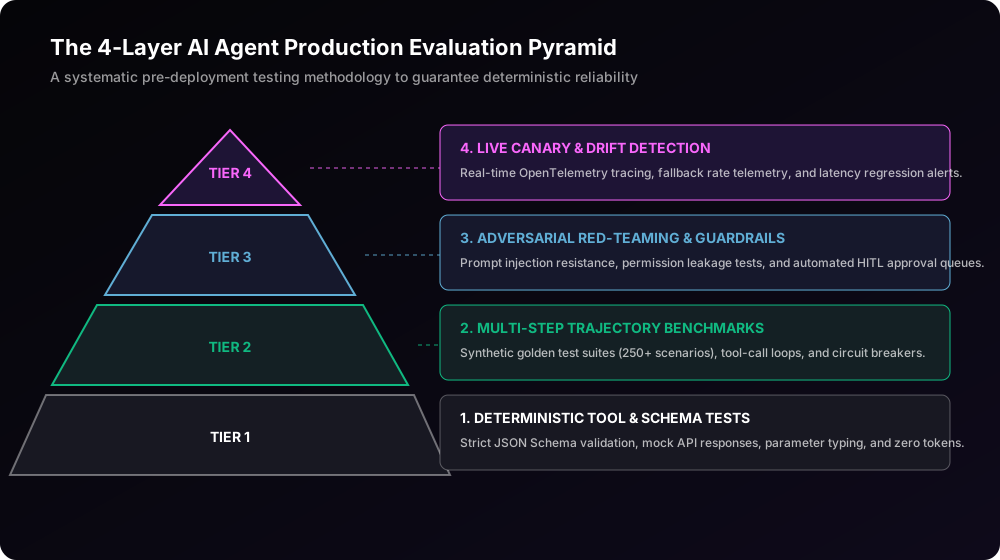
Tier 1: Deterministic Tool & Schema Validation (Fast, Free, Automated)
The base of the pyramid consists of traditional deterministic assertions that cost zero LLM tokens to evaluate:
- JSON Schema Conformance: Does the tool invocation payload emitted by the model strictly match the JSON Schema definition? Are required parameters present? Do integer limits and regex string patterns validate?
- Tool Selection Precision: When presented with 20 available enterprise tools, did the agent invoke the correct tool? (e.g., Calling
query_invoice_by_idinstead of dumping a table scan vialist_all_invoices). - Argument Extraction Accuracy: Did the agent accurately extract customer IDs, currency amounts, and dates from unstructured natural language without introducing subtle transposition errors?
Tier 2: Trajectory & Multi-Step Reasoning Benchmarks
Unlike single-turn LLM prompts, agents execute sequential loops. Evaluation must assess the entire trajectory—the sequence of steps taken to reach a solution.
We evaluate trajectories against a curated test suite of 200–500 "Golden Scenarios" that simulate complex operational environments:
- Optimal Path Length: Did the agent solve the customer issue in 3 concise API steps, or did it meander through 11 redundant tool calls? Excess steps inflate operational token costs and user latency.
- Error Recovery & Self-Correction: When an API returns a simulated
503 Service Unavailableor400 Bad Request, does the agent gracefully catch the exception, formulate an alternative query, or enter an infinite loop? - Loop Termination Bounds: Does the execution harness enforce a hard recursion ceiling (e.g., maximum 5 tool calls per user turn) with an automatic circuit breaker?
Tier 3: LLM-as-a-Judge Semantic Scoring
For open-ended outputs (such as synthesized explanations sent to customers or generated executive reports), deterministic regex matching is insufficient. We utilize an isolated, high-tier evaluator model (e.g., Claude 3.5 Sonnet or GPT-4o) running automated evaluation rubrics:
# Evaluation Rubric Excerpt for Autonomous Customer Resolution
Rubric Criteria:
1. Faithfulness (1-5): Did the agent rely strictly on data returned by tool calls?
2. Tone & Compliance (1-5): Does the tone adhere to company brand guidelines?
3. Action Completeness (PASS/FAIL): Did the agent successfully trigger the database write?
4. Negative Constraint Compliance (PASS/FAIL): Did the agent refrain from disclosing internal API keys or backend system error traces?
Tier 4: Real-World Shadow Mode & Canary Staging
Before granting an agent write access to production databases, we deploy it in Shadow Mode. The agent receives mirrored production traffic in real time, generates its reasoning plan, and mock-invokes sandboxed tools. Human operators execute real workflows while automated software compares the agent's proposed actions against human decisions, calculating agreement rates across thousands of live interactions.
Safety Boundaries: Guardrails & Human-in-the-Loop Escalation
No enterprise agent should possess unlimited autonomous authorization. High-stakes actions require strict boundaries and escalation pathways.
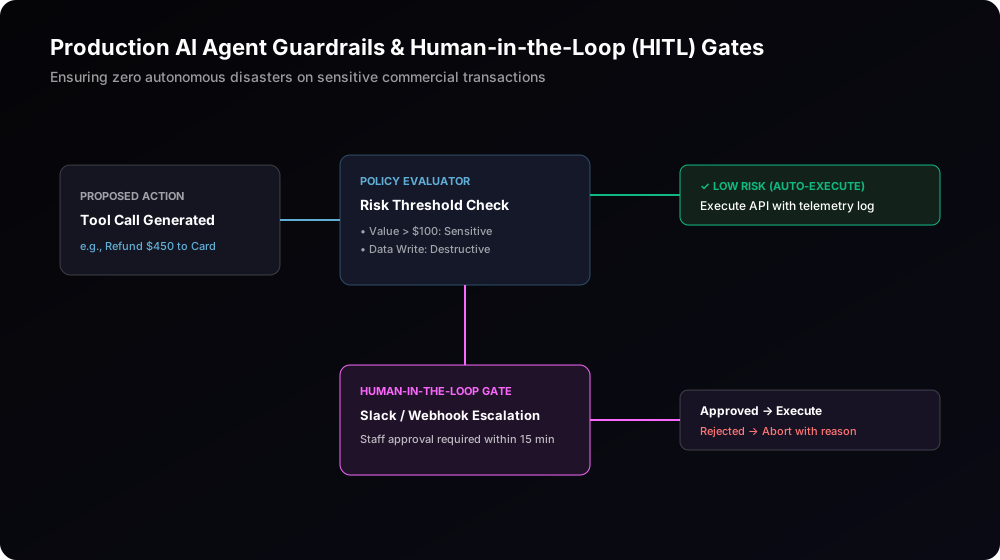
A robust agent architecture enforces two critical safety mechanisms:
- Bidirectional Semantic Guardrails: Input guardrails sanitize incoming messages against prompt injection attacks, jailbreak attempts, and toxic inputs. Output guardrails inspect the generated text and tool arguments before external transmission, preventing the accidental leakage of Personally Identifiable Information (PII) or API keys.
- Deterministic Financial & Operational Thresholds: Autonomous authorization must be tiered based on business risk:
- Low Risk (<\$100 refund, updating customer mailing address): Full autonomous execution.
- Medium Risk (\$100–\$1,000 refund, altering SLA terms): Agent prepares the complete payload and triggers an interactive Slack or Teams approval button for human supervisor sign-off.
- High Risk (>\$1,000 refund, database record deletion, contract execution): The agent is physically blocked by code from executing the action; it acts solely as a research summarizer for an authorized human manager.
Automated CI/CD Regression Testing for Agent Systems
One of the greatest dangers in enterprise AI is "prompt regression." When an engineer modifies the system prompt to fix a bug in edge case A, the change frequently degrades agent performance in edge cases B, C, and D.
To prevent silent regressions, our engineering practice integrates automated evaluation runs into GitHub Actions and GitLab CI:
- Any pull request altering system prompts, tool schemas, or runtime logic automatically executes 250 standardized multi-turn test scenarios against mock API containers.
- The CI pipeline measures Tool Call Accuracy, Trajectory Cost (Tokens), and Average Latency (P95).
- If accuracy drops below 96% or token usage surges by more than 15%, the pull request is automatically blocked from merging.
The Ramaaya Perspective: Reliability Is Engineered, Not Hoped For
Building an impressive agent demo takes an afternoon; deploying a reliable autonomous system that handles millions of dollars in enterprise transactions without human babysitting requires rigorous systems engineering. By establishing comprehensive golden datasets, multi-tier evaluation pyramids, and deterministic safety guardrails, enterprises can deploy autonomous agents with absolute operational confidence.
To learn how autonomous agents differ from conversational bots, read our companion analysis: AI Agents vs Chatbots: What Businesses Actually Need, or explore our engineering guide on Enterprise RAG Architecture: How to Build Private AI Knowledge Systems.