
Who This Architecture Guide Is For
This analysis is written for Chief Technology Officers, engineering directors, and founding architects at growing B2B and consumer SaaS companies. If your platform is experiencing growing pains—whether deployment queue bottlenecks, database load spikes, or team coordination friction—and your team is debating whether to break apart the existing codebase into microservices, this guide provides the systems-level trade-offs required to make the right decision.
The Problem: The Premature Microservices Trap
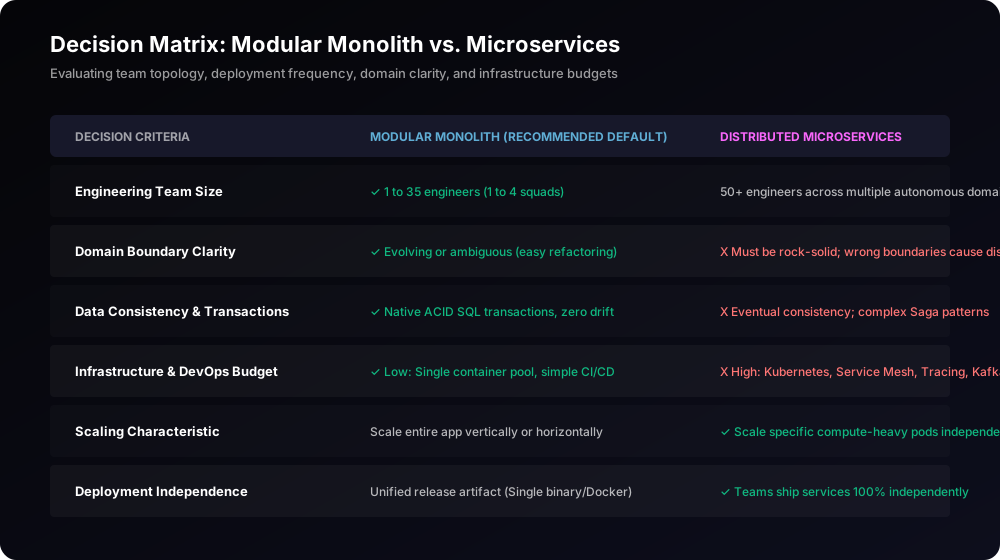
Microservices solve an organizational scaling problem, not primarily a performance or computational problem. At organizations like Netflix, Uber, or Amazon, thousands of engineers cannot deploy safely into a single repository without constant merge conflicts, blocked release trains, and organizational gridlock. Splitting systems into hundreds of independent services allows 150 separate squads to ship code autonomously.
However, when a 15-person engineering team adopts microservices to build a product with 10,000 active users, they do not get Netflix-level agility. Instead, they incur the full complexity of distributed systems:
- Network Latency Cascades: What was once an in-memory function call completing in 0.2 microseconds becomes an HTTP or gRPC network hop taking 15 to 45 milliseconds, compounding across nested service dependencies.
- Loss of ACID Database Guarantees: Without a shared relational database, developers must abandon atomic SQL transactions and implement complex distributed Saga patterns or eventual consistency compensation logic.
- DevOps Tax & Overhead SURGE: The team spends 40% of its engineering capacity maintaining Kubernetes clusters, Istio service meshes, Kafka brokers, distributed tracing backends, and container registries instead of shipping customer features.
Deconstructing the Two Topologies
1. What Is a True Monolith? (And Why Most People Misunderstand It)
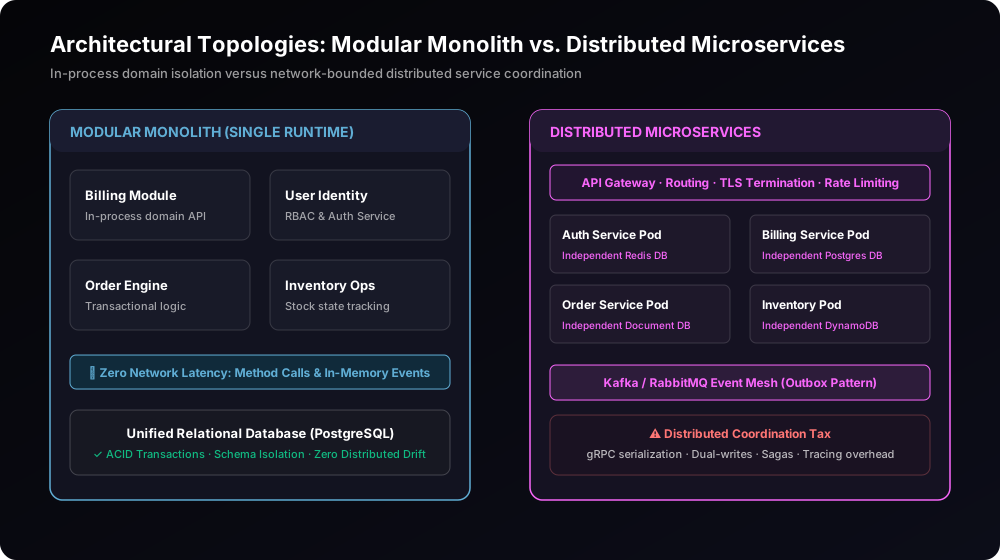
A monolith is simply an application deployed as a single runtime unit (one executable, container, or server process). Crucially, a monolith does not mean "spaghetti code."
The gold standard of monolith design is the Modular Monolith. In a modular monolith, domain boundaries are strictly enforced by software architecture and compiler rules:
- Code is partitioned into discrete domain packages (e.g.,
Billing,Auth,Inventory,Reporting). - Modules communicate exclusively through clearly typed public interfaces or in-memory domain events. Direct database queries across domain table boundaries are forbidden by static analysis linters (e.g., ArchUnit, Packwerk).
- Data resides in a unified PostgreSQL database, but tables are grouped into isolated schemas or namespaced models.
Because the code runs within a single process memory space, function calls take nanoseconds, data consistency is guaranteed by native database transactions, and running the entire platform locally requires just one command: docker compose up.
2. What Are Microservices?
In a microservices architecture, the application is decomposed into multiple autonomous services. Each service:
- Runs in its own independent process and container pod.
- Owns its private data store (Database-per-Service pattern). Service A cannot query Service B's database directly under any circumstance.
- Communicates across physical network boundaries via synchronous APIs (REST, gRPC) or asynchronous message queues (Kafka, RabbitMQ, AWS SQS).
- Has an independent CI/CD pipeline and release lifecycle.
The Hidden Operational Tax of Microservices
Before adopting microservices, technical leaders must account for the distributed systems tax that comes bundled with network boundaries:

A. The Dual-Write & Distributed Transaction Nightmare
Consider a standard checkout workflow: Charge customer credit card → Decrement warehouse inventory → Record order state → Send confirmation email.
In a modular monolith, this is a 6-line database transaction:
BEGIN TRANSACTION;
  INSERT INTO orders (id, user_id, amount) VALUES (...);
  UPDATE inventory SET stock = stock - 1 WHERE sku = ...;
  INSERT INTO outbox_events (type, payload) VALUES ('order.created', ...);
COMMIT;
If the server loses power or a constraint fails, the database rolls back atomically. Zero inconsistent state.
In a microservices architecture, each step touches a different service with its own database. If the payment service succeeds but the inventory service times out or throws an error, you have a partial write. Resolving this requires implementing an asynchronous Saga Orchestrator with compensation endpoints, distributed idempotent deduplication, and outbox event tables. What took 15 minutes to code in a monolith now takes 3 weeks of distributed consensus engineering.
B. Latency Amplification (The P99 Problem)
In a monolith, 10 sequential method calls take less than 1 millisecond total. In microservices, 10 sequential network calls across container pods—each subject to TCP handshakes, TLS termination, DNS resolution, and JSON serialization—can easily consume 200–400ms. If even one downstream dependency experiences transient thread pool congestion, your 99th percentile (P99) user latency degrades catastrophically.
C. Developer Velocity & Local Environment Complexity
With a modular monolith, a new engineer clones the git repo, runs one setup script, and has a fully functional local development environment with instant hot-reloading and unified debugging.
With 20 microservices, running the full system locally requires 32GB of RAM, complex Helm charts, mocked services, or cloud staging proxies (Telepresence). Engineers spend hours debugging why Service 14 cannot talk to Service 7 in their local Docker environment instead of writing product features.
When Microservices Actually Make Sense
Despite the operational cost, microservices are not a mistake when the right conditions are met. Ramaaya's Software Engineering team recommends extracting microservices in specific architectural scenarios:
- Divergent Scaling Profiles: When 95% of your platform is lightweight CRUD operations, but 5% involves CPU-heavy video encoding, AI vector generation, or real-time document OCR. Extracting that single compute-heavy capability into an isolated microservice allows you to scale GPU/CPU worker pods independently without paying to scale the entire web tier.
- Organizational Scaling (Conway's Law): When your engineering team expands beyond 50–60 engineers and multiple autonomous squads need to deploy independently without coordinate meetings or release train lockouts.
- Different Technology Runtimes: When a specialized component requires a completely different tech stack (e.g., Python for PyTorch machine learning inference, Go for high-throughput WebSocket routing, and TypeScript for the primary SaaS business logic).
The Pragmatic Middle Ground: Start Monolithic, Extract by Need
The most successful software platforms in the world—including Shopify, GitHub, Basecamp, and Stripe—operate on massive modular monoliths that handle tens of billions of requests daily.
At Ramaaya Technologies, our recommended architectural roadmap for growing SaaS businesses is straightforward:
Phase 1: Build the Modular Monolith
Build your SaaS as a single deployment artifact with clean, decoupled domain packages. Leverage PostgreSQL schemas, in-memory domain events, and background worker queues (Redis / Sidekiq / BullMQ).
Phase 2: Carve Out Asymmetrical Spikes
When a specific capability encounters distinct operational demands (e.g., real-time WebSocket messaging or heavy AI processing), extract only that specific capability into an external service while keeping 90% of your business logic inside the modular monolith.
When NOT to Choose Microservices
Do NOT transition to microservices if:
- Your engineering organization has fewer than 25 full-time backend developers.
- Your business model or product-market fit is still evolving. Refactoring domain boundaries across a monolith takes hours; refactoring boundaries across 15 databases and API contracts takes weeks.
- You cannot point to a specific, measured bottleneck that cannot be resolved with database indexing, read replicas, or background job queues.
- Your team does not already have mature automated CI/CD, distributed tracing, and dedicated platform/DevOps engineers.
The Ramaaya Perspective: Architecture Serves Business Velocity
Great software architecture is not about using the newest buzzword; it is about maximizing shipping velocity while minimizing operational fragility. For 90% of scaling SaaS businesses, the Modular Monolith is not a legacy compromise—it is a competitive super-weapon that lets small engineering teams out-build bloated enterprises.
To learn how multi-tenant database isolation models integrate with scalable architectures, read our deep dive on B2B SaaS Multi-Tenant Architecture: A Practical Engineering Guide, or explore our economic analysis on Custom Software vs SaaS: When Should a Business Build Its Own System?.