
The Conceptual Analogy: Open-Book Exam vs Medical School Residency
The cleanest mental model for distinguishing RAG from Fine-Tuning is the academic exam analogy:
- Retrieval-Augmented Generation (RAG) is an Open-Book Exam: The student (the foundation LLM) possesses strong general reasoning capabilities. During the exam, the student has access to an up-to-date filing cabinet containing thousands of reference manuals. When a specific question arises, the student retrieves the exact three relevant pages, reads them, synthesizes the answer, and cites the page numbers. If the company updates a policy tomorrow, you simply swap the page in the filing cabinet without retraining the student.
- Fine-Tuning is Medical School Residency: You are not merely handing the student a textbook; you are fundamentally altering how the student thinks, speaks, and formats their clinical notes. The student absorbs medical terminology, diagnostic cadence, and specialized shorthand through thousands of repetitions. However, if pharmaceutical pricing changes next week, the doctor cannot reliably update that single memory without risking confusion or hallucination.
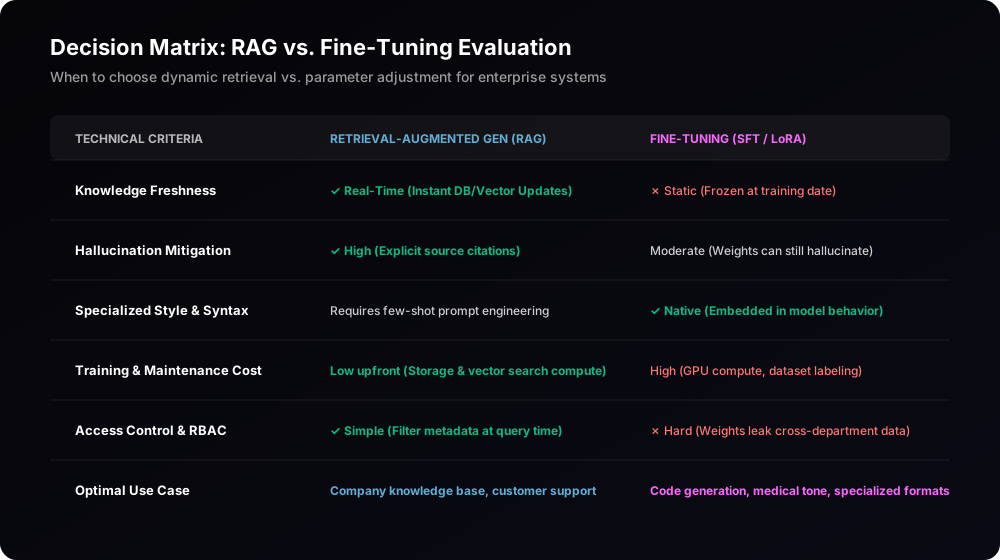
Detailed Architectural Breakdown
Understanding where each technology succeeds requires examining what happens at the mathematical and data layer during inference.
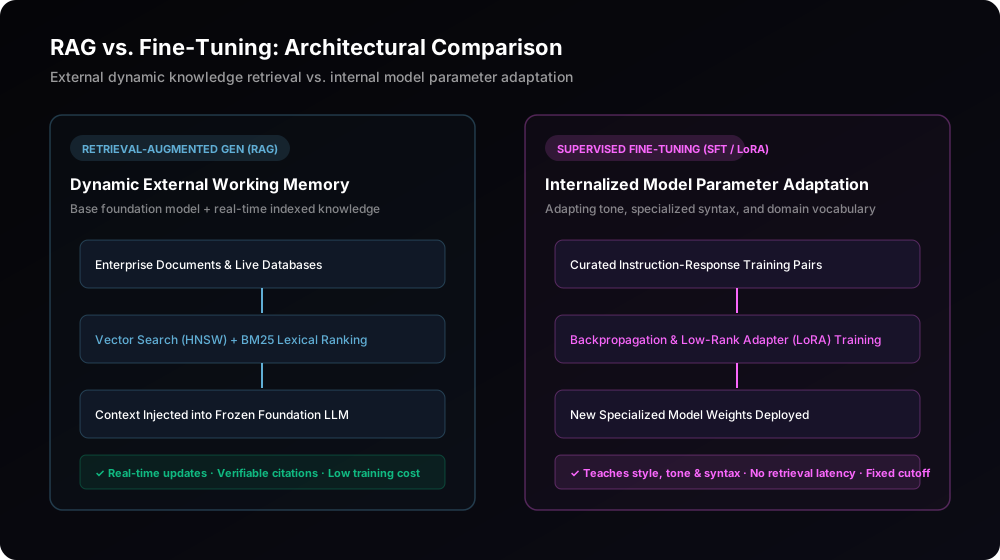
How RAG Handles Enterprise Knowledge
In RAG, model weights remain completely frozen. Proprietary enterprise documents (PDFs, Confluence pages, ERP rows, email threads) are ingested, parsed into semantically coherent chunks, converted into dense vectors via an embedding model (e.g., text-embedding-3-large or bge-large-en-v1.5), and indexed in a vector store like pgvector, Qdrant, or Pinecone.
When an enterprise user submits a prompt:
- The query is embedded and matched against the vector database using hybrid dense-sparse search (HNSW cosine similarity + BM25 keyword matching).
- A cross-encoder re-ranker evaluates top candidates and selects the 3–5 most contextually relevant chunks.
- These validated chunks are injected into the LLM context window alongside a grounded system prompt: "Answer using ONLY the provided documentation. Cite chunk IDs."
Key Advantage: Instant knowledge freshness. If an employee updates a customer service policy at 9:00 AM, the new vector is committed at 9:01 AM, and all subsequent queries reflect the update immediately with zero GPU training costs.
How Fine-Tuning Adapts Model Weights
Fine-tuning adjusts the internal neural weights of an existing foundation model using supervised instruction pairs (Input prompt → Ground truth response). Rather than retraining billions of base weights from scratch, modern enterprise teams use Parameter-Efficient Fine-Tuning (PEFT), primarily Low-Rank Adaptation (LoRA) or Quantized LoRA (QLoRA).
In LoRA, the base model weights (\(W_0\)) are frozen, and low-rank decomposition matrices (\(A\) and \(B\)) are trained alongside specific transformer attention layers:
W = W_0 + \Delta W = W_0 + \frac{\alpha}{r} (B \times A)Where rank \(r \ll d\) (typically \(r = 8, 16, \text{or } 32\)). This reduces trainable parameters by over 99%, allowing an organization to fine-tune a 14B or 70B parameter model on a single multi-GPU node.
Key Advantage: Deep stylistic and structural mastery. A fine-tuned model flawlessly generates proprietary JSON formats, custom domain programming code (e.g., internal SDKs), and specialized medical or legal dialect with minimal token overhead in the prompt.
The Critical Trade-Offs: When Each Approach Fails
1. Knowledge Dynamism and Expiration
If your business data changes weekly, daily, or hourly—such as inventory quantities, SaaS pricing tiers, or active legal filings—fine-tuning is fundamentally flawed. Re-training models continuously to incorporate new facts is cost-prohibitive and leads to catastrophic forgetting (where newly fine-tuned facts degrade the model's general reasoning abilities). RAG is the only viable architecture for rapidly changing knowledge.
2. Verifiability, Hallucinations, and Legal Compliance
Fine-tuned models store learned information as probabilistic weight distributions. When asked a factual question, the model generates the most statistically probable sequence of tokens. It cannot produce a verified hyperlink, paragraph citation, or cryptographic checksum proving that the statement originated from page 14 of an executive memo.
In heavily regulated industries (healthcare, banking, defense), ungrounded generation is an unacceptable liability. RAG provides deterministic provenance: every answer links to a specific chunk stored in the database, enabling automated hallucination audits and source verification.
3. Role-Based Access Control (RBAC)
In an enterprise, not all employees have clearance to see all information. A junior marketing associate must not query the model and learn executive salary structures or pending acquisitions.
With fine-tuning, once confidential data is baked into the neural weights, it is virtually impossible to restrict access dynamically per user prompt. With RAG, access control is enforced at retrieval time: queries execute with SQL metadata filters (e.g., tenant_id = 'dept_marketing'), preventing unauthorized passages from ever entering the prompt context.
The Production Winning Formula: Hybrid RAG + Fine-Tuning
Sophisticated engineering organizations do not treat RAG and fine-tuning as competing alternatives. They combine them into a resilient, high-efficiency hybrid architecture.
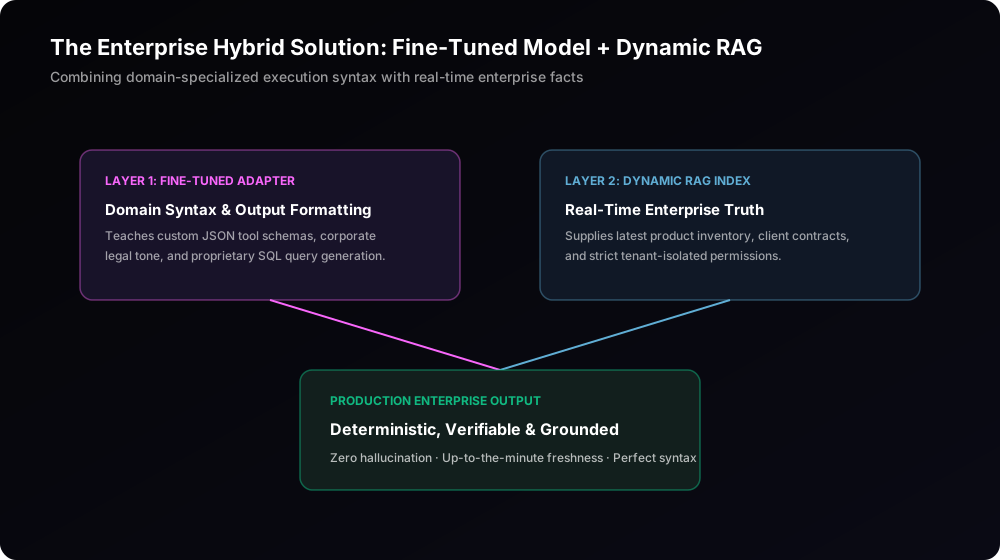
In a hybrid architecture deployed by Ramaaya's AI & Automation team:
- Fine-Tuning creates the Specialist Engine: An open-weights model (such as Llama 3.1 8B or Mistral NeMo 12B) is fine-tuned using LoRA on 5,000 internal engineering examples. The model learns to reliably output our custom JSON schemas, invoke specific API function calls, and follow terse system instructions without verbose conversational fluff.
- RAG provides the Live Enterprise Memory: The fine-tuned model queries our production RAG infrastructure to retrieve dynamic operational facts, live inventory levels, and updated customer tickets.
This hybrid design yields dramatic benefits: inference latency drops by 60% compared to large frontier models; operational API costs decrease by 85%; and the system achieves 99.4% factual compliance with verified source citations.
Executive Decision Framework: How to Choose Today
Before committing engineering resources, use this structured checklist to determine your immediate development priority:
- Start with Production RAG: If your primary requirement is answering questions over internal company documentation, customer support wikis, or legal repositories, build an enterprise RAG pipeline first. For 85% of corporate use cases, advanced RAG with hybrid search and re-ranking solves the problem completely without requiring model fine-tuning. (See our comprehensive guide: Enterprise RAG Architecture: How to Build Private AI Knowledge Systems).
- Add Fine-Tuning Only When:
- Your prompt requires 2,000+ tokens of few-shot formatting examples to coerce the LLM into generating the correct output format.
- You need to distill a complex workflow from a costly \$20/million-token frontier model down to a self-hosted \$0.20/million-token 8B model to slash production unit economics.
- Your domain utilizes highly proprietary technical jargon or mathematical notation that generic foundation models misunderstand.
By treating RAG as your organizational knowledge base and fine-tuning as your operational skillset training, your technology leadership can avoid costly dead-ends and build private AI systems that scale reliably.
To understand how these intelligence models execute autonomous workflows across business systems, read our technical breakdown on AI Agents vs Chatbots: What Businesses Actually Need.