

Why Enterprise AI Projects Stall in "Pilot Purgatory"
Between 2023 and 2025, corporate enthusiasm for Large Language Models sparked hundreds of internal innovation hackathons. Teams successfully connected OpenAI or Anthropic APIs to internal Slack channels, created customer support answer-bots, and built document summarization widgets. Yet, as boards demanded tangible EBITDA contributions, the vast majority of these pilots were quietly mothballed.
Gartner and MIT research reveal three root causes behind the failure to scale:
- Unmeasured Baseline Workflows: Organizations attempt to automate a process without knowing its baseline cost per transaction, manual error rate, or cycle latency. If you cannot measure the pre-AI cost, you cannot prove post-AI ROI.
- Ignoring Fully-Loaded Token & Governance Opex: Demos cost pennies because they process 20 test queries. At enterprise production scale—processing 150,000 multi-page documents monthly with RAG chunking and agent validation loops—token costs, vector database storage, and monitoring tools can exceed \$15,000/month.
- The Missing Action Layer: An AI system that merely outputs conversational text does not complete work. As explored in our analysis of AI Agents Moving From Chat to Action, real economic value only materializes when an agent deterministically executes actions inside enterprise systems of record (ERP, CRM, SQL databases).
The Production Automation Architecture Funnel
To produce verifiable financial returns, modern enterprise AI automation systems do not operate as open-ended chatbots. They operate as structured, multi-stage processing funnels with deterministic boundaries and error safeguards.
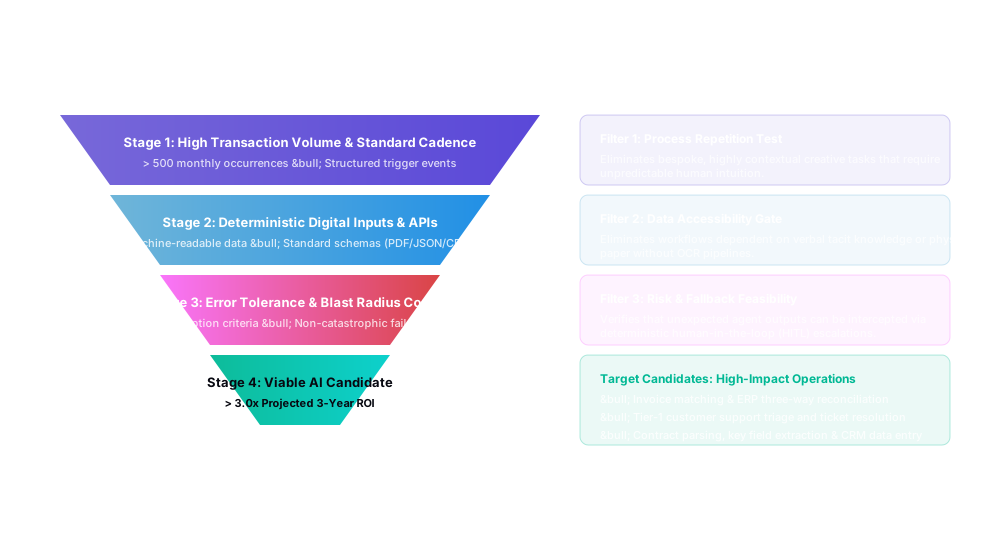
As illustrated in Figure 1, the pipeline consists of four distinct engineering gates:
- Input Normalization & Sanitization: Raw multi-format unstructured payloads (PDF contracts, unstructured emails, vendor invoices) are ingested via secure webhooks, OCR-parsed, and stripped of prompt injection vectors.
- Semantic Classification & Confidence Scoring: A specialized SLM or frontier LLM extracts entity schemas and assigns an explicit confidence coefficient (0.00 – 1.00). If confidence drops below 0.92, execution halts.
- Deterministic API & Tool Calling: Rather than allowing the LLM to improvise actions, validated parameters are dispatched to rigid, type-safe API endpoints (e.g., creating a purchase order via SAP BAPI or updating Stripe invoice statuses).
- Human-in-the-Loop (HITL) Exception Queue: Edge cases and low-confidence predictions route to a dedicated operations dashboard where human analysts resolve discrepancies in seconds, simultaneously generating fine-tuning data to prevent future regressions.
The Comprehensive AI ROI Equation
A defensible business case balances the total economic return against the fully-loaded Total Cost of Ownership (TCO) over a multi-year horizon.
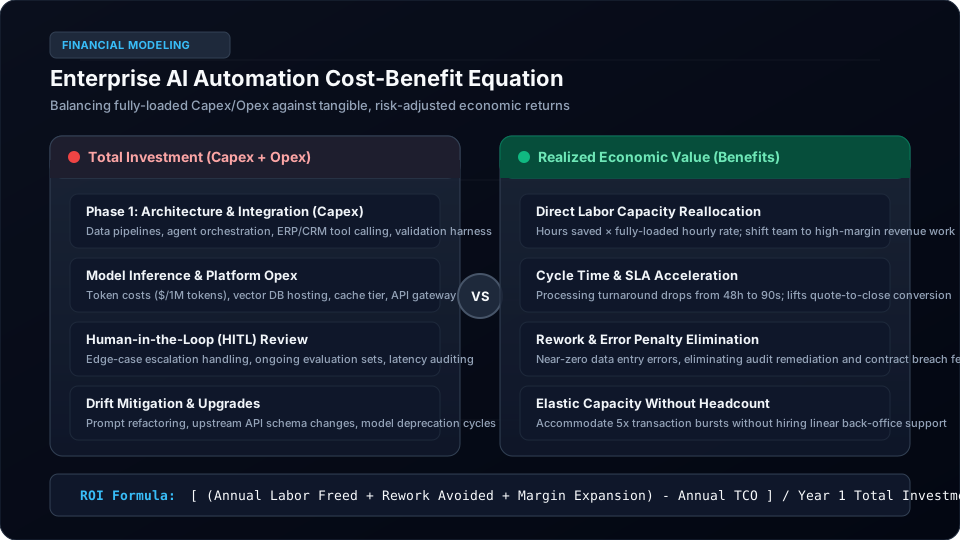
1. Quantifying the Economic Benefits
Enterprise benefits fall into three quantifiable pillars:
- Direct Labor Hours Liberated: Calculated as:
Annual Transactions × Manual Minutes Saved per Transaction × Fully-Loaded Hourly Rate. Crucially, the business case must specify how this liberated capacity will be deployed (e.g., redirecting 4 loan officers from manual data extraction to outbound origination). - Error Reduction & Compliance Penalty Avoidance: Manual data transcription in operations typically experiences a 3% to 6% error rate. In healthcare billing or financial reconciliation, each defect costs \$85 to \$250 in audit triage, customer penalties, and rework. Reducing transcription defects by 90% creates immediate bottom-line cash savings.
- Cycle Time Acceleration & Conversion Velocity: Compressing turnaround time from 72 hours down to 4 minutes dramatically lifts commercial conversion rates. In commercial lending or B2B quote generation, faster response times reliably expand win rates by 15% to 25%.
2. Calculating the Fully-Loaded TCO (Capex + Opex)
CFOs reject AI business cases that fail to model operational expenditures. Your model must incorporate four recurring costs. (Note: The figures below represent an illustrative baseline financial model for a mid-market workflow processing 10,000 to 50,000 transactions monthly; actual token consumption, inference rates, and review overhead depend on model selection, context length, and internal labor costs.):
| Cost Category | Typical Budget Range | Underlying Cost Driver |
|---|---|---|
| Phase 1: Solution Engineering (Capex) | \$35,000 – \$85,000 | Architecture design, data pipelines, system integrations, prompt engineering, evaluation harnesses, and security hardening. |
| Model Inference & Embeddings (Opex) | \$400 – \$2,500 / month | LLM token costs (\$ per million input/output tokens), embedding generation, vector database cluster hosting (Pinecone/pgvector). |
| Human-in-the-Loop Review (Opex) | \$800 – \$3,500 / month | Internal operational staff reviewing the 5% to 8% edge-case exception queue. Must be accounted for in the ongoing run-rate. |
| System Maintenance & Schema Drift (Opex) | \$1,000 – \$2,000 / month | Upgrading model versions, updating prompts as business rules change, and adjusting to third-party API deprecations. |
Prioritization: The 2x2 AI Payback Matrix
Not every manual workflow should be automated with AI. High-performing organizations use a 2x2 matrix to categorize candidate processes based on implementation friction versus economic impact.
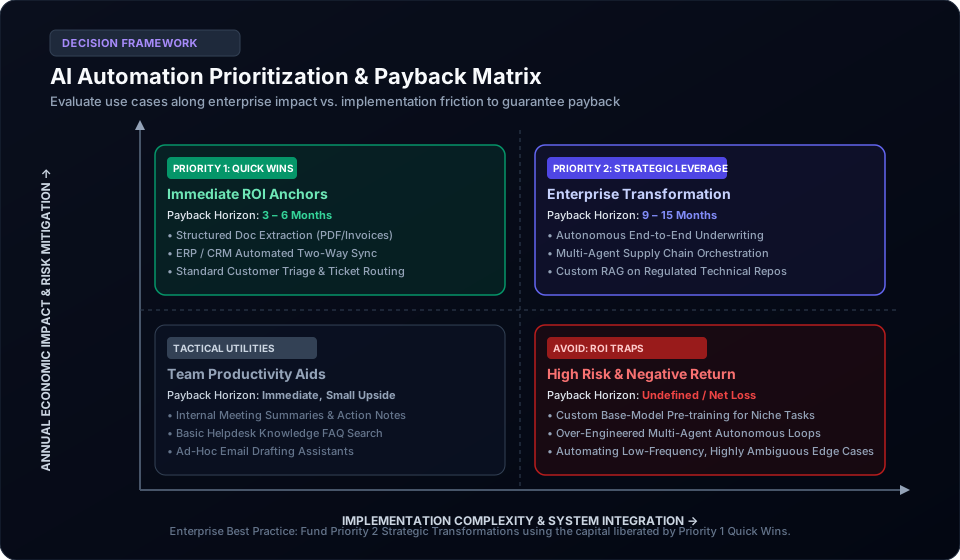
Priority 1: Immediate ROI Anchors
Characteristics: Structured inputs, high transaction volume, clear rules, existing APIs (e.g., AP invoice extraction, CRM record enrichment).
Payback: 3 to 6 months. High certainty, minimal architectural friction.
Priority 2: Strategic Transformations
Characteristics: Core business processes, multi-system orchestration, significant competitive moat (e.g., autonomous insurance underwriting).
Payback: 9 to 15 months. Requires deep domain modeling and rigorous evaluation harnesses.
Tactical Utilities
Characteristics: Individual productivity tools (meeting summarizers, email drafters).
Payback: Modest, unmeasurable bottom-line impact. Best purchased as off-the-shelf SaaS rather than custom-engineered.
Avoid: ROI Value Traps
Characteristics: Low-frequency, highly subjective tasks, or pre-training bespoke foundational models from scratch.
Payback: Negative or undefined. High Capex with massive maintenance overhead.
Step-by-Step Business Case Modeling for CFO Presentation
When presenting an automation initiative to the investment committee, structure the proposal around this 5-step validation sequence:
Document the Baseline As-Is Workflow
Conduct time-and-motion audits of the existing manual workflow. Record exact transaction counts, median processing minutes, employee fully-loaded compensation, and current defect error rates across a 90-day window.
Establish an "Evaluation Benchmark Set" (Golden Dataset)
Compile a repository of 200 real historic transactions representing typical volume, rare edge cases, and noisy corrupted inputs. Measure prospective models against this benchmark. An automation system cannot be deployed until it achieves >95% accuracy on this golden set. Read our guide on Evaluating AI Agents in Production for deep architectural benchmarking protocols.
Design for "Worst-Case" Token Economics
Model inference costs assuming input contexts are 50% larger than anticipated and reasoning models (o1/o3/Claude 3.7 Sonnet) execute multi-step tool calls. Build prompt caching and semantic response caching into the architecture to ensure unit costs decrease as transaction volumes scale.
Define Human Escalation Paths Before Writing Logic
Detail exactly what happens when confidence fails. Who receives the alert? What is the SLA for human review? If the escalation process is vague, operational backlog will stall the automated pipeline and eliminate cost savings.
Commit to Phased Capital Release (Milestone Gating)
Structure funding in two tranches: Tranche 1 (\$15,000 – \$25,000) for a 4-week architectural prototype validated on the golden dataset. Tranche 2 (remaining balance) unlocked only upon demonstrating target accuracy and SLA compliance on live staging traffic.
Primary Research & Economic Citations
- Gartner Research (2025/2026). Predicts 2026: Generative AI Governance, Costs, and Pilot Abandonment Rates.
- MIT Sloan Management Review & BCG. Expanding AI's Impact With Organizational Learning (Analysis of labor capacity redeployment vs. linear workforce reductions).
- OpenAI / Anthropic Engineering Benchmarks. System Prompt Token Optimization and Tool Use Latency Distributions.
- FinOps Foundation. FinOps for AI Framework (2026) — Tracking unit economic costs per inference transaction.
Ready to Validate Your AI Automation Business Case?
Ramaaya Technologies designs, builds, and deploys high-ROI enterprise AI agents and workflow automation pipelines engineered for measurable financial impact.