Section 2: What Changed in October 2026?
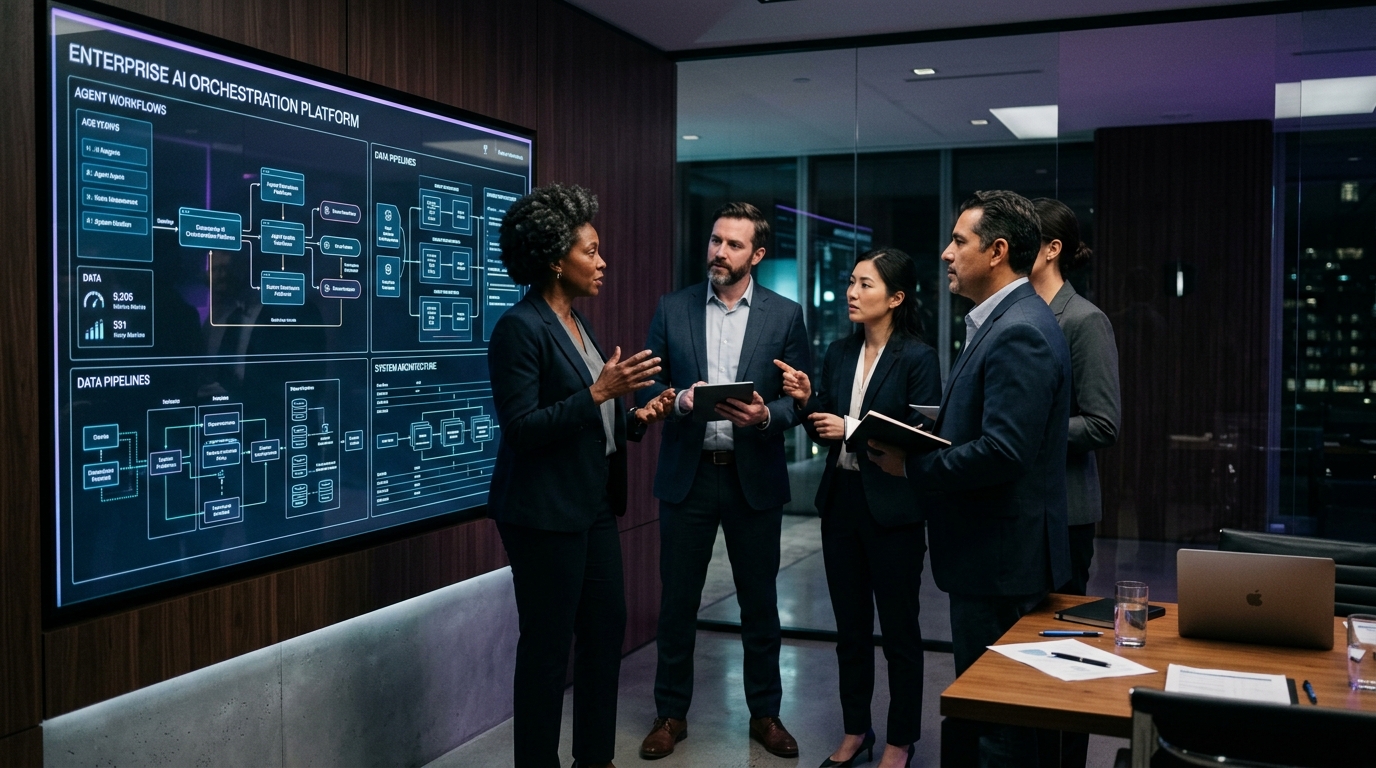
For nearly three years, enterprise adoption of generative AI centered primarily on passive retrieval: chatbots answering HR questions, knowledge assistants querying internal wikis, and copilots auto-completing code blocks. However, the first week of October 2026 marked a coordinated industry transition from conversational knowledge retrieval to authenticated system execution. Two major announcements from Microsoft and the OpenAI/Atlassian alliance illustrate this evolution.
Microsoft: Building Windows for Hybrid Intelligence
On October 7, 2026, Microsoft detailed its vision positioning Windows as a dedicated operating platform for "hybrid intelligence". Key verified technical highlights include:
- General availability of Microsoft Execution Containers on Windows, providing sandboxed, hardware-isolated virtual environments for local agentic task execution.
- Intelligent Workload Routing: Dynamic runtimes that evaluate whether an agentic operation should execute on local device NPUs (sub-millisecond latency, zero network egress) or route to cloud frontier models for complex multi-step reasoning.
- A clear architectural commitment that local device AI, private infrastructure, and hyperscaler cloud AI are complementary layers rather than competing silos.
The Architectural Implication: Microsoft's move validates that autonomous agents cannot simply run as arbitrary root scripts on an operating system. Execution containers solve the containment problem: if an agent running a shell script or browser automation goes rogue or encounters adversarial prompt injection, the blast radius is strictly confined within an ephemeral virtualization boundary.
OpenAI + Atlassian: Enterprise Knowledge Graph to Action
On October 6, 2026, OpenAI and Atlassian expanded their strategic partnership to transition enterprise workplace AI from summarization to automated action. Key points include:
- OpenAI frontier models now deeply interface with Atlassian's Teamwork Graph across Jira, Confluence, and Rovo agents.
- The Teamwork Graph serves as an enterprise context layer, mapping relationships between cross-functional teams, software repositories, sprint backlogs, customer escalations, and technical architecture decisions.
- Agents are explicitly granted tool-execution capabilities to update project states, resolve bug dependencies, and draft pull requests, all governed by enterprise role-based permissions.
The Architectural Implication: High-quality agentic reasoning cannot operate on raw unindexed text files. Atlassian and OpenAI demonstrated that agents require a structured knowledge graph to understand who owns a system, why a decision was made, and what downstream systems are affected before initiating a mutating tool call.
Section 3: Chatbot vs AI Agent: An Engineering Comparison
Many enterprise pitch decks conflate conversational chatbots with autonomous software agents. While both employ large language models as core reasoning components, their operational profiles, risk surfaces, and architectural implementations are fundamentally divergent.
| Evaluation Dimension | Conversational Chatbot | Autonomous AI Agent |
|---|---|---|
| Primary Interaction | Turn-based human dialogue via chat prompt box | Event-driven, asynchronous background execution or conversational directive |
| Context Scope | Ephemeral session conversation buffer | Persistent enterprise context graph, vector memory, database state, and file trees |
| Tool Utilization | Zero tools, or read-only vector search retrieval (RAG) | Multi-tool invocations: REST APIs, SQL execution, shell containers, webhooks, git actions |
| Workflow Execution | Passive suggestion generation; human must copy-paste results | Active mutation: closes tickets, dispatches emails, mutates rows, creates PRs |
| Decision-Making | Probabilistic text generation based on statistical token prediction | Structured iterative planning (ReAct / State Graph loops, reflection, self-correction) |
| Required Permissions | Read-only access to indexed document chunks | Scoped machine identity (Service Principal) with granular OAuth read/write scopes |
| Human Approval | Implicit (human reviews generated text before taking manual action) | Explicit programmatic Human-in-the-Loop (HITL) gates for high-impact mutations |
| Audit & Telemetry | Standard HTTP prompt and completion token logging | Forensic ledger: prompt snapshots, tool arguments, runtime state, and approval signatures |
| Failure Impact | User receives a confusing or hallucinated response; blast radius zero | Corrupted database records, unintended customer messages, financial discrepancies |
Section 4: What an Enterprise AI Agent Actually Needs (Architecture)
To transition an agent safely from a weekend prototype into a production enterprise asset, software architects must construct a multi-layered execution pipeline. A model cannot be directly wired to an API key; it must pass through identity, permission, and validation middleware.
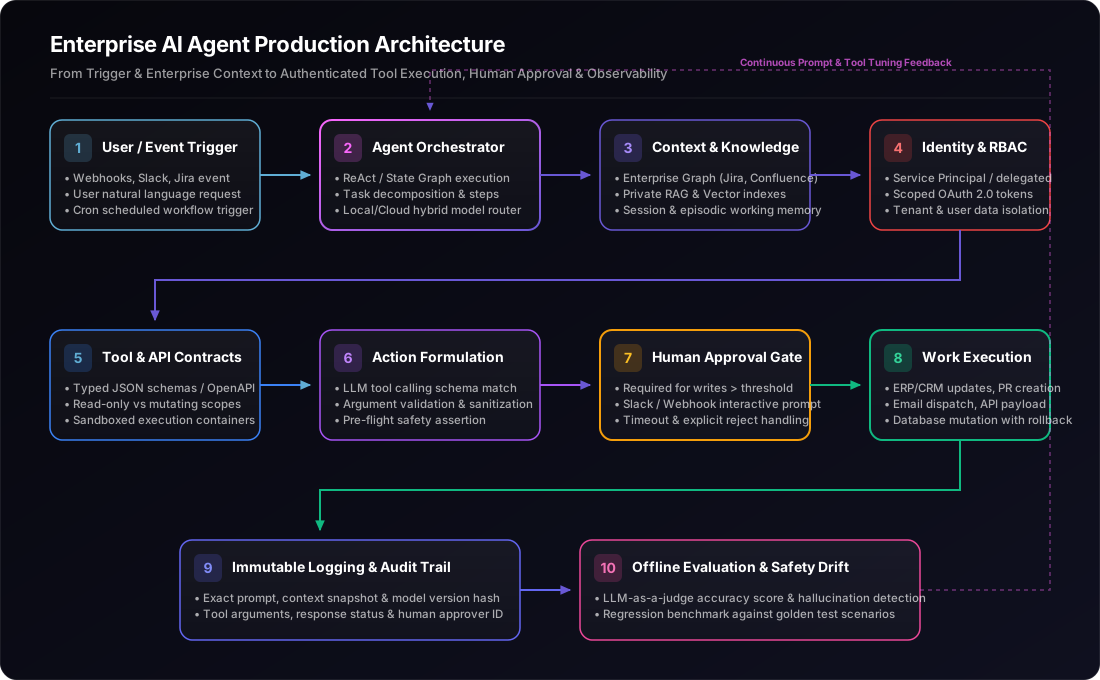
Let us examine the mandatory components of this production execution topology:
- 1. Event / Ingestion Layer: Captures incoming triggers—whether a webhook from an ERP, a customer email via API, or an automated cron scheduler.
- 2. Agent Orchestrator: Manages state machine graphs (such as LangGraph or custom stateful engines), decomposing high-level objectives into atomic sub-tasks.
- 3. Enterprise Context & Graph: Injects relevant business context—not merely flat vector embeddings, but relational entity graphs that connect customer records, project history, and architectural dependencies.
- 4. Identity & Authorization Gateway: Validates whether the agent is acting on behalf of an authenticated user (On-Behalf-Of flow) or as an isolated background service principal.
- 5. Tool & API Contracts: Enforces strictly typed JSON schemas (OpenAPI specs) on every tool. The agent is never permitted to emit raw arbitrary SQL or uncontrolled shell strings without strict schema validation.
- 6. Reasoning & Planning: The model formulates the action payload, matching arguments against tool signatures.
- 7. Human Approval Gate: If an action exceeds predefined risk thresholds (e.g., modifying production billing data or executing refunds), the system halts execution and issues an interactive approval request to human operators.
- 8. Sandboxed Execution Container: Executes the mutating action inside an isolated environment (such as Windows Execution Containers or ephemeral Docker sandboxes), preventing host privilege escalation.
- 9. Immutable Audit Ledger: Records an append-only forensic event log capturing the exact prompt, model version hash, context snapshot, tool parameters, and response status.
- 10. Offline Evaluation Loop: Continuously monitors output quality, running automated LLM-as-a-judge assertions to detect safety drift and hallucination risks over time.
Section 5: The Five Control Layers for Enterprise Agent Security
Drawing from real-world systems architecture and vendor-neutral interpretations of guidance like Microsoft's Secure Agents center-of-excellence documentation, enterprises must erect five distinct control layers before deploying agentic workflows.
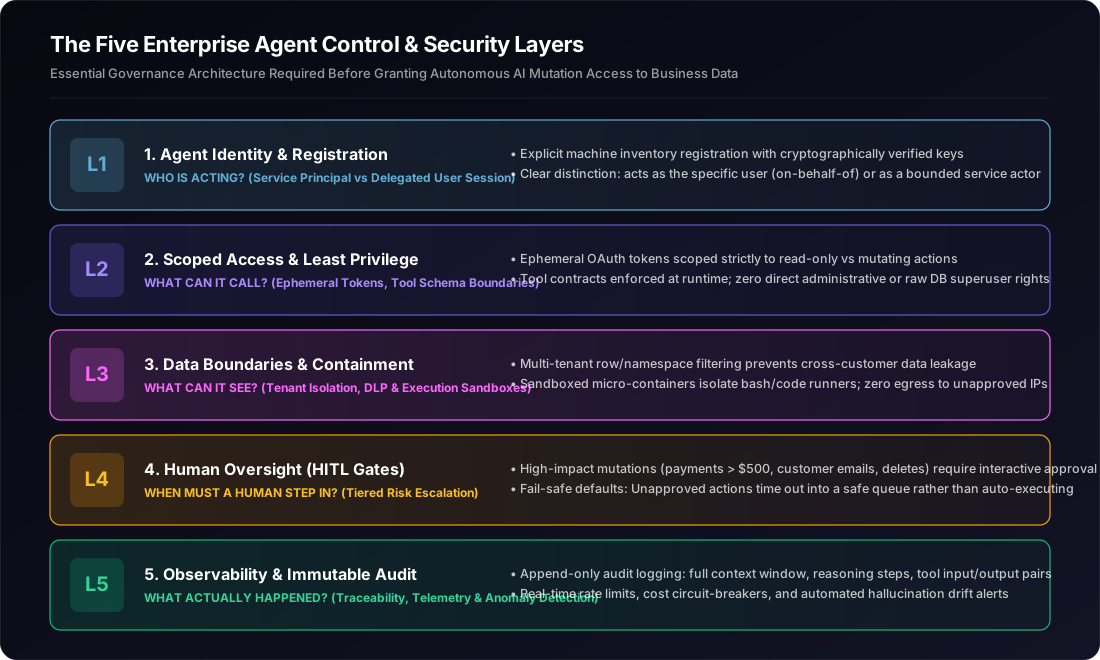
Layer 1: Agent Identity
Every agent must possess a unique, cryptographically attested machine identity registered in the company's enterprise directory (e.g., Azure AD / Entra ID or Okta). Business Example: If an agent updates a Salesforce opportunity, the change log must attribute the write to svc-agent-renewal-bot, not a generic administrator account or the individual engineer who configured the API key.
Layer 2: Least Privilege & Tool Contracts
Agents should never hold blanket admin access. Grant ephemeral, narrowly scoped OAuth tokens that enforce read vs. write separation. Business Example: A customer support agent should have write permissions only to create draft Zendesk replies, with zero permission to delete user accounts or alter billing subscriptions.
Layer 3: Data Boundaries & Sandboxes
Strict multi-tenant row-level security and context filtering must isolate sensitive data. Code execution tools must run in hardware-isolated containers without egress to internal networks. Business Example: An agent running Python scripts to analyze financial CSVs must execute inside an ephemeral container blocked from reaching the corporate LAN.
Layer 4: Human-in-the-Loop (HITL) Gates
Tiered approval frameworks ensure consequential actions require verified human sign-off. If approval times out, the system defaults to safe abort. Business Example: An inventory agent can automatically reorder office supplies under $200, but purchase orders over $5,000 generate an interactive Slack button requiring CFO confirmation.
Layer 5: Observability & Forensic Auditing
Every agent action requires end-to-end tracing: inputs, reasoning chains, intermediate tool calls, and outputs. Business Example: When an automated vendor onboarding agent flags a supplier as fraudulent, legal and compliance teams can reconstruct the exact documents, retrieved embeddings, and reasoning tokens that produced the determination.
Section 6: Local vs Cloud vs Hybrid Agents: Architectural Decision Matrix
Microsoft's announcement of Windows as a platform for "hybrid intelligence" highlights a critical architectural question: where should enterprise agents actually run?
The debate between running small language models (SLMs) on local client hardware versus querying massive frontier models in the public cloud is not binary. The modern enterprise consensus is converging on Hybrid Agent Architectures that leverage intelligent routing.
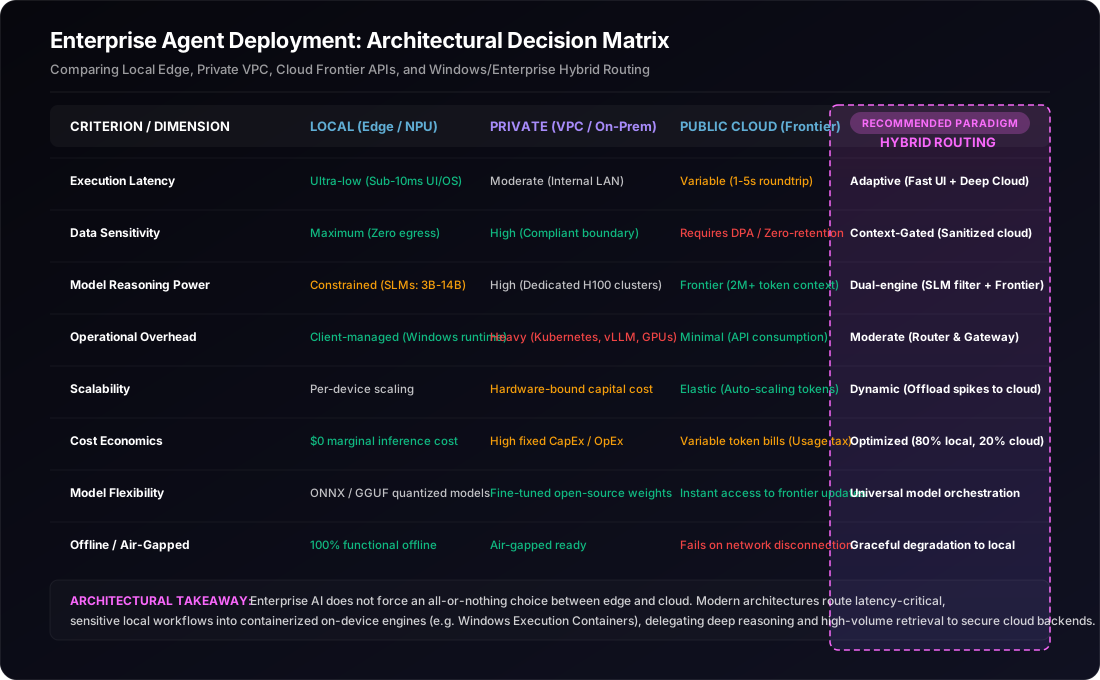
| Criterion | Local (Edge / NPU) | Private VPC / On-Prem | Public Cloud Frontier | Hybrid Intelligent Routing |
|---|---|---|---|---|
| Execution Latency | Ultra-low (sub-10ms UI/OS calls) | Moderate (LAN / VPC roundtrip) | Variable (1–5s network + queue) | Adaptive: Instant local triage + deep cloud reasoning |
| Data Privacy & Egress | Maximum: Zero bytes leave device | High: Compliant internal perimeter | Requires strict enterprise DPAs | Context-Gated: Sensitive PII stays local; sanitized tokens route out |
| Model Capacity | Constrained: 3B–14B SLMs | High: 70B open weights on H100s | Frontier: 2M+ token reasoning | Dual-Engine: Local SLMs filter & route; cloud handles complex plans |
| Cost Economics | $0 marginal inference per device | High fixed CapEx & GPU hosting | Variable per-token operational tax | Optimized: 75–80% local workloads slash API spend |
| Offline Reliability | 100% operational air-gapped | Operational within internal network | Fails entirely during network drops | Graceful Degradation: Offline mode continues core workflows |
Section 7: When Should a Business Actually Use an AI Agent?
Building an agent is technically demanding and operationally risky. Leaders must evaluate use cases against a disciplined filter of operational suitability.
High-Value Agent Candidates
- Cross-System Triage & Routing: Ingesting unstructured support tickets, categorizing urgency, fetching customer contract terms from CRM, and drafting responses.
- Sales Intelligence & Enrichment: Monitoring public news, earnings releases, and tender databases, extracting key criteria, and updating internal sales pipeline records.
- Complex Document Reconciliation: Comparing vendor invoices against purchase orders and logistics bills of lading where field names and layouts differ across formats.
- Repetitive API Choreography: Coordinating workflows spanning five disparate SaaS tools (e.g. Jira, Slack, GitHub, Datadog) where conditional routing requires semantic comprehension.
Poor Agent Candidates (Avoid)
- Deterministic Arithmetic & Payroll: Calculating employee salaries, VAT computations, or stock ledger math. Use proven relational databases and code.
- High-Frequency Mutation Without Oversight: Permitting an agent to execute live financial trades, delete databases, or modify firewall access rules autonomously.
- Chaotic, Undocumented Workflows: Attempting to automate a workflow that human operators cannot clearly describe or standardize. AI amplifies operational chaos.
- Zero Ground-Truth Data: Workflows where systems have conflicting, corrupted, or stale customer data. An agent will hallucinate actions upon bad inputs.
Section 8: The Real Enterprise Problem: Context + Control
The technology industry is prone to model obsession. Every new benchmark showing a 2% improvement on MMLU or coding evaluation sets off a wave of excitement. Yet inside real enterprise environments, the frontier reasoning model is rarely the bottleneck to successful automation.
The real bottlenecks are Context and Control:
- The Context Problem: Models cannot take meaningful action if enterprise knowledge is fragmented across locked Google Docs, private Slack channels, undocumented PostgreSQL schemas, and tribal employee memory. As Atlassian demonstrated with their Teamwork Graph, agents require a structured semantic layer that maps the organizational graph before they can decide which issue to update.
- The Control Problem: Businesses cannot risk probabilistic execution in regulated industries. An agent that succeeds 94% of the time represents a 6% failure rate. In customer support, a 6% failure rate is an inconvenience; in regulatory reporting, healthcare, or financial settlement, a 6% error rate is an existential legal liability.
Section 9: How to Prepare a Business for AI Agents (10-Step Checklist)
Before writing your first LangGraph script or issuing API credentials to an autonomous system, execute this structured engineering readiness checklist:
Map and Decompose the Target Workflow
Document every step, input, decision branch, and output of the business process. If a senior operator cannot draw the workflow on a whiteboard, an AI agent cannot execute it reliably.
Audit and Cleanse Underlying Source Data
Verify that the databases, APIs, and document repositories the agent will query contain clean, validated, and up-to-date business records. Eliminate conflicting duplicate data.
Define Typed Tool Contracts (OpenAPI / JSON Schema)
Create strict schemas for every tool the agent can call. Include explicit argument typing, parameter validation rules, and comprehensive descriptions of what each tool does.
Provision Scoped Machine Identities
Register dedicated Service Principals in your identity provider. Restrict permissions to the bare minimum read and write endpoints necessary for task completion.
Establish Programmatic Human Approval Gates (HITL)
Define clear risk thresholds. Any action involving financial transactions, customer-facing communication, or data deletion must pause for interactive human verification.
Isolate Execution Runtimes
Deploy execution sandboxes (e.g. Windows Execution Containers, gVisor, or isolated container runtimes) to constrain any code execution or browser automation tools.
Implement Immutable Audit Telemetry
Instrument the agent with end-to-end tracing. Record every user prompt, model thought trace, tool argument payload, execution status, and human approval signature in an append-only log.
Assemble an Offline Golden Evaluation Benchmark
Construct a test suite of 50–100 realistic workflow scenarios with known good outputs. Benchmark new prompts, model versions, and tool updates against this golden dataset before deployment.
Run a Supervised Shadow Pilot
Deploy the agent in "read-only" or "shadow" mode where it formulates actions and plans, but a human operator manually reviews and executes every tool call for the first 30 days.
Expand Autonomy Gradually
Only after the shadow pilot demonstrates zero critical regressions, unlock automated execution for low-risk tiers while maintaining strict observability and budget circuit breakers.
Section 10: The Ramaaya Perspective: Where the Engineering Work Actually Begins
At Ramaaya Technologies, our systems engineering practice approaches AI automation not as an isolated machine learning experiment, but as a disciplined extension of enterprise software architecture and distributed systems engineering.
Deploying a functioning model using an off-the-shelf SDK requires only an afternoon. But connecting that model safely to a legacy ERP, a multi-tenant PostgreSQL database, an enterprise identity provider, and a compliance audit stream requires deep software engineering expertise:
- Business Workflow Discovery: Eliminating organizational ambiguity before writing code. Learn more about our discovery process in our IT Consulting Services.
- Systems & API Integration: Designing contract-first architectures that protect core systems from runaway probabilistic execution. Explore our Custom Software Engineering Practice and our guide on API-First Architecture for Business Systems.
- Cloud, Data & Vector Infrastructure: Structuring private enterprise context layers and private RAG pipelines that prevent data leakage. See our Cloud & Data Engineering Services and our deep dive on Enterprise RAG Architecture.
- AI Workflow Automation: Designing robust agent orchestrators with human-in-the-loop safety gates. Learn about our dedicated AI & Automation Services.
Section 11: Practical Conclusion: What Should a Business Do Now?
If your leadership team is evaluating whether to adopt autonomous AI agents in late 2026, the most effective strategy is deliberate, bounded pragmatism:
- Do not give an AI agent broad, unrestricted access to your organization's tools or files.
- Select exactly ONE well-defined, multi-step business workflow where human operators currently spend significant time copying and translating information across systems.
- Provide bounded, high-quality context using private retrieval and structured knowledge graphs rather than dumping raw company documents into model context windows.
- Enforce the principle of least privilege: grant the minimum necessary API scopes and mandate explicit human approval for any mutating or destructive action.
- Instrument every step with forensic telemetry and measure failure modes against an objective golden evaluation benchmark.
AI agents are undeniably shifting from conversational novelties into systems that execute genuine business work. But in the enterprise, autonomy without architecture is merely automated failure. The organizations that win in this era will not be those that give AI models the most freedom—they will be the organizations that build the most resilient, secure, and observable control systems around them.
Sources & Further Reading
This analysis synthesizes primary industry announcements and enterprise engineering standards published in October 2026:
- Microsoft: "Building Windows for Hybrid Intelligence" (Published October 7, 2026). View Microsoft Announcement — Details on Windows Execution Containers, hybrid intelligence routing, and complementary edge-to-cloud computing.
- OpenAI & Atlassian: "Atlassian and OpenAI expand partnership to turn enterprise knowledge into action" (Published October 6, 2026). View OpenAI Announcement — Analysis of the Teamwork Graph enterprise context layer and agentic workflows in Atlassian Rovo.
- Microsoft Learn: "Secure agents in the Center of Excellence". View Microsoft Agent Security Documentation — Industry framework for agent identity, least privilege, data protection, and continuous monitoring.
- Related Ramaaya Architectural Guides: AI Agents vs Chatbots: Key Differences · Evaluating AI Agents in Production · RAG vs Fine-Tuning for Enterprise AI · Enterprise RAG Architecture Guide