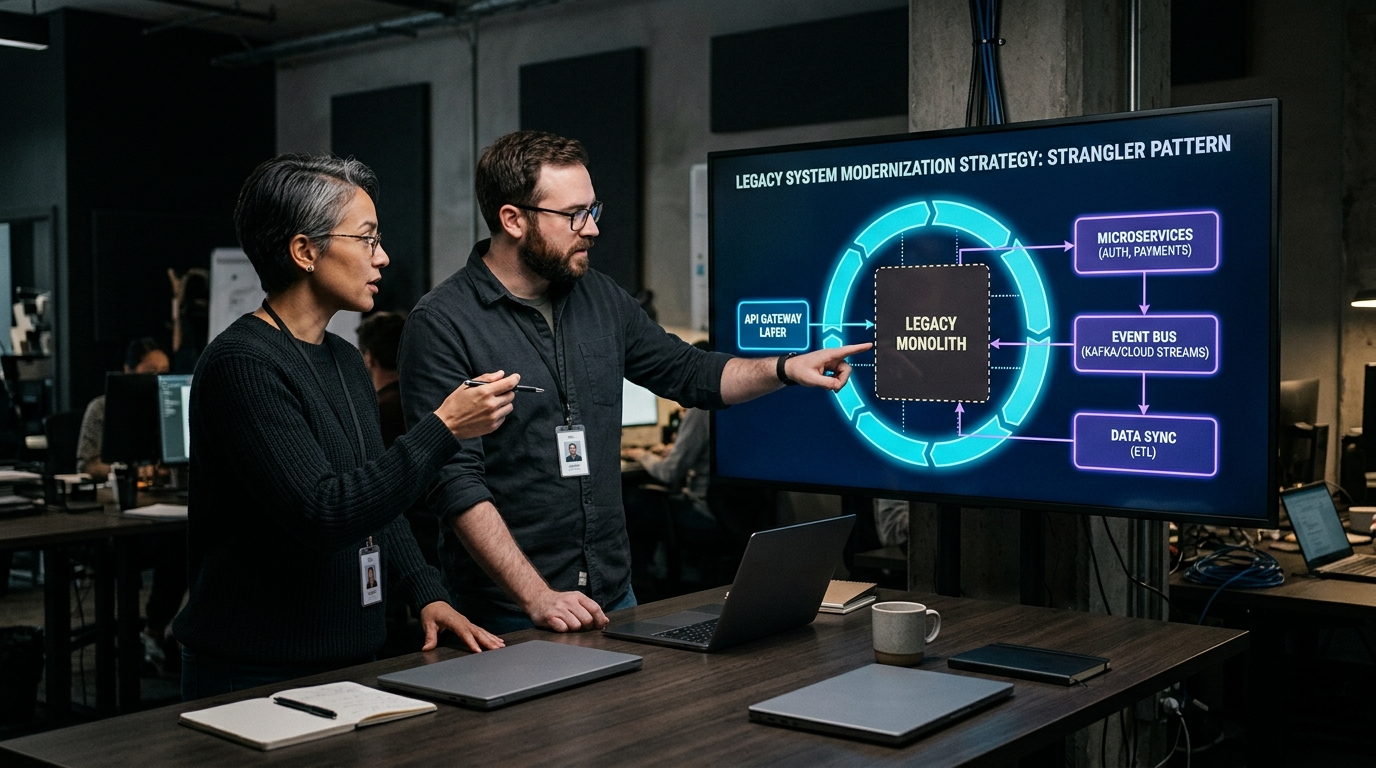
1. The "Grand Rewrite" Fallacy: Why Big Bang Rewrites Fail
Every software engineering team eventually reaches a point of acute frustration with their legacy codebase. Changes take three times longer than expected, pull requests trigger unexpected regressions in forgotten modules, onboarding new engineers requires months of oral tradition, and modern libraries cannot be adopted due to out-of-date runtime versions.
At this point, someone inevitably pitches the executive team on a tempting narrative:
"If we pause non-critical features for six months and rewrite this from scratch using Go, Next.js, and clean microservices, we will eliminate all technical debt and double our shipping velocity forever."
This proposal is virtually always a catastrophic miscalculation. Here is why ground-up rewrites consistently derail businesses:
- The Moving Target Problem: A production business cannot freeze its competitive landscape. While the rewrite team spends twelve months rebuilding existing features, the legacy system continues to evolve to satisfy urgent client requests, regulatory mandates, and revenue-critical features. The new system is already out of date before it ever deploys.
- Lost Business Logic & Edge Cases: The legacy codebase is an archaeological record of ten years of hard-won edge cases: quirky tax exemptions, partner API timeouts, race condition safeguards, and legacy billing quirks. Much of this context exists nowhere except in the messy code itself. Rebuilding from scratch inevitably introduces regressions in subtle workflows that users have relied on for years.
- Second-System Syndrome: Fred Brooks coined "Second-System Syndrome" to describe the human tendency to over-engineer the replacement system. Engineers pack all the deferred wishes, unnecessary abstractions, and bleeding-edge frameworks into the rewrite, compounding complexity until the timeline balloons out of control.
- Zero Value Until 100% Complete: A big-bang rewrite yields zero commercial value to users until the day of cutover. If the project runs out of executive patience at 85% completion, millions of dollars of engineering effort are written off as total waste.
2. What "Legacy" Truly Represents: Operational Business Value
In enterprise consulting, we encourage leadership to redefine the word "legacy." Legacy software is not defective code; it is code that solved a business problem so effectively that the organization built an entire operational engine on top of it.
The friction experienced by engineering teams is usually not that the software fails to work, but that the software's architecture no longer matches the organization's current scale, team structure, or operational cadence. Modernization, therefore, is not about aesthetic cleanliness—it is an economic investment in operational resilience and time-to-market.
The objective of modern engineering leadership is to systematically extract value from technical debt without triggering systemic organizational shock. We accomplish this through disciplined, phased decomposition.
3. The Strangler Fig Pattern: Incremental Functional Extraction
Named by Martin Fowler after the Australian strangler fig tree that seeds in the branches of a host tree, slowly grows downward, and eventually envelops the host, the Strangler Fig Pattern is the gold standard for enterprise software modernization.
Rather than replacing the legacy system in one catastrophic cutover, the Strangler Fig approach places an interception layer (an API Gateway or Reverse Proxy) in front of the existing system. New capabilities and modernized subsystems are implemented alongside the legacy core, and traffic is incrementally routed to the new services route-by-route.
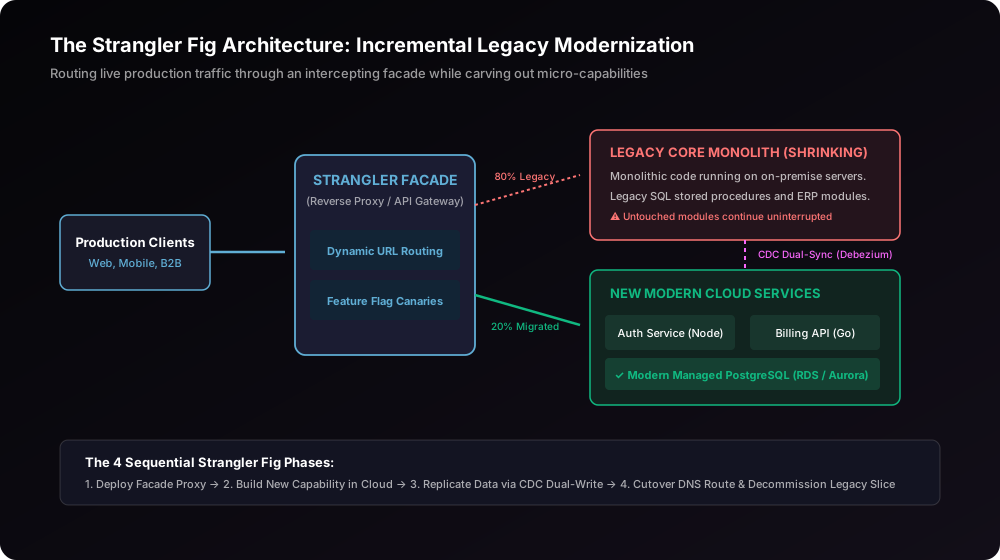
Implementing the Strangler Fig pattern follows four distinct architectural phases:
- Phase 1: Ingress Interception (The Edge Facade): Deploy an edge API Gateway (such as Kong, Envoy, or Cloudflare Workers) in front of the legacy monolith. All client requests—web browsers, mobile applications, and partner integrations—terminate at the gateway, which initially proxies 100% of traffic to the legacy application.
- Phase 2: Target Subsystem Carve-Out: Select a single, bounded domain capability (e.g., the Notification Service, Billing Engine, or PDF Report Generation). Build that capability as a modern, independently tested service with its own isolated data storage.
- Phase 3: Route Diversion & Canary Validation: Update the edge proxy routing rules to direct requests for that specific subsystem (e.g.,
/api/v2/notifications/*) to the new service, while keeping all other traffic routed to the legacy core. Gradually increase traffic from 5% canary to 100%. - Phase 4: Legacy Deprecation & Decommissioning: Once the new subsystem has proven resilient under production load, delete the legacy module's code and drop its associated database tables. Repeat the sequence for the next bounded context.
4. Database Modernization: Dual-Write, CDC, & Zero Downtime
The most terrifying part of legacy modernization is rarely the application code—it is the database. Legacy databases often feature thousands of tables, deeply nested foreign keys, missing indexes, triggers, stored procedures containing critical business logic, and denormalized tables queried by dozens of distinct services.
Migrating an operational database cannot be achieved by taking a 12-hour weekend maintenance window, exporting a dump, and hoping the restore finishes before Monday morning 8:00 AM. Enterprise modernization demands zero-downtime data migration.
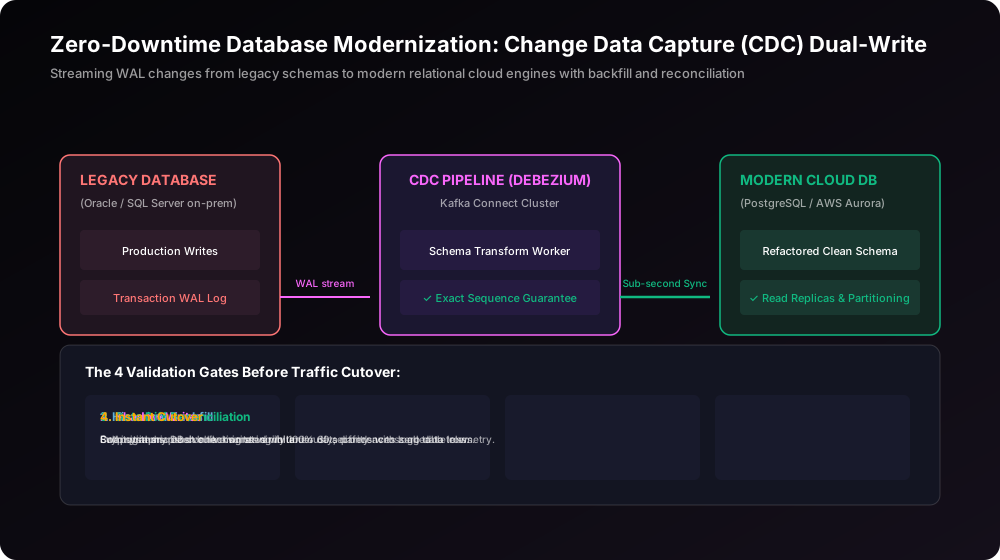
Change Data Capture (CDC) vs. Application Dual-Writes
There are two primary architectural patterns for keeping legacy and modern databases synchronized during migration:
- Application-Level Dual Writes: The application tier writes simultaneously to both the legacy database and the target database. While conceptually straightforward, dual writes suffer from distributed transaction failure: if the write to DB-A succeeds but the write to DB-B fails due to network latency, the databases immediately fall out of sync, requiring complex two-phase commit protocols or compensating transactions.
- Log-Based Change Data Capture (CDC): The gold-standard approach. Tools like Debezium read the transaction write-ahead log (WAL) of the legacy database (e.g., PostgreSQL WAL, MySQL Binlog, or SQL Server CDC). Every insert, update, and delete is streamed into an Apache Kafka or AWS Kinesis topic and consumed asynchronously by a modern pipeline that hydrates the target data store. Because CDC reads from the database storage engine directly, it introduces zero latency overhead to production transactions and guarantees event ordering.
The 5-Step Zero-Downtime Data Cutover Playbook
- Initialize CDC Streaming: Enable CDC on the legacy source database and stream log records to a message bus.
- Execute Historical Backfill: Run a snapshot dump of historical data up to the CDC start timestamp and load it into the target database. CDC consumers replay subsequent events to bring the target store into real-time parity.
- Continuous Automated Reconciliation: Run background verification workers that continuously compare primary keys, checksums, and record counts between the source and target databases, alerting on discrepancies.
- Shadow Reads: Switch the application to perform reads against the target database in shadow mode: execute queries against both stores, compare response latency and payload consistency, and log any divergence.
- Write Cutover & Reverse Sync: Once verified, switch the primary write target to the new database. Reverse the CDC stream so that writes to the new database replicate back to the legacy database temporarily, ensuring a fail-safe fallback path if unanticipated issues arise.
5. In-Place Modular Refactoring: Cleaning Without Relocating
Not all legacy modernization requires extracting code into separate cloud services or external microservices. As discussed in our analysis on Monolith vs Microservices for Growing SaaS, distributing a messy monolith across multiple network boundaries simply transforms an unmaintainable codebase into an unmaintainable distributed nightmare.
In-Place Modular Refactoring is the practice of imposing clean architectural boundaries within the existing repository before contemplating infrastructure changes.
1. Eliminate Cross-Domain SQL Joins
Legacy codebases frequently feature queries that join the users, orders, billing, and inventory tables in a single 200-line SQL statement. Break these queries into domain-specific data access objects (DAOs). No domain module may query another module's database tables directly.
2. In-Memory Domain Events
Replace tight procedural coupling (e.g., the billing function calling the email sender, the analytics logger, and the inventory updater directly) with in-process event buses. When an invoice pays, publish an InvoicePaidEvent. Other modules subscribe asynchronously.
3. Static Analysis Architecture Rules
Use tools like ArchUnit (Java), ts-arch (TypeScript), or Packwerk (Ruby) to enforce module boundaries in CI pipelines. If code in the Billing namespace attempts to import internal utilities from the Inventory namespace, the build breaks automatically.
4. Characterization Testing Harness
Before modifying complex legacy algorithms whose original specifications have been lost, record hundreds of real inputs and outputs from production logs. Wrap the legacy code in automated regression tests that verify the new implementation produces identical results across all historic cases.
6. API Façades and Anti-Corruption Layers
When building new capabilities on top of a legacy platform, a major danger is that the idiosyncrasies, messy data models, and cryptic naming conventions of the legacy system bleed into the new software.
In Domain-Driven Design (DDD), Eric Evans introduced the Anti-Corruption Layer (ACL). An ACL is an adapter translation layer that sits between the legacy system and the modern application. It translates the legacy system's archaic payloads, non-standard HTTP codes, and denormalized tables into clean, domain-pure abstractions expected by the new software.
If the legacy system stores a customer address across ADDR_L1, ADDR_L2, and a cryptic FLG_ST_CD column, the Anti-Corruption Layer consumes this structure and exposes a clean, typed CustomerAddress model with validated ISO country codes. If the legacy backend is eventually rewritten or swapped for a modern microservice, the new application requires zero modifications—only the ACL adapter changes.
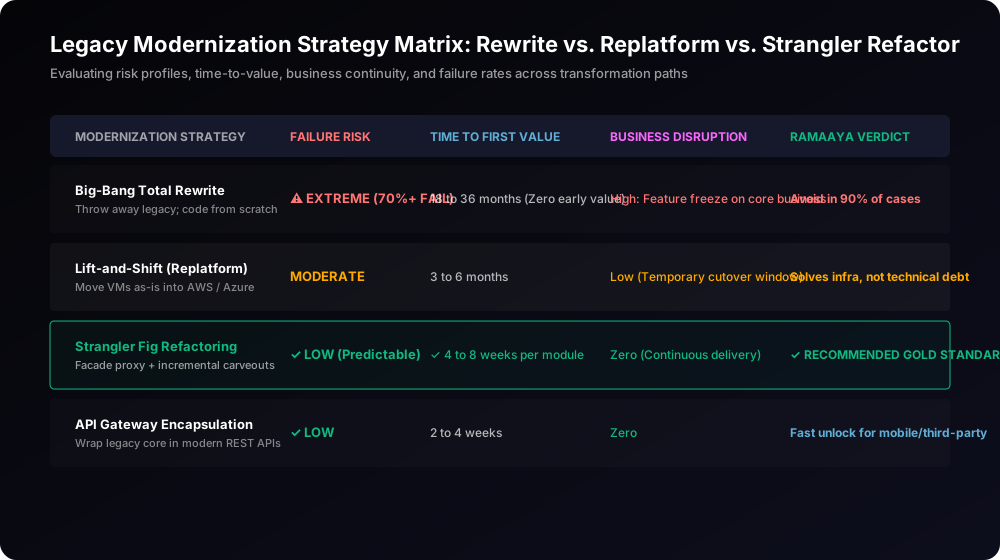
7. The Modernization Risk & Feasibility Matrix
Before committing engineering capital, leadership must evaluate the four architectural options: Full Rewrite, Strangler Fig Facade, In-Place Modularization, or API Encapsulation.
8. Subsystem Prioritization: Risk vs. Business ROI
How do you decide which component of a legacy system to modernize first?
Many engineering teams make the mistake of picking the absolute easiest component (e.g., the "About Us" page or a static FAQ endpoint) or the absolute most terrifying component (the core transaction ledger). Both approaches are flawed.
At Ramaaya Technologies, our IT Consulting & Architecture practice uses a two-axis prioritization matrix: Business Velocity Impact vs. Coupling/Extraction Complexity.
- Wave 1: High Velocity, Low Coupling (The Quick Wins): Capabilities that product teams touch frequently and are critical to revenue, but have relatively few database dependencies (e.g., Customer Onboarding Flow, Notification Engine, Third-Party Webhook Processing). Modernizing these first unlocks immediate product shipping speed and proves the deployment pipeline.
- Wave 2: High Velocity, Moderate Coupling (The Core Value Drivers): Subsystems that undergo continuous feature development but interact with the central database (e.g., Search & Filtering, Reporting & Analytics, Pricing Engine). These benefit enormously from CDC synchronization and API facades.
- Wave 3: Low Velocity, High Complexity (The Stable Core): Subsystems that are deeply coupled but rarely change (e.g., Ledger Accounting, Historical Audit Logs, Legacy User Authentication). Leave these alone in the legacy core until later phases. If code has zero active bug reports and requires no new feature development, the technical debt is benign.
9. The Ramaaya Engineering Modernization Playbook
Successful legacy modernization is an engineering discipline that balances operational continuity with long-term technological agility. At Ramaaya Technologies, our engineering teams modernize mission-critical systems through a structured four-stage process:
- Architectural Audit & Domain Boundary Mapping: We analyze the codebase's git history, dependency graphs, and database schema relationships to uncover hidden domain boundaries, cyclic imports, and hotspot complexity.
- Edge Proxy & Contract Stabilization: We implement API gateways and automated contract testing harnesses (OpenAPI / Pact) to guarantee that legacy client applications and external partners experience zero breaking changes.
- Automated Data Pipelines: We architect robust Change Data Capture (CDC) and shadow read verification harnesses that validate data fidelity before any production traffic cuts over.
- Iterative Team Enablement: We build side-by-side with in-house engineering squads, instilling modern CI/CD automation, trunk-based development, and observability practices into daily workflows.
To understand how contract-driven engineering accelerates enterprise integrations, explore our companion analysis on API-First Architecture: When Business Systems Need to Talk to Each Other. If you are assessing the broader financial and strategic viability of custom software, review our framework on Build vs Buy: The Technology Decision Framework.