

The Core Conflict: Two Workloads at War
Every software application begins with a single relational database. In the early stages of a product, this unified model is optimal: a customer registers, an order is inserted, and a basic admin dashboard calculates today's total revenue using SELECT SUM(amount) FROM orders.
However, as transactional volume scales from 10,000 orders to 10 million rows, the fundamental tension between operational transactions and analytical queries manifests:
- Online Transaction Processing (OLTP): Serves end-user application requests. Workloads consist of thousands of concurrent, highly focused reads and writes modifying individual records (e.g.,
UPDATE users SET status = 'active' WHERE id = 4821). Success is measured in low latency (under 15ms), high concurrency, and absolute ACID transactional consistency. - Online Analytical Processing (OLAP): Serves internal business analysts, executives, and machine learning pipelines. Workloads consist of low-concurrency, complex analytical aggregations scanning millions of historical rows across multiple years (e.g., calculating 365-day cohort customer lifetime value grouped by acquisition channel). Success is measured in raw data throughput and query processing power.
GROUP BY query on a 20-million row table will sweep memory pages out of the database cache, forcing transactional write queries to perform expensive physical disk I/O and triggering cascading application timeouts.
Decoupling the Architecture: From Production DB to Analytics Warehouse
To prevent reporting queries from starving user transactions, mature software architectures decouple operational writes from analytical reads using an asynchronous streaming pattern:
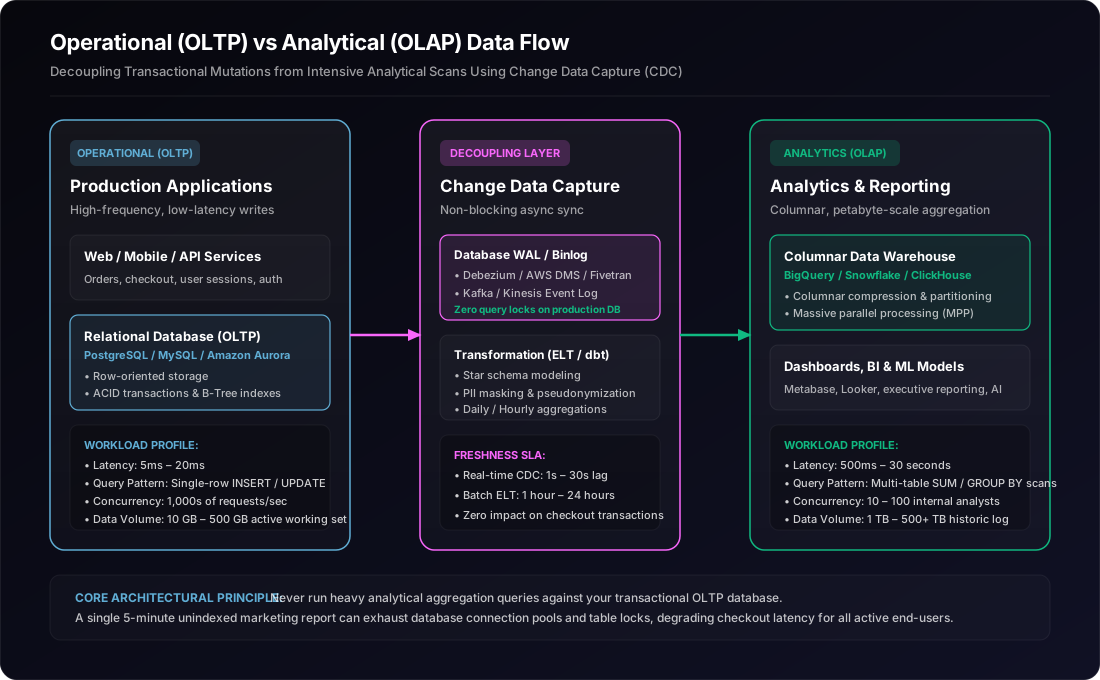
1. The Operational Layer (Row-Oriented Storage)
Relational databases store data in rows on disk. When your application queries a single user row, the storage engine reads all columns for that user in a single contiguous disk read. This is extremely efficient for operational CRUD transactions. However, if an analytics query wants to calculate the average order total across 5 million rows, the database must read every customer's name, email, billing address, and metadata off disk simply to access the amount column.
2. The Decoupling Layer (Change Data Capture / CDC)
Rather than running expensive batch SELECT * queries that lock production tables every night, modern systems employ Change Data Capture (CDC). Tools like Debezium, AWS Database Migration Service (DMS), or Fivetran tail the database write-ahead log (WAL / binlog) asynchronously. Every committed transaction is emitted as a lightweight event stream into Kafka, Kinesis, or an object store without placing any query locks on the active database engine.
3. The Analytical Layer (Columnar Compression & MPP)
Analytical warehouses (BigQuery, Snowflake, ClickHouse, Amazon Redshift) store data in columns rather than rows. When a query requests SELECT SUM(amount), the engine reads only the byte stream for the amount column off disk, skipping all other columns entirely. Paired with dictionary compression and Massive Parallel Processing (MPP) compute clusters, queries that take 6 minutes on PostgreSQL execute in 400 milliseconds on a columnar warehouse.
The Evolution of Data Topologies: 4 Architectural Patterns
Not every company needs an immediate multi-node Snowflake cluster. Software teams should evolve through four distinct replication topologies based on data volume and team capacity:
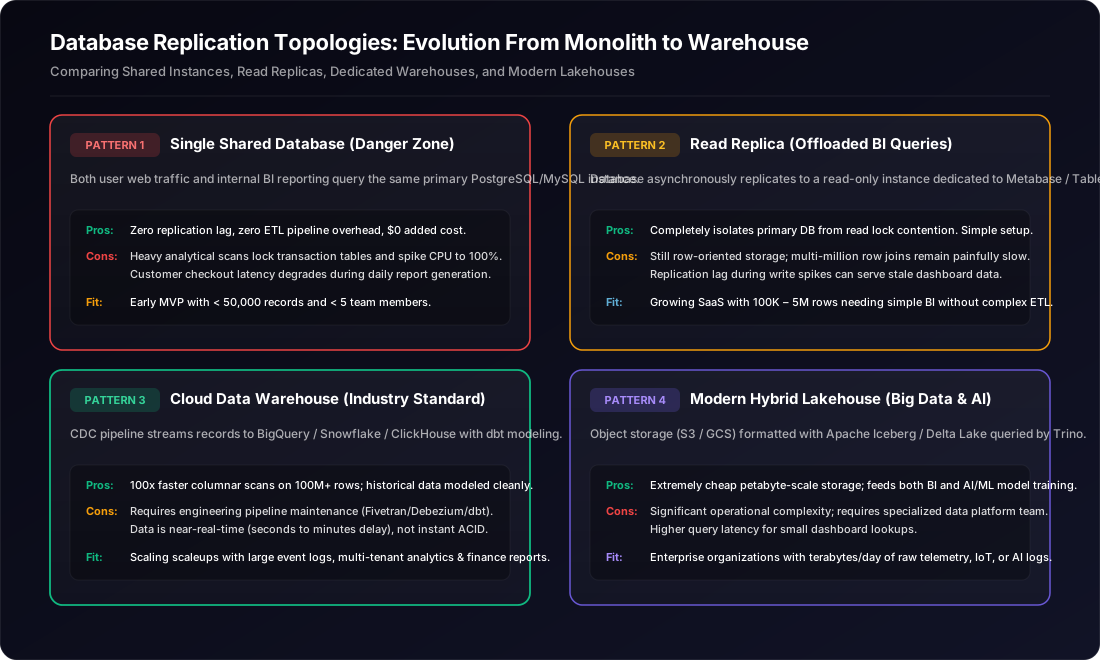
Pattern 1: Single Shared DB (Danger Zone)
Applications and reporting tools (Metabase, Tableau) query the primary transactional instance. Zero replication lag and zero added infrastructure cost. However, long-running reports lock tables, spike CPU to 100%, and cause user-facing checkout freezes. Acceptable only for early MVPs with < 50,000 records.
Pattern 2: Read Replica (Pragmatic Middle)
An asynchronous read-only clone of your primary database dedicated exclusively to internal analytics. Completely isolates user write transactions from read lock contention. Simple 1-click cloud provisioning, but data remains row-oriented and large multi-million row joins remain slow.
Pattern 3: Cloud Data Warehouse (Scale Standard)
CDC streaming populates a dedicated columnar warehouse (BigQuery, Snowflake) where data is modeled via dbt star schemas. 100x faster scans on 100M+ rows. Decouples analytics compute entirely from production. Requires engineering pipeline maintenance.
Pattern 4: Modern Hybrid Lakehouse
Object storage (S3 / GCS) formatted with open table formats (Apache Iceberg, Delta Lake) queried by distributed engines (Trino / DuckDB). Ultra-low storage cost for petabytes of raw event telemetry; feeds both BI reports and machine learning pipelines.
Data Governance, PII Masking, and Consistency Guarantees
Decoupling operational and analytics systems introduces a critical operational challenge: Data Governance and Compliance.
- Replication Lag and Eventual Consistency: Operational databases guarantee strict serializability (ACID). Analytical systems are eventually consistent; records stream in with a lag of 2 seconds to several minutes. Business stakeholders must understand that an analytics dashboard is designed for aggregate trends, not minute-by-minute transaction auditing.
- PII Masking & Access Controls: In an operational database, user records contain sensitive Personally Identifiable Information (passwords hashes, credit card tokens, national IDs). Analytical warehouses accessible to dozens of product managers and analysts must implement automated pseudonymization or column-level masking during the ELT pipeline, ensuring compliance with GDPR, HIPAA, and SOC 2.
- Data Duplication Costs: Storing data in both an operational database and an analytical warehouse doubles storage footprint. Fortunately, cloud object storage and columnar compression ratios (often 4:1 to 10:1 compared to uncompressed row storage) make analytical storage a fraction of operational database hosting costs.
The Decision Matrix: When Does Separating Workloads Make Sense?
To avoid over-engineering prematurely or waiting until production crashes, technical leaders should evaluate their workload against this structured decision matrix:
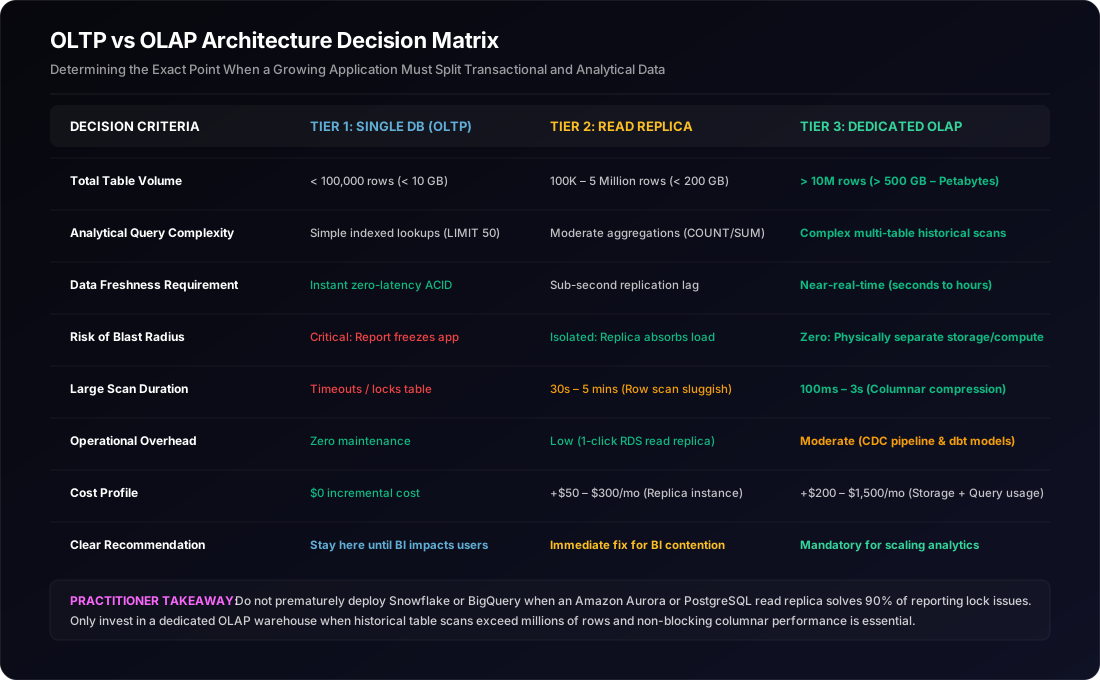
| Evaluation Dimension | Tier 1: Single Operational DB | Tier 2: Read Replica | Tier 3: Dedicated OLAP Warehouse |
|---|---|---|---|
| Total Active Rows | < 100,000 rows (< 10 GB) | 100,000 – 5,000,000 rows | > 10 Million – Billions of rows |
| Query Complexity | Simple primary-key lookups (LIMIT 50) |
Moderate aggregations (COUNT, GROUP BY) |
Multi-table historical joins & window functions |
| Freshness Requirement | Sub-millisecond ACID consistency | 100ms – 1s replication lag acceptable | 10s – 15m eventual consistency acceptable |
| User Impact of Reports | High risk: Reporting locks checkout tables | Zero: Replica absorbs read workload | Zero: Physically independent compute engine |
| Engineering Tax | Zero pipeline maintenance | Low: Managed cloud replica configuration | Moderate: CDC sync & dbt schema modeling |
| Recommended Action | Optimize indexes; do not separate yet | Adopt immediately if BI affects users | Adopt when data exceeds 5M rows or 200 GB |
An Incremental 3-Step Migration Strategy
If your growing application is experiencing database sluggishness caused by internal reporting, execute this incremental migration plan:
Step 1: Audit and Isolate Heavy Queries (Day 1 – 3)
Examine pg_stat_statements or RDS Performance Insights. Identify long-running queries (> 500ms) originating from internal admin portals or BI tools. Terminate unindexed cross-table scans running against the primary database.
Step 2: Spin Up an Asynchronous Read Replica (Day 4 – 7)
Provision an asynchronous read-only replica on Amazon Aurora or Cloud SQL. Point your Metabase, Tableau, and internal admin dashboard connections to the replica's read endpoint. This completely shields your customer-facing transactions from reporting lock contention with zero application code changes.
Step 3: Introduce CDC Streaming & Columnar Storage (Month 2+)
When table sizes exceed 5 million rows and replica joins become sluggish, implement a managed CDC connector (Fivetran or Debezium) streaming database write logs to BigQuery or ClickHouse. Model business facts into star schemas using dbt, unlocking sub-second analytics across years of historical data.
The Ramaaya Perspective: Pragmatic Data Engineering
At Ramaaya Technologies, our data architects believe that the best data architecture is the simplest one that satisfies your business SLAs without creating operational drag.
We frequently see seed-stage startups with 20,000 customers spending $4,000/month maintaining Snowflake, Fivetran, and complex dbt DAGs when a single well-indexed PostgreSQL read replica would have served their reporting needs for another two years. Conversely, we see scaling scaleups crashing their core production database during Monday morning executive meetings because they resisted separating analytical workloads.
Our engineering practice partners with organizations to architect pragmatic, scalable data systems:
- Cloud & Data Engineering: Designing resilient database topologies, read replicas, and streaming CDC pipelines. Explore our Cloud & Data Engineering Services.
- Custom Software Engineering: Building multi-tenant backends with strict data isolation. Read our architectural deep dive on B2B SaaS Multi-Tenant Architecture.
- Systems Architecture Reviews: Auditing slow database queries, indexing strategies, and connection pooling. See our guide on Software Architecture Reviews.
Conclusion: What Should You Do This Week?
Before you purchase an expensive data warehouse contract or begin an unneeded database rewrite:
- Inspect your production database connections: are internal reporting tools and business dashboards querying the exact same database host as your customer web app?
- If yes, provision an asynchronous read replica this week and repoint your BI connections. It is the highest-ROI, lowest-risk stability upgrade a growing engineering team can make.
- Monitor your historical table growth: when individual transactional tables surpass 5 to 10 million records, begin planning your CDC streaming pipeline to a dedicated columnar warehouse.
Operational data is about execution; analytical data is about insight. Keeping them separate preserves the speed and stability of both.
Sources & Authoritative References
This analysis synthesizes database architecture principles from authoritative cloud standards:
- Microsoft Azure Architecture Center: "Online Transaction Processing (OLTP) Architecture Guide". View Azure OLTP Guidance — Operational database design, transaction isolation, and normalization.
- Microsoft Azure Architecture Center: "Online Analytical Processing (OLAP) Architecture Guide". View Azure OLAP Guidance — Columnar storage, multidimensional modeling, and aggregation engines.
- Google Cloud Architecture: "How Spanner and BigQuery Work Together to Handle Transactional and Analytical Workloads". View Google Cloud Architecture Blog — Federation, change streams, and workload decoupling patterns.
- Related Ramaaya Architectural Guides: B2B SaaS Multi-Tenant Architecture Guide · Monolith vs Microservices for Growing SaaS · Software Architecture Review Guide