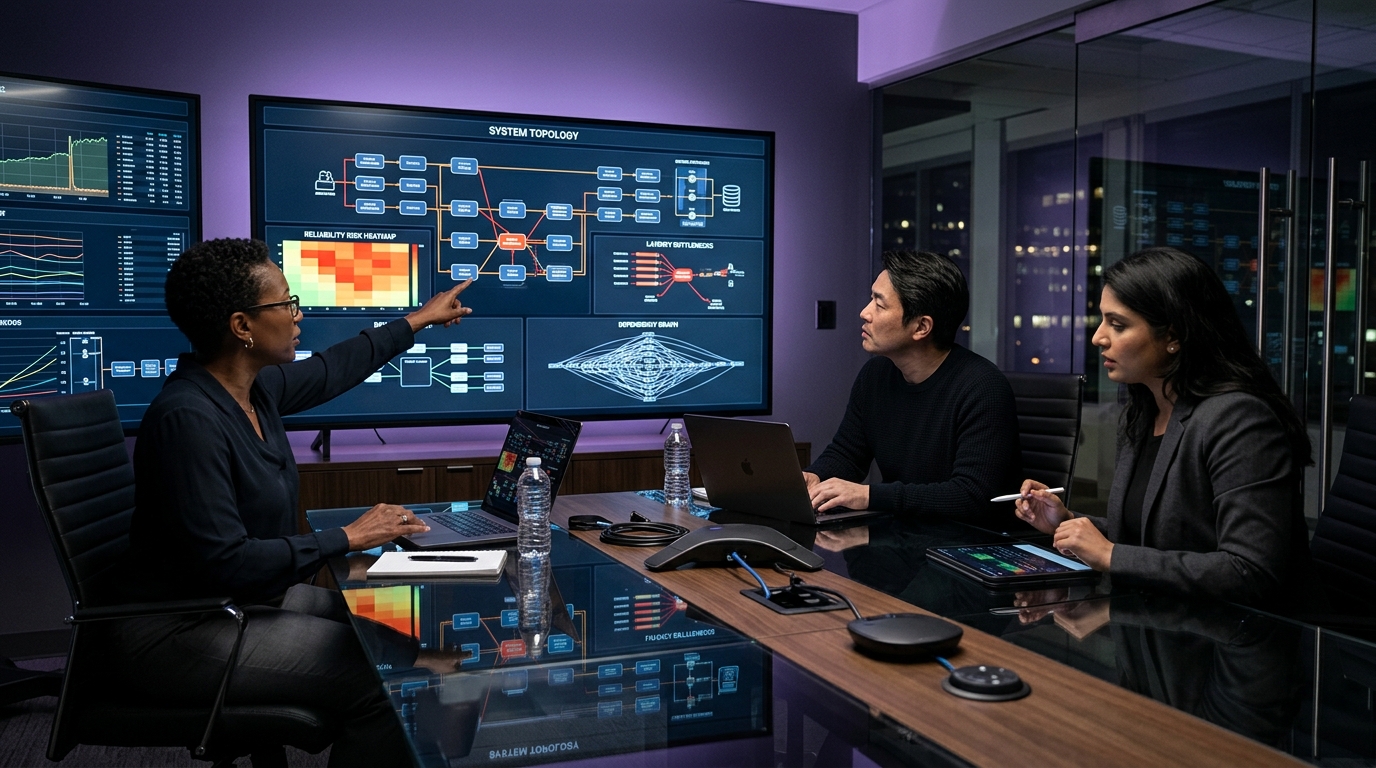
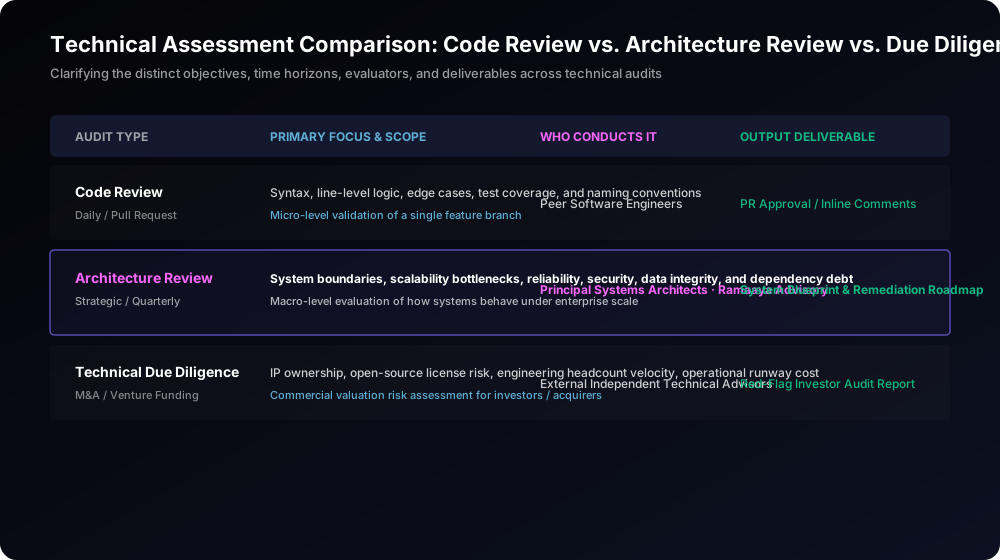
1. Code Review vs. Architecture Review vs. Technical Due Diligence
In engineering leadership, a dangerous false equivalence is conflating a code review with a software architecture review.
A standard pull request code review asks micro-level questions: Is the logic formatted properly? Does this function handle null values? Is test coverage sufficient? Is there an obvious SQL injection?
A Software Architecture Review operates at the macro-system boundary. It asks questions that no single pull request can ever answer:
- What happens to ingress thread pools when the payment gateway's response time degrades from 150ms to 4,500ms?
- If two concurrent worker jobs attempt to mutate the account balance table simultaneously, does the database dead-lock or silently permit phantom reads?
- Does a tenant with 10,000,000 records degrade query latency for the tenant with 5,000 records sharing the same database replica?
- Can an attacker who compromises a non-critical marketing analytics endpoint pivot laterally into the core transactional ledger?
Similarly, Technical Due Diligence—frequently conducted during private equity acquisitions, venture rounds, or mergers—is an architecture review viewed through an economic lens: What is the true cost to scale this platform 10x? How much technical debt is buried in undocumented tribal knowledge? What legal or licensing liabilities exist in unmanaged third-party dependencies?
2. The Six Foundational Dimensions of an Architecture Review
A rigorous architectural review cannot be an unstructured code walk-through. It requires a systematic investigation across six structural pillars:
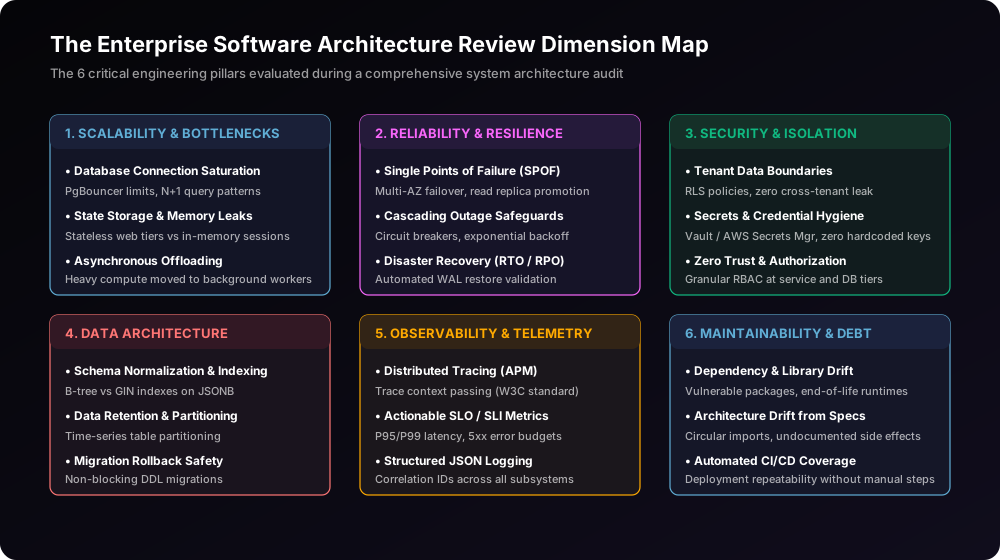
Let us examine each dimension and the specific anti-patterns a good review must expose.
3. Dimension 1: Data Model Scalability & State Isolation
More than 80% of scaling bottlenecks originate in the data tier. Modern software architectures rarely fail because of CPU limits in the application container; they fail because the database engine is choking on locks, table scans, or unindexed foreign keys.
An architecture audit examines:
- Query Execution & Access Paths: Are hot transactional queries supported by composite indexes matching the actual
WHERE,ORDER BY, andJOINcriteria? Are ORM-generated queries generating classic N+1 query storms during list rendering? - Multi-Tenant State Isolation: In multi-tenant systems, is tenant segregation enforced via database-level schemas, row-level security (RLS), or fragile application-tier
WHERE tenant_id = xclauses? (See our technical breakdown on B2B SaaS Multi-Tenant Architecture: A Practical Engineering Guide). - Hotspot Tables & Unbounded Growth: Does the data model contain unbounded tables (e.g., audit logs, event streams, webhook payloads) appended inside the primary transactional OLTP database without a partitioning or cold-storage archiving strategy?
4. Dimension 2: Concurrency, Locking, & Transaction Scope
Race conditions and concurrency failures are the most expensive bugs to troubleshoot because they cannot be reproduced on local developer laptops or single-threaded unit tests. They emerge only under concurrent production load.
A thorough architecture review inspects:
- Transaction Longevity: Are network calls (HTTP requests to external APIs, S3 file uploads, or email delivery) executed inside an active database transaction? Keeping a database connection open while waiting on a 2-second external network call starves the connection pool and halts all database operations.
- Optimistic vs. Pessimistic Locking: Does the system use optimistic locking (e.g., version columns) or pessimistic row locks (
SELECT ... FOR UPDATE) when handling inventory, wallet balances, or seat reservations? - Idempotency Guarantees: If an ingress request is submitted twice due to mobile network retries, does the API execute duplicate billing charges or create duplicate orders? Are mutation endpoints protected by idempotent request keys stored in high-performance cache stores?
5. Dimension 3: Failure Modes & Cascading Degradation
Resilient systems are not systems that never experience failures; they are systems designed to fail gracefully without taking down the entire enterprise.
When evaluating distributed architectures or external integrations, an architectural audit looks closely at how failure propagates across service boundaries:
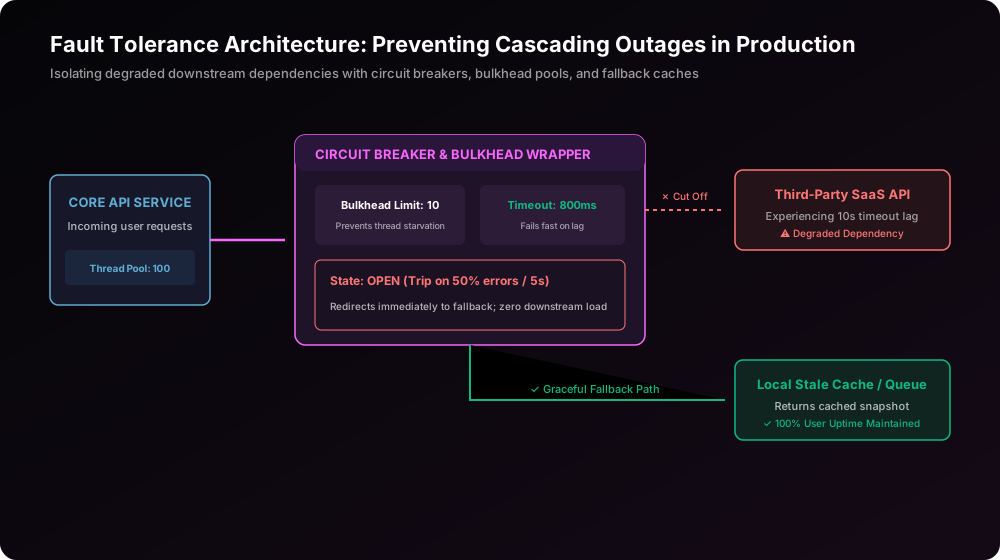
A proper architecture review verifies the presence of:
- Explicit Bounded Timeouts: Every network call must have hard connection and read timeouts (e.g., 500ms connection, 1500ms read). Zero network calls may use default "infinite" socket timeouts.
- Circuit Breakers: When downstream failure rates exceed a threshold (e.g., 20% over 10 seconds), the circuit opens immediately, shedding load and returning a fallback response rather than queuing threads.
- Bulkheads: Isolate thread pools and worker allocations so that a degradation in non-critical features (e.g., invoice PDF generation) cannot starve core customer checkout workflows.
6. Dimension 4: Security Boundaries & Secret Isolation
Architectural security goes far beyond static code analysis. An architecture review looks at the threat model and trust boundaries:
- Network Segmentation & Least Privilege: Can the frontend web tier establish direct TCP connections to the production database, or is all database access restricted to backend microservices inside private VPC subnets?
- Secret Lifecycle Management: Are API tokens, database credentials, and signing keys stored in hardcoded environment variables deployed across all worker pods, or are they retrieved just-in-time from managed secret vaults (AWS Secrets Manager, HashiCorp Vault) with automated rotation?
- Authentication Token Validation: Are JWTs verified cryptographically at the API edge with public keys, and is token revocation supported via distributed token blacklists or short-lived expiry windows?
7. Dimension 5: API Contract Durability & Version Governance
As business systems interconnect, an unmanaged API change can silently break mobile applications, external partner integrations, and internal microservices. As discussed in our analysis on API-First Architecture for Business Systems, API contracts must be treated as public promises.
The review evaluates:
- Contract-First Definitions: Does a formal OpenAPI/Swagger specification exist that serves as the single source of truth, or is documentation manually maintained after the fact?
- Backward Compatibility Safeguards: Does the continuous integration pipeline run automated breaking change detection (e.g.,
oasdiff) to ensure fields are never deleted, renamed, or converted from optional to mandatory? - Payload Size Limits & Rate Throttling: Does the ingress tier enforce payload size ceilings and distributed rate limits (token bucket / leaky bucket) to prevent Denial of Service from misconfigured clients?
8. Dimension 6: Operational Observability & Traceability
Can your engineering team answer this question during an outage: "Which exact query in which microservice caused request #98214 to fail at 14:22:01?"
If diagnosing an error requires an engineer to SSH into five cloud instances, grep unstructured text logs, and guess the sequence of events, your architecture lacks fundamental observability.
An architecture review inspects:
- Distributed Tracing & Correlation IDs: Does every inbound HTTP request receive a unique
X-Correlation-IDat the edge gateway that is propagated across all internal service calls, message queues, and database logs? - Structured JSON Logging: Are logs written as structured JSON with standardized fields (level, timestamp, service, tenant_id, trace_id, duration_ms) rather than arbitrary human-readable text strings?
- Golden Signals Instrumentation: Does the platform track Latency, Traffic, Errors, and Saturation (the Google SRE Four Golden Signals) across every critical subsystem with automated anomaly alerting?
9. The Actionable Architecture Review Deliverable
The output of an architecture review must never be a 90-page academic theoretical report that sits unread in Google Drive. A good architecture review delivers actionable engineering clarity:
- Executive Risk Register: A prioritized 1-page summary categorizing identified risks by Likelihood and Business Impact (Critical, High, Medium, Low).
- Architecture Flaw Deep-Dives: Explicit technical explanations of each flaw, including reproduction evidence, system bottlenecks, and worst-case scenario modeling.
- Remediation Pathways: Practical, phased architectural solutions broken down into 30-day, 60-day, and 90-day execution milestones.
- Architectural Decision Records (ADRs): Formal templates documenting recommended target architectures, tradeoffs considered, and transition strategies.
10. How to Run Reviews Without Freezing Velocity
The most common resistance to conducting architecture reviews is fear: engineering leadership worries that an audit will pause ongoing product development, demoralize developers, or create bureaucratic friction.
When executed correctly by experienced architects, an architecture review is non-disruptive:
- Asynchronous Codebase & Infrastructure Inspection: 80% of the review occurs through direct inspection of repositories, database schemas, CI/CD pipelines, and cloud telemetry without demanding engineer meeting time.
- Targeted 45-Minute Architect Interviews: Reviewers conduct focused interviews with tech leads around key domain boundaries and historical pain points.
- Blameless Structural Focus: The review evaluates systems, architectures, and coupling—not individual developer performance. Framing issues as structural evolution rather than past mistakes creates enthusiastic alignment across the engineering team.
11. The Ramaaya Technology Advisory Framework
At Ramaaya Technologies, our IT Consulting & Architecture Advisory team conducts comprehensive software architecture reviews for scaling startups, mid-market SaaS companies, and enterprise organizations.
We evaluate your systems through the lens of seasoned builders who have designed and scaled complex commercial platforms—including Sniper.AI Pro, our enterprise procurement intelligence workstation. We understand how architectural decisions impact real-world latency, operational cost, and developer velocity.
Whether you are preparing for a major funding round, planning a high-stakes legacy migration, or troubleshooting persistent production fragility, our reviews provide clear, unbiased technical truth.
To understand the complete lifecycle of turning business needs into production-grade systems, read our companion piece on From Business Requirements to Production Architecture: A Practical Discovery Framework.