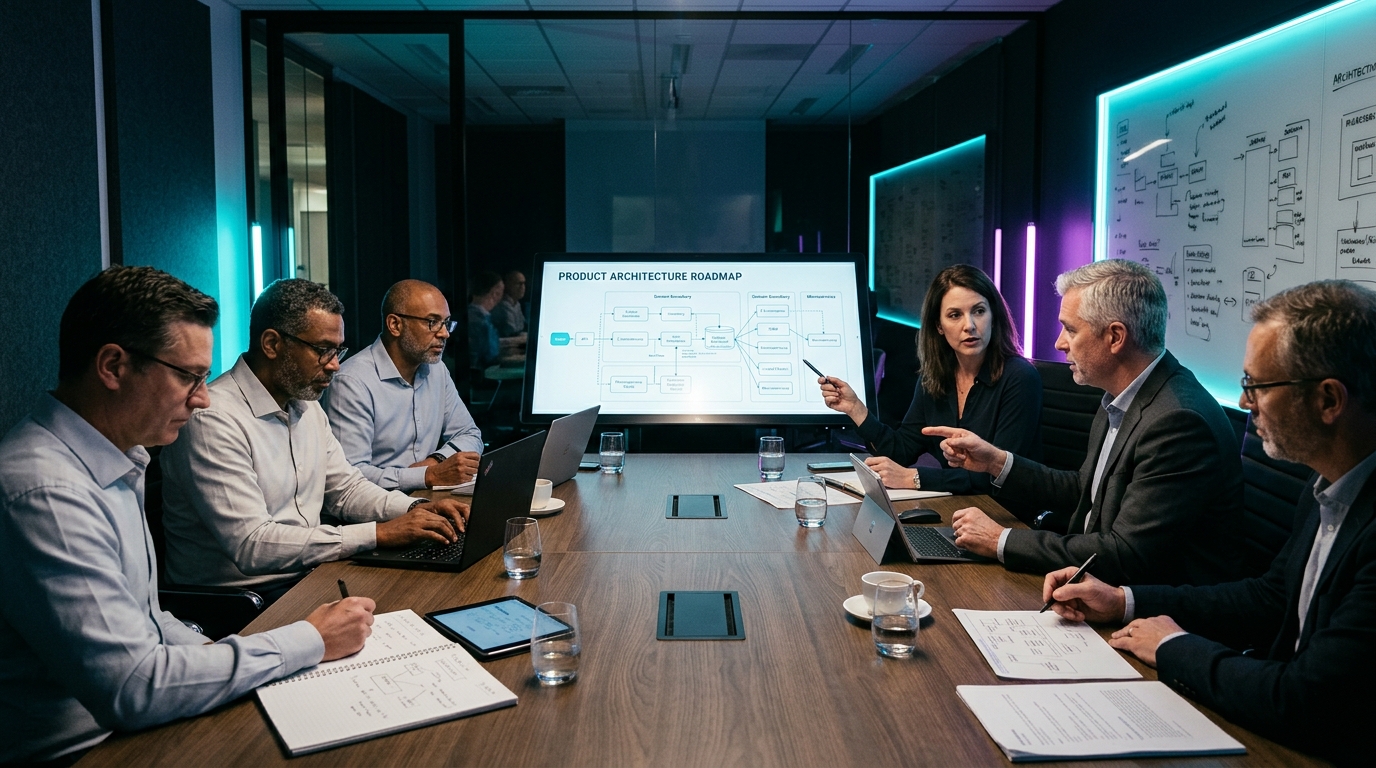
1. The Chasm Between Business Intent and Technical Execution
In enterprise software development, projects rarely fail because software engineers do not know how to write code. They fail because engineers built an exquisite architectural solution to an entirely misunderstood problem.
Business stakeholders think in operational outcomes: "We need to reduce order processing cycle times by 40%," or "We want our field sales agents to work offline in regional warehouses."
If an engineering team takes those colloquial statements and immediately begins sprint planning, disaster looms. "Work offline" implies complex local state storage, conflict-resolution algorithms (CRDTs or last-write-wins), bidirectional synchronization protocols, and custom replication queues. If the team assumed standard cloud REST APIs, the entire application architecture will fail in production.
A disciplined Technical Discovery Phase exists precisely to eliminate this cognitive gap. Discovery is not an open-ended philosophical brainstorming exercise; it is an engineering discipline designed to de-risk assumptions, extract mathematical constraints, and produce an ironclad architectural blueprint before engineering capital is deployed.
2. The 6-Stage Technical Discovery Framework
At Ramaaya Technologies, our architecture practice guides clients through a structured 6-stage discovery pipeline:
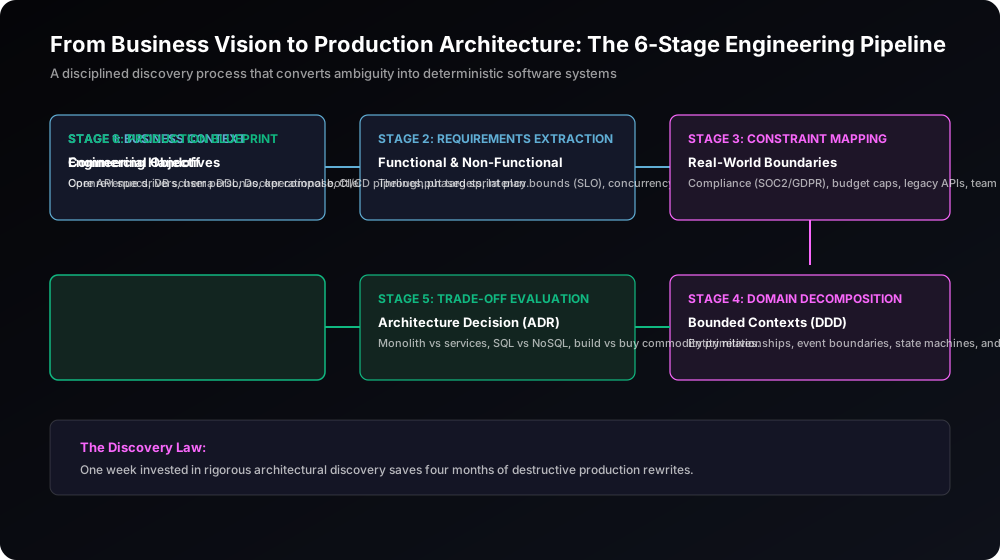
Let us walk through each stage of this discovery pipeline and see how ambiguous business statements are converted into concrete engineering specifications.
3. Stage 1 & 2: Translating Ambiguity into Quantified NFRs
Functional requirements define what the software does ("users can submit an order"). Non-Functional Requirements (NFRs) define under what environmental constraints the system must perform.
Business stakeholders frequently express NFRs using vague adjectives that are useless to software architects. A senior discovery team interrogates and quantifies these statements:
Vague: "The system must be blazing fast"
Architectural Translation: p95 API response time must remain under 180ms and p99 under 350ms at sustained peak concurrency of 4,500 HTTP requests per second. Requires distributed in-memory caching (Redis), composite database indexing, and edge CDN termination.
Vague: "We can never lose customer transactions"
Architectural Translation: Recovery Point Objective (RPO) = 0 seconds. Requires synchronous multi-Availability-Zone database replication, write-ahead log (WAL) archiving to immutable S3 buckets, and transactional two-phase commits on payment records.
Vague: "The platform must be secure and compliant"
Architectural Translation: SOC 2 Type II and HIPAA compliance. Requires customer data encryption at rest via AES-256 with customer-managed KMS keys, TLS 1.3 in-transit, role-based access control (RBAC) integrated with corporate Okta/Azure AD SAML, and immutable audit logging.
Vague: "We expect explosive business growth"
Architectural Translation: Data tier must accommodate 500,000 new orders/month and 5TB of document attachments annually with linear infrastructure cost scaling. Mandates cold-storage archival partitions and horizontal database read replicas.
4. Stage 3: Domain Decomposition & Bounded Contexts (DDD)
Once constraints are quantified, the architects must identify the natural operational boundaries of the software using Domain-Driven Design (DDD).
In monolithic enterprise failures, a single catastrophic concept (such as a Customer or Order class) exists across the entire codebase. The marketing team adds fields to the customer record, the accounting team adds billing fields, the logistics team adds shipping fields, and the security team adds hashed passwords. The result is an unmaintainable 400-column database table and a 5,000-line God Object.
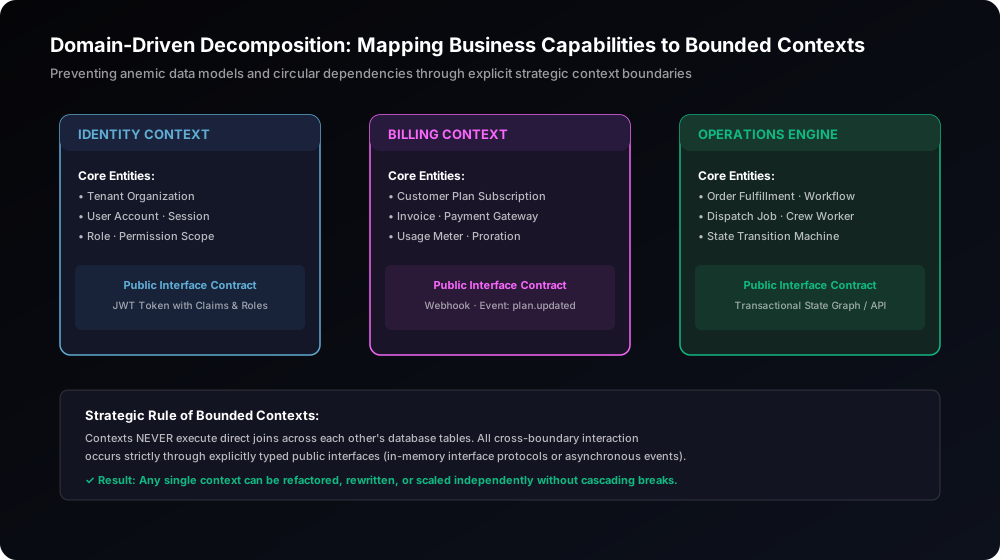
In our discovery framework, we decompose the enterprise into explicit Bounded Contexts:
- Identity & Auth Context: Cares only about credentials, MFA tokens, session lifetimes, and organizational tenancy. It has zero knowledge of shipping addresses or shopping carts.
- Order Fulfillment Context: Cares about order line items, fulfillment state machines (Pending → Picked → Shipped → Delivered), and tracking identifiers.
- Inventory & Warehousing Context: Cares about stock reservations, warehouse bin locations, and SKU replenishment thresholds.
- Billing & Financial Ledger Context: Cares about debit/credit double-entry ledgers, taxation rates, invoice PDFs, and payment gateway transactions.
By isolating these contexts early, software engineering teams can build modular monoliths or microservices with clean API contracts, preventing catastrophic dependency tangles before coding starts (see our guide on Monolith vs Microservices for Growing SaaS).
5. Stage 4: Data Topology Selection (OLTP, OLAP, & Consistency)
One database engine cannot efficiently solve all data patterns. Modern system design requires matching data storage models to workload characteristics:
- Relational OLTP (PostgreSQL / MySQL): Ideal for transactional state, strict ACID compliance, financial ledgers, and relational integrity.
- Document / Key-Value Stores (MongoDB / DynamoDB / Redis): Ideal for ephemeral session state, high-throughput caching, shopping carts, or unstructured third-party payloads.
- Analytical OLAP Stores (ClickHouse / Snowflake / BigQuery): Essential when business requirements call for multi-million-row aggregation queries, cohort retention dashboards, or operational reporting without degrading transactional database response times.
- Vector Databases (pgvector / Qdrant): Critical when incorporating enterprise retrieval-augmented generation (RAG) or semantic AI search across company documents (see our architectural blueprint on Enterprise RAG Architecture: How to Build Private AI Knowledge Systems).
6. Stage 5: Integration Contracts & API Communication Protocols
Systems do not operate in a vacuum. A critical output of technical discovery is defining the communication topology between subsystems and external partner ecosystems:
- Synchronous REST / GraphQL: Used when client user interfaces require immediate, blocking feedback (e.g., user login, card authorization).
- Asynchronous Event-Driven Messaging: Used when business workflows can proceed in the background without blocking the user (e.g., webhook notifications, order status updates, PDF generation). By placing an event queue (Kafka, RabbitMQ, SQS) between domains, spikes in traffic are smoothed out and downstream outages do not break the ingress API.
- Contract Governance: All communication contracts must be authored as OpenAPI 3.1 specifications or Protocol Buffers prior to development (see our analysis on API-First Architecture for Business Systems).
7. Stage 6: Infrastructure Scoping & Financial Engineering
Architecture is incomplete without financial modeling. A technical discovery phase must answer: "What will this architecture cost to operate in production at Month 1, Month 12, and Month 36?"
A great discovery process prevents "Cloud Shock"—where a system runs smoothly in development, but costs $30,000/month in production due to unbudgeted cross-AZ data transfer fees, uncompressed vector embeddings, or poorly managed serverless execution times.
The discovery team produces a preliminary Infrastructure Bill of Materials (BOM) detailing compute instances, database replica tiers, egress bandwidth allowances, caching nodes, and log retention tiers.
8. Architectural Decision Records (ADRs) as Living Contracts
Why did the team choose PostgreSQL over MongoDB? Why was asynchronous Kafka chosen over synchronous gRPC for order processing?
In poorly managed projects, the answers to these critical questions are lost within weeks as Slack messages disappear and team members rotate. New engineers arrive six months later and reverse architectural decisions without understanding the original context.
We prevent this through Architectural Decision Records (ADRs):
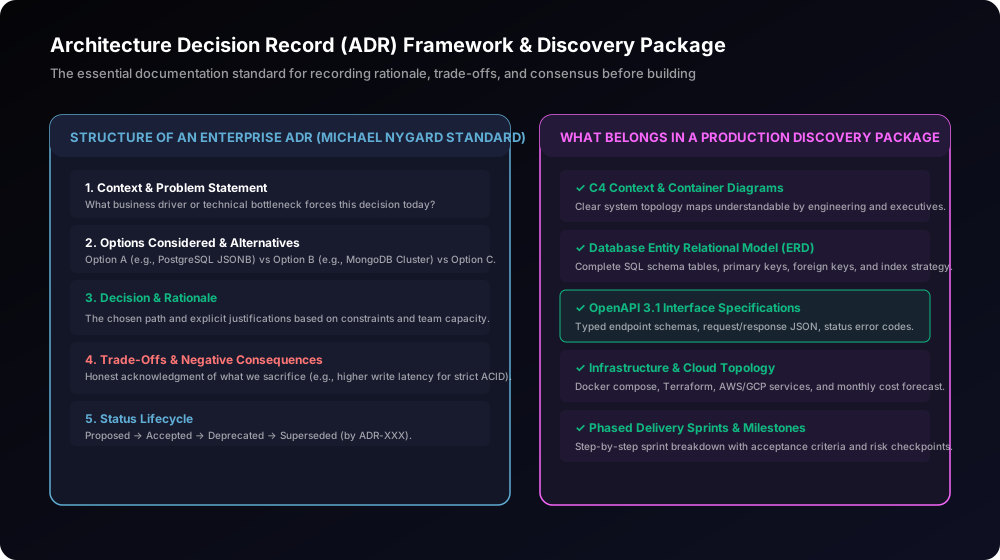
- Title & Status: ADR-003: Selection of PostgreSQL with Row-Level Security for Multi-Tenant Isolation (Status: ACCEPTED).
- Context & Problem Statement: Business requirements demand strict data isolation between enterprise healthcare clients while maintaining unified schema migration simplicity.
- Alternatives Considered: Schema-per-tenant, Database-per-tenant, Application-level filtering.
- Decision Outcome: Adopt shared-schema PostgreSQL with Postgres Row-Level Security (RLS) driven by session tenant tokens.
- Consequences & Tradeoffs: Simplifies migrations and reduces hosting costs by 65%; requires automated testing on database connection pool context resets.
9. The Production Discovery Handoff Package
At the conclusion of a Ramaaya Technical Discovery engagement, the engineering team does not receive a vague PowerPoint presentation. They receive an operational Discovery Handoff Package that serves as the immediate foundation for sprint execution:
- Architecture Blueprint: C4 Model Diagrams (System Context, Container, and Component levels) visualizing all services, protocols, and data flows.
- Target Database Schema Draft: Entity Relationship Diagrams (ERDs) and SQL schema migrations defining primary entities, indexing strategies, and foreign key boundaries.
- Validated OpenAPI 3.1 Contracts: Machine-readable API specifications ready for client SDK generation and automated contract testing harnesses.
- Infrastructure Bill of Materials (BOM): Cloud infrastructure topology and automated Terraform / OpenTofu scaffolding for staging and production environments.
- Formal ADR Catalog: A version-controlled repository containing all architectural decisions, evaluated tradeoffs, and rejected options.
- Quantified NFR Verification Harness: Automated load-testing scripts (k6 / Locust) ready to validate latency, throughput, and error budgets against the quantified NFR targets.
10. The Ramaaya Engineering Advisory Practice
At Ramaaya Technologies, our IT Consulting & Systems Advisory practice provides end-to-end technical discovery for enterprise organizations, high-growth venture-backed companies, and non-technical founders embarking on complex software initiatives.
We apply this exact discovery framework across all Ramaaya proprietary platforms, including Sniper.AI Pro, our enterprise procurement intelligence workstation. In Sniper.AI Pro, early discovery revealed that parsing gigabyte-scale government tender PDFs required local edge SQLite caching and background multi-threaded parsing pipelines rather than centralized cloud queues—saving hundreds of thousands of dollars in serverless compute bills while delivering sub-second response times for users.
If your organization is planning a major software build, modernizing legacy systems, or re-evaluating technical debt, discover how our architectural discovery practice de-risks execution and ensures your investment yields a resilient, production-ready platform.
To prepare your existing systems for scale, read our companion guide on What a Good Software Architecture Review Should Actually Find, or learn about incremental refactoring in Modernizing Legacy Software Without Rebuilding Everything.