
De-Mythologizing CI and CD
The terms CI and CD are frequently bundled together as an amorphous buzzword, obscuring their distinct technical purposes:
- Continuous Integration (CI): The engineering discipline where developers merge code into a shared mainline branch frequently (at least daily). Every integration triggers an automated build and test runner that verifies the change against trunk within minutes, ensuring that integration defects are caught immediately when the context is fresh.
- Continuous Delivery (CD): The practice of keeping software in a release-ready state at all times. Every build that passes automated CI gates is automatically packaged into an immutable deployable artifact and can be released to production at the click of a button.
- Continuous Deployment: An extension of Continuous Delivery where every change that clears automated staging verification is pushed directly to production without manual human sign-off.
The Minimum Viable CI/CD Pipeline
Growing teams do not need a bespoke internal developer platform. A production-grade deployment pipeline consists of eight sequential, deterministic steps divided cleanly into two halves:
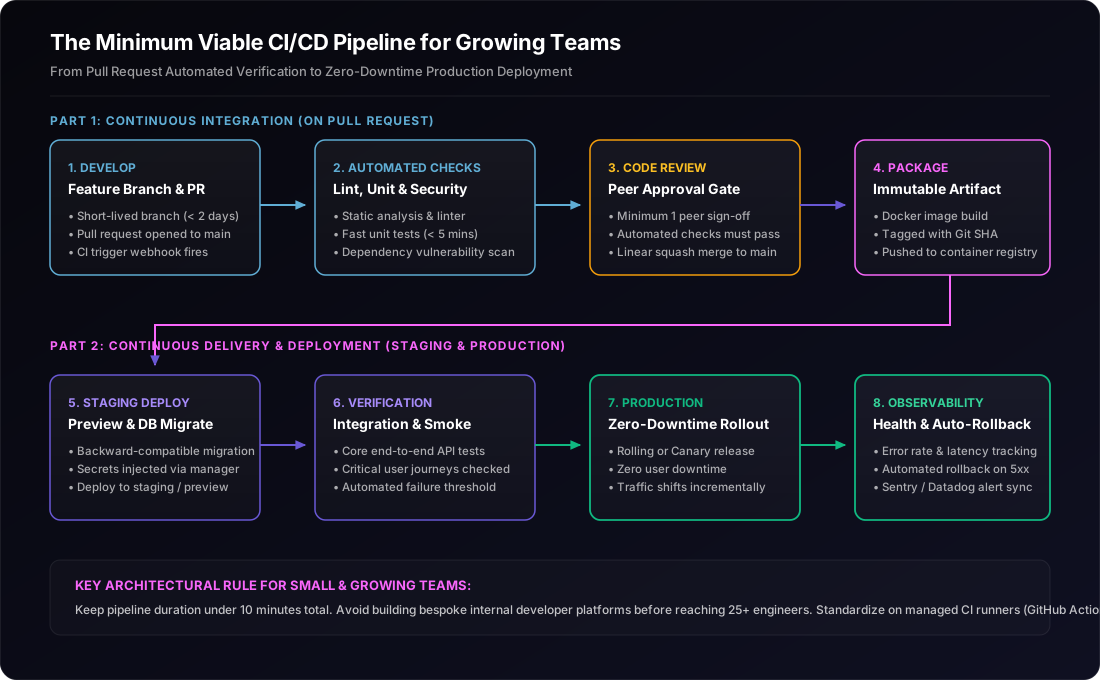
Stage 1 – 3: Continuous Integration (On Every Pull Request)
- Trunk-Based Feature Branches: Developers branch from
main, keep branch lifespans under 48 hours, and open small, focused pull requests (ideally < 300 lines of code). - Automated Pre-Merge Verification: CI runners execute static code analysis (ESLint, Ruff, Sonar), run fast unit and integration tests (target < 5 minutes), and scan dependencies for critical CVEs (Dependabot / Trivy). If any test fails, merge buttons are strictly blocked.
- Peer Code Review Gate: At least one human peer reviews business logic, architecture alignment, and security implications. Once approved, the branch is squash-merged into
mainwith linear Git history.
Stage 4 – 8: Continuous Delivery & Deployment (Post-Merge)
- Build Immutable Artifact: A Docker container image is compiled once, tagged with the Git commit SHA (e.g.
api:sha-7f3b9a1), and stored in an artifact registry. Never re-compile code between environments. - Staging Deployment & Database Migrations: The artifact is deployed to a staging or ephemeral preview environment. Database migrations run automatically using backward-compatible schema changes (Expand/Contract pattern). Secrets are injected at runtime via a centralized secrets manager (AWS Secrets Manager / Vault), never hardcoded.
- Automated Smoke Tests: A lightweight suite of end-to-end API health assertions confirms that critical customer journeys (login, checkout, search) execute successfully against the new deployment.
- Production Zero-Downtime Rollout: The container orchestrator (ECS, EKS, Kubernetes, or Fly.io) executes a rolling or canary release, shifting 10% of production traffic before scaling to 100%, ensuring zero dropped connections.
- Automated Health Telemetry & Rollback: Monitoring systems track HTTP 5xx error rates, response latencies, and exception streams for 10 minutes post-release. If error rates exceed baseline thresholds, the deployment automatically halts and rolls back to the prior commit SHA within 60 seconds.
Measuring What Matters: The Four DORA Metrics
How do you know if your engineering delivery process is healthy? Measuring lines of code, commit counts, or story velocity creates perverse incentives. The industry gold standard for measuring engineering delivery performance is the four DORA core metrics:
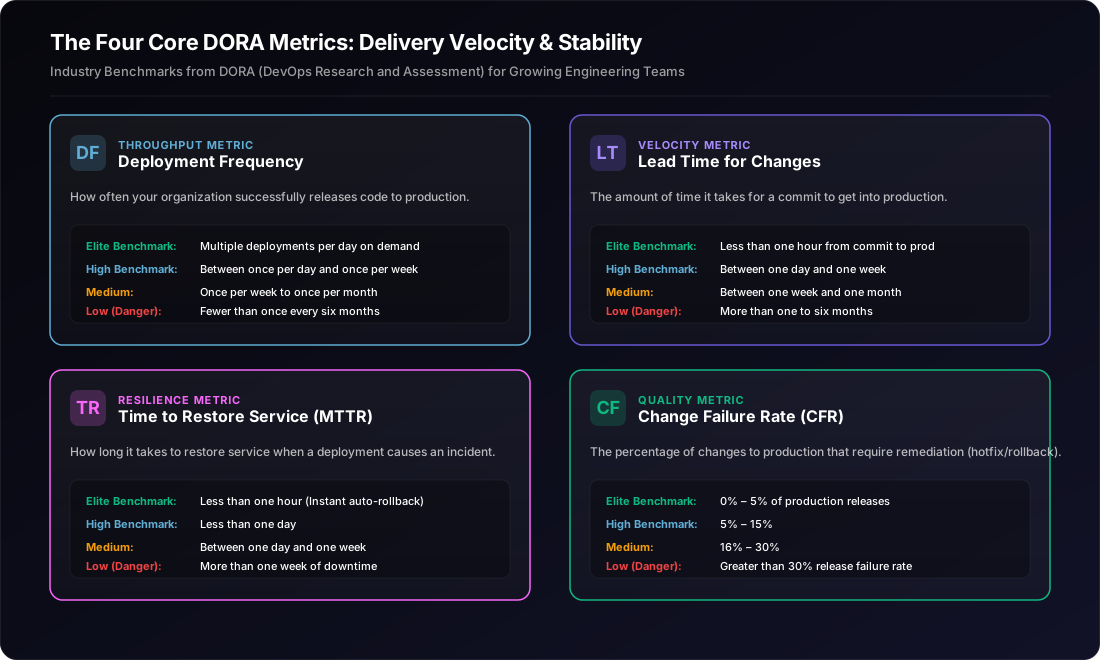
| DORA Metric | What It Measures | Elite Benchmark | Warning Sign for Growing Teams |
|---|---|---|---|
| Deployment Frequency | How often code successfully deploys to production | Multiple times per day on-demand | Deploying only once every 2–4 weeks due to release anxiety |
| Lead Time for Changes | Time from commit creation to running in production | < 1 hour | PRs sitting in review or staging queues for > 2 weeks |
| Time to Restore Service (MTTR) | Time required to recover from a production incident | < 1 hour (auto-rollback) | Engineers scrambling for 6+ hours writing manual production hotfixes |
| Change Failure Rate (CFR) | Percentage of releases requiring immediate rollback or patch | 0% – 5% | > 25% of deployments breaking production functionality |
The Hard Part: Database Migrations in Continuous Delivery
Stateless application code is easy to deploy and roll back: you simply update container image tags. Relational database state is the true bottleneck to continuous delivery. If a deployment executes a migration that drops or renames a column while older application pods are still serving traffic, your application will crash immediately.
To achieve true zero-downtime CD, engineering teams must mandate the Expand/Contract (Parallel Run) Migration Pattern:
- Phase 1 (Expand): Add the new database column or table as nullable. Deploy application code that writes to both old and new columns, but reads from the old column.
- Phase 2 (Backfill): Run an asynchronous background worker script to migrate historical rows from the old column to the new column without locking tables.
- Phase 3 (Switch): Deploy application code that now reads exclusively from the new column.
- Phase 4 (Contract): In a subsequent sprint deployment, safely drop the old column and remove legacy compatibility code.
By breaking schema modifications into multi-step backward-compatible releases, zero-downtime database migrations become routine engineering events rather than midnight maintenance windows.
Four CI/CD Anti-Patterns That Cripple Growing Teams
In our technical architecture discovery audits at Ramaaya Technologies, we frequently encounter four anti-patterns that subvert engineering velocity:
1. Manual Production Edits
SSH-ing into production servers to edit environment variables, restart processes, or patch code directly. Any configuration not managed in Git and deployed through the automated CI pipeline creates untracked drift that guarantees future deployment failures.
2. Testing Only After Deployment
Relying on manual QA testers to click through staging environments for three days before release. Automated unit, integration, and contract tests must execute on the pull request before code ever touches a shared branch.
3. Oversized Release Batches
Accumulating 40 distinct features into a monthly "big bang" release train. When an incident occurs, identifying which of the 150 merged commits caused the regression requires hours of forensic debugging. Small, frequent releases make root-cause isolation trivial.
4. Premature Platform Engineering
A 12-person engineering team building a custom Kubernetes service mesh, internal developer portal (Backstage), and multi-cluster GitOps orchestration. Standardize on managed CI/CD runners (GitHub Actions / GitLab CI) until your team exceeds 30 developers.
The Incremental CI/CD Implementation Roadmap
Do not attempt to leap directly to complex canary deployments if your team lacks automated unit tests. Progress through this three-stage maturity roadmap:
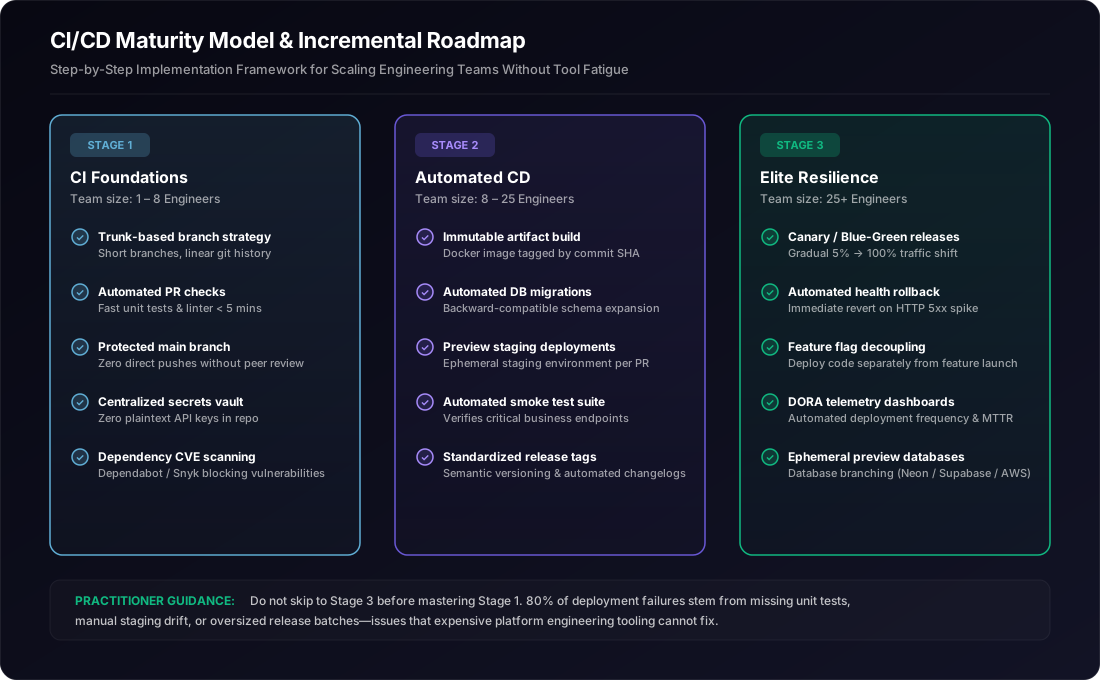
Stage 1: Establish Strict CI Foundations (Week 1 – 2)
Adopt trunk-based development. Protect the main branch with required pull request status checks: automated linter, unit test suite (execution time < 5 minutes), and peer approval. Store all secrets in a centralized vault, eliminating all hardcoded API tokens.
Stage 2: Automate Container Builds & Staging Delivery (Week 3 – 4)
Build immutable Docker container images tagged with the commit SHA. Automate deployment to a staging environment on every merge to main. Enforce backward-compatible database migration scripts and execute automated post-deploy smoke tests.
Stage 3: Production Rollout & Automated Resilience (Month 2+)
Configure rolling or canary deployments that eliminate user downtime. Implement automated health check triggers that revert failed deployments in under 60 seconds on elevated HTTP 5xx errors. Track DORA metrics on an engineering dashboard.
The Ramaaya Perspective: Delivery Pipelines Are Software Products
At Ramaaya Technologies, we view a team's CI/CD pipeline not as a collection of throwaway shell scripts, but as a mission-critical software product whose primary customer is your engineering organization.
A fast, dependable pipeline compounds engineering velocity across every developer, every day. When an engineer knows their changes will be verified in four minutes and deployed to production safely without fear of breaking the database, shipping frequency accelerates by an order of magnitude:
- Custom Software Engineering: Building contract-first, modular applications with built-in test harnesses. Explore our Custom Software Engineering Practice and our guide on API-First Architecture for Business Systems.
- Cloud & DevOps Engineering: Architecting automated, secure infrastructure pipelines on AWS, GCP, and Kubernetes. Learn about our Cloud & Infrastructure Services.
- Architecture Audits & Modernization: Removing technical debt and unblocking release trains. Read our guide on Software Architecture Reviews.
Conclusion: What Should You Build This Week?
If your deployment process is currently manual, stressful, or slow, resist the urge to buy another enterprise DevOps tool. Instead, execute three immediate changes:
- Protect your
mainbranch: disable direct Git pushes and require green automated tests before merging. - Time your CI test suite: if it takes longer than 10 minutes, parallelize test runners and prune flaky end-to-end tests until feedback arrives under 5 minutes.
- Package your application as an immutable Docker container image tagged with the Git commit SHA, ensuring that what was tested in staging is identical to what runs in production.
Great engineering teams are not defined by how many complex tools they configure—they are defined by how quickly, safely, and effortlessly their developers can deliver value to end-users.
Sources & Authoritative References
This analysis synthesizes research and delivery practices from industry DevOps standards:
- DORA (DevOps Research and Assessment): "2025/2026 State of DevOps Research". View DORA Research at dora.dev — Empirical analysis linking delivery velocity, team well-being, and organizational performance.
- DORA Core Capabilities: "Platform Engineering & Continuous Delivery". View DORA Platform Engineering Capabilities — Guidance on establishing developer feedback loops without premature tooling.
- Related Ramaaya Architectural Guides: Monolith vs Microservices for Growing SaaS · Modernizing Legacy Software Without Rebuilding · Software Architecture Review Guide